
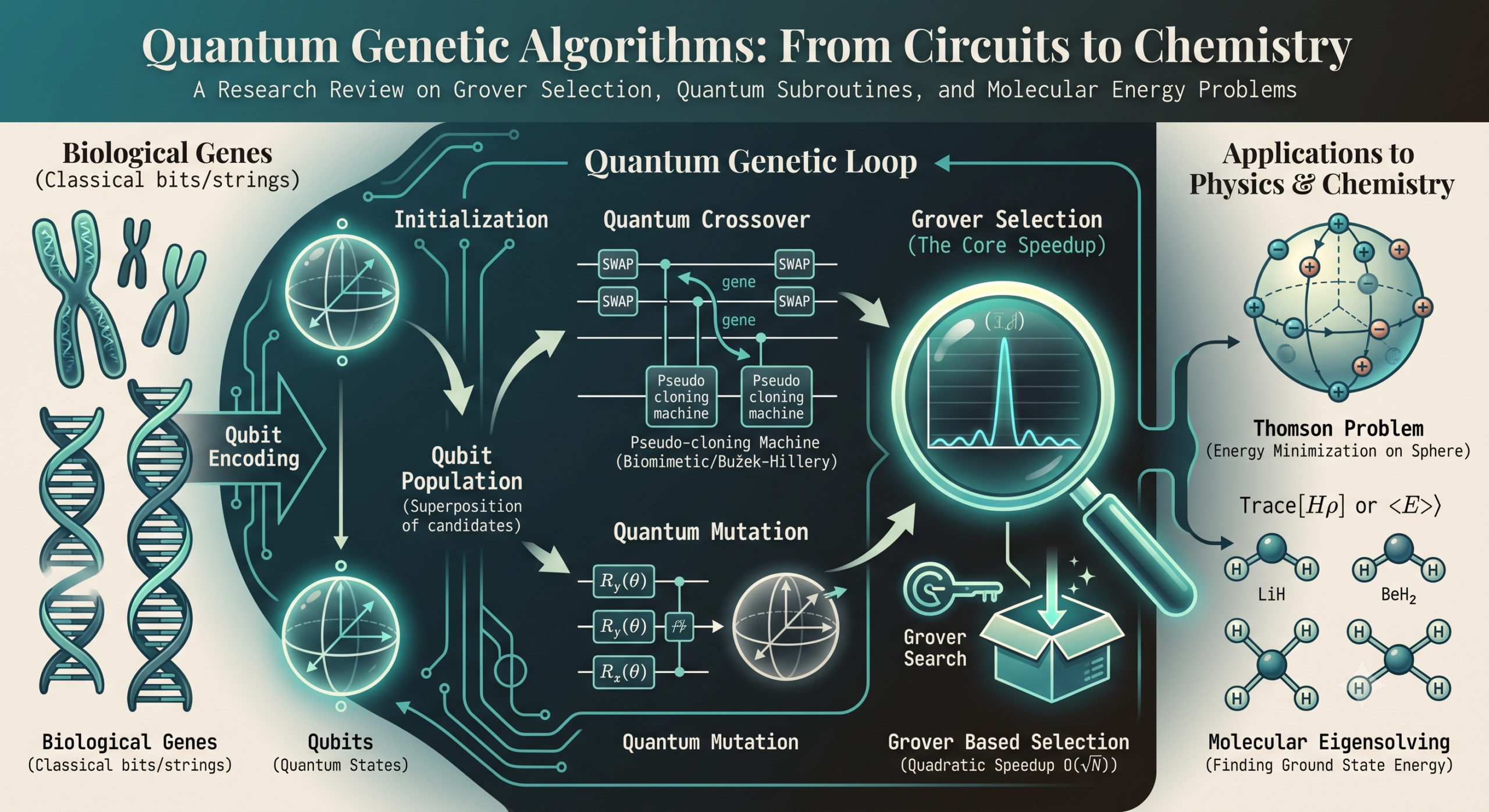
- Quantum genetic algorithms rebuild the three classical operations, crossover, mutation, and fitness selection, using qubits and quantum gates instead of arrays and random number generators.
- The review traces five distinct periods of research, from the first quantum inspired genetic algorithm in 1996 through what the authors call the current scaling age.
- Fitness selection is consistently the slowest classical step, and replacing it with Grover’s search is the single biggest source of reported quantum speedup across the papers surveyed.
- Reduced quantum genetic algorithms, which strip out crossover and mutation entirely and rely on Grover’s search alone, currently represent the most complete working version of the idea.
- The Thomson problem, minimizing the potential energy of particles on a sphere, and molecular eigenvalue solving are the two physical problems where this approach has been tested most seriously, though every result so far comes from small scale simulation rather than large scale quantum hardware.
Why evolution and quantum computing keep intersecting
A classical genetic algorithm is a loop with three moving parts. Crossover swaps segments between two candidate solutions the way chromosomes recombine during reproduction. Mutation flips a random element to introduce fresh variation. Fitness selection scores every candidate and keeps the ones that scored well. Run that loop enough times over a population of candidate solutions and the population tends to drift toward better answers, even for problems too large to search exhaustively.
The review frames quantum genetic algorithms as sitting at the overlap of three separate fields, evolutionary computing, general optimization theory, and quantum computing itself. That framing matters because it explains why the field has been messy to define. A paper calling itself a quantum genetic algorithm might mean a classical algorithm that borrows quantum sounding math to imitate superposition, or it might mean an algorithm that genuinely runs on qubits and quantum gates. The review is careful to keep these apart, and one of its more useful contributions is a clear vocabulary for telling a quantum inspired genetic algorithm from an actual quantum genetic algorithm running quantum circuits.
The appeal of moving to qubits is structural rather than magical. A quantum register of a modest number of qubits can represent an exponentially large number of classical states at once. A chromosome encoded as a qubit does not have to commit to one specific string of genes, it can exist as a superposition of many candidate strings simultaneously, and a single quantum operation applied to that superposition touches every one of those candidates at the same time. That is the theoretical hook. Whether it pays off in practice is a much narrower and more interesting question, and it is the one this review spends most of its pages answering.
Five periods of a young field
The authors organize roughly three decades of work into five periods, which is itself a useful map for anyone trying to get oriented in this literature. The Quantum Foundations Age runs from the mid 1990s and covers the arrival of the first quantum computer concepts, Grover’s search algorithm, and early quantum cloning machines. The Quantum Inspired Applications Age follows shortly after, marked by the first quantum inspired genetic algorithm from Narayanan and Moore in 1996 and early applications to problems such as the Traveling Salesman Problem and face detection.
A Quantization Age runs from roughly 2006 to 2016, during which researchers focused on adapting each individual classical genetic algorithm step into a quantum circuit rather than treating the whole algorithm as one block. The Applications Age begins in 2016, the year the authors identify as the first peer reviewed survey of quantum genetic algorithms, and is marked by a sharp rise in papers applying hybrid quantum genetic algorithms to real engineering problems. Most recently, the authors describe a Scaling Age, where the emphasis has shifted from proving the concept works to making it work at a larger number of qubits, with research increasingly focused on reduced complexity algorithms, partitioning strategies, and benchmarking against the 100 qubit mark.
That last shift is visible in the raw numbers the review reports. Quantum genetic algorithm simulations used around 8 qubits in 2022, climbed to about 20 qubits in 2023, and reached roughly 100 qubits by 2025, with IBM’s Qiskit software cited as the dominant tool for running these circuit simulations. Growth like that sounds impressive until you remember these are still simulated or small scale experimental circuits solving toy versions of real problems, a point the authors themselves return to directly in their concluding remarks.
What a quantum genetic algorithm is actually built from
To understand what is genuinely new here, it helps to walk through how each classical step gets rebuilt with quantum gates, since the review does exactly this in careful, almost engineering grade detail.
Qubits standing in for genes
In the encoding scheme the review adopts as standard, a single qubit plays the role of a gene, a set of qubits forms a chromosome, and the full quantum register represents the population. A qubit state is written as a combination of two basis states.
The coefficients \(\alpha\) and \(\beta\) are complex probability amplitudes satisfying \(|\alpha|^2 + |\beta|^2 = 1\), and this is the basic unit the review builds every quantum genetic operator on top of.
Initialization can be random, mirroring how a classical genetic algorithm seeds its starting population, or it can be problem specific. The review highlights an elegant example from work by Amal and Ivan, where the coordinates of electrons arranged on a sphere are mapped directly onto qubit states through the Bloch sphere, so the initial quantum state already encodes real physical geometry rather than starting from pure randomness.
Selection, the slow step that Grover’s search speeds up
Fitness selection sorts every candidate solution by quality and keeps the best ones. Classically this is a sorting operation, and the review notes its complexity scales as the population size multiplied by the logarithm of the population size, which sounds modest until fitness evaluation itself is expensive, since selection has to wait on every candidate being scored first.
Grover’s algorithm, originally built for searching an unsorted database, offers a genuinely different scaling. A classical search through N entries needs on the order of N queries on average. Grover’s algorithm needs only on the order of the square root of N.
This quadratic speedup, achieved by using an oracle to mark the best fit candidates and then amplifying their probability amplitude through repeated inversion about the mean, is what the review identifies as the single most reliable source of quantum advantage across the entire body of quantum genetic algorithm research it surveyed.
This is a specific and testable claim, not a vague gesture at quantum speedup, and it is worth sitting with. The review reports that Malossini and colleagues found the advantage from Grover based selection is largest specifically when the fitness function changes at every iteration and the underlying data is unstructured. For structured data, the review notes there was no clear efficiency difference between dynamic and static fitness functions. That is the kind of nuance that separates a serious technical review from a hype piece, and it is a detail worth remembering the next time a paper claims quantum advantage without specifying which regime it was tested in.
Crossover without a copy machine
Classical crossover freely copies genetic material between parent and offspring. Quantum mechanics will not allow that. The no cloning theorem guarantees that no quantum circuit can perfectly duplicate an arbitrary unknown quantum state, so quantum crossover has to work around that restriction rather than ignore it.
The review describes two main approaches. The first, called pseudo cloning, produces imperfect copies deliberately, accepting reduced fidelity in exchange for a workable crossover operator. Two specific pseudo cloning machines show up repeatedly across the literature, the Biomimetic Cloning of Quantum Observables and the Bužek-Hillery Universal Quantum Cloning Machine. The review notes a genuinely useful practical distinction here, the Biomimetic Cloning method converges faster and suits problems like search space reduction, while the Bužek-Hillery machine preserves fidelity more precisely and suits problems that demand high precision, such as molecular eigensolving. The second approach skips cloning altogether and instead swaps quantum amplitudes directly between the fittest and least fit halves of the population using a SWAP gate.
Mutation as a small quantum nudge
Quantum mutation applies small random rotations or Pauli gates to a randomly chosen subset of qubits, nudging their amplitudes rather than flipping a bit outright the way classical mutation does. The review notes an important practical tension here. Keeping the mutation rate constant risks either too much exploration, which slows convergence, or too little, which risks getting stuck. Several of the papers surveyed address this by shrinking the scale of the random rotation angle as the algorithm approaches convergence, mirroring how classical genetic algorithms sometimes anneal their mutation rate over time.
From hybrid algorithms to a fully quantum idea
One of the review’s clearest organizing contributions is a spectrum running from lightly quantum to fully quantum, and it is worth walking through because it doubles as a practical guide to reading any individual paper in this space.
| Architecture | What runs as a quantum gate | What stays classical | Practical tradeoff |
|---|---|---|---|
| General hybrid QGA | Initialization, crossover, mutation | Fitness evaluation and selection | Easiest to run on current noisy hardware, but the classical steps limit how much speedup is possible |
| Rylander Soule Foster hybrid QGA | Initialization, crossover, mutation, and fitness stored in an entangled quantum register | Final sorting and iteration control | Fitness updates automatically as individuals change, at the cost of needing extra qubits purely for bookkeeping |
| Diffusion QGA | Most steps, with selection as Grover’s search or a related minimum finding routine | The generational loop itself, still run classically | Captures most of the available speedup while remaining testable on todays hardware |
| Reduced QGA | Initialization and fitness marking, with selection entirely as Grover’s search | Only measurement and the outer iteration | No crossover or mutation at all, the population is initialized in full and refined purely through repeated amplitude amplification |
The Reduced Quantum Genetic Algorithm, introduced by Udrescu and colleagues, is described by the review as the version that currently comes closest to a genuinely quantum genetic algorithm rather than a classical loop with quantum flourishes. It drops crossover and mutation entirely and relies purely on Grover’s search to repeatedly amplify the probability of the best fit individual until a measurement reveals it. That simplicity is also its most interesting limitation, since dropping crossover and mutation means dropping two of the three operations that gave genetic algorithms their name in the first place, which raises a fair question about how much of the original evolutionary metaphor survives in its most quantum form.
What these algorithms are actually being used to solve
The review catalogs a genuinely wide spread of applications, and reading through them gives a much more grounded sense of the field than the theory alone. A custom quantum genetic algorithm tuned the parameters of a proportional integral derivative speed controller for permanent magnet synchronous motors, finding a more stable configuration than either the classical genetic algorithm or an earlier quantum genetic algorithm it was compared against. A separate study used a quantum genetic algorithm to shrink Internet of Things antenna designs, cutting antenna size by 87 percent while keeping radiation efficiency intact, a meaningfully large gain for wearable devices with limited space. Office building envelope design converged 50 percent faster than an equivalent classical genetic algorithm in another cited study.
Other applications lean into the combinatorial strengths of the approach. Bus route planning in a large city, emergency evacuation route and shelter allocation planning, and a two dimensional task allocation problem all showed faster convergence to a good solution than a comparable classical genetic algorithm. Plagiarism detection through semantic textual similarity used a quantum genetic algorithm specifically because the legal risk of a wrong answer meant accuracy mattered more than raw speed. Cloud computing workload scheduling, energy efficiency optimization in multiple input multiple output wireless systems, and even video object tracking assisted by deep learning all show up as tested use cases.
It is worth being clear eyed about what these results actually demonstrate. Nearly every one of them compares a quantum or quantum inspired genetic algorithm against its classical counterpart on a specific benchmark or simulated dataset, not against the best available classical optimization method in general. A quantum genetic algorithm beating a classical genetic algorithm is a meaningful and interesting result. It is a narrower claim than beating the best classical optimizer available for that problem, and the review is careful enough in its own framing to keep that distinction visible even when the individual papers it cites are not always as careful.
The two physical problems this line of research keeps returning to
Rather than spreading thin across every possible application, the review argues that two specific physical problems have become the proving ground for quantum genetic algorithms, and both are genuinely elegant fits for the qubit encoding.
The Thomson problem
Named after J. J. Thomson’s century old question about how charged particles arrange themselves on a sphere to minimize their mutual repulsion, this problem maps unusually well onto quantum hardware because the coordinates of a particle on a unit sphere and the state of a qubit on the Bloch sphere are described by the same geometry. The fitness function to minimize is the total potential energy summed across every pair of particles.
Each particle position \(\hat{r}_s\) maps directly onto a qubit through the Bloch sphere, so a lower energy configuration corresponds to a fitter individual in the genetic algorithm sense, and the review flags this encoding as a decisive step toward using quantum genetic algorithms across a wider range of physical applications, since the same geometry generalizes to problems such as viral shell structure and general molecular geometry optimization.
Molecular eigensolving
The second problem is finding the lowest energy eigenstate of a molecule, a calculation central to computational chemistry. Here the fitness function is the average energy of a candidate state with respect to the molecule’s Hamiltonian.
When \(\rho\) is the true ground state, this average energy equals the smallest eigenvalue of the Hamiltonian \(H\). The review reports that a digital analog implementation of this approach reached about 1 percent error when eigensolving the H2, LiH, and BeH2 molecules, using circuits of 2, 6, and 6 qubits respectively, which is a genuinely small and chemically relevant molecule size rather than a toy example.
The gap between these results and a real quantum computer
Here is where the review earns real credit for restraint. Nearly every number reported across its citation list comes from a simulation, either running entirely on a classical computer emulating quantum behavior or running on a small noisy intermediate scale quantum device with a handful of qubits. The parametric comparisons in the review itself encode only 4 individuals in 8 qubits for the eigenvalue problems, and up to 20 individuals in fewer than 32 qubits including ancilla qubits for the Knapsack Problem comparisons. These are proof of concept scales, not production scales.
The authors are explicit that this creates a real analytical problem. Because an advantage in genetic algorithms is what they call an emergent property, arising from how the specific operators interact with a specific problem rather than from any single guaranteed theorem, it is genuinely hard to run a clean complexity analysis on quantum genetic algorithms the way you can for something like Grover’s algorithm in isolation. Each new application effectively needs its own empirical study to know whether a speedup will show up at all, which is a meaningfully different and more fragile situation than a general purpose quantum speedup guarantee.
There is also a scaling story hiding inside the Reduced Quantum Genetic Algorithm numbers that deserves more attention than it usually gets. The original version needed on the order of 2 to the power of n over 2 oracle queries. Later refinements brought that down to 2 to the power of n minus 1 over 2 through graph partitioning, and further down by fixing a subset of qubits into classical values, trading some of the quantum flexibility for a smaller search space. That is real progress, but it is exponential progress against an exponential baseline, which means the fundamental scaling challenge has been softened rather than solved.
What this means for anyone deciding whether to build on this research
If you are a researcher or engineer deciding whether to invest time in quantum genetic algorithms right now, the review’s material supports a fairly specific set of conclusions rather than a blanket yes or no. If your problem is genuinely unstructured, your fitness function changes at every iteration, and you can express the problem as an oracle that a Grover style search can query, the selection step is where the literature’s strongest and most consistent evidence for speedup lives. If your problem is more naturally suited to structured search, the review’s own citation of Malossini and colleagues suggests the quantum selection advantage narrows considerably, and a hybrid or even purely classical approach may be just as effective with far less implementation overhead.
If your interest is specifically in chemistry or physics style problems, both the Thomson problem and molecular eigensolving are genuinely promising directions precisely because the qubit encoding maps so naturally onto the physics involved, rather than being bolted on artificially. That is a meaningfully different situation from trying to force, say, a scheduling problem into a quantum framework where the encoding itself does not carry any physical meaning.
Anyone building in this space right now should also plan around noisy intermediate scale hardware rather than assuming access to large, error corrected qubit counts. The review’s own numbers, moving from 8 to 20 to roughly 100 qubits in successive years, suggest steady but incremental progress rather than a sudden jump, and the honest planning assumption for the next few years is closer to the smaller end of that range for anything beyond a proof of concept.
Honest limitations of this body of research
It is worth being direct about what this review can and cannot establish. First, essentially every comparison between a quantum genetic algorithm and its classical counterpart in the papers surveyed uses small, simulated populations, often four to twenty individuals, and small qubit counts. That is not a criticism of the review, which reports these numbers accurately, it is a limitation of the underlying field it is summarizing.
Second, the review itself notes that quantum emulation on classical computers does not guarantee quantum or hybrid genetic algorithms will outperform classical ones for every application, and that recent quantum processing unit implementations have shown speedup only under problem specific conditions rather than universally. That caveat, stated plainly in the paper’s own quantum advantages section, is worth taking seriously rather than skimming past.
Third, in at least one of the differential evolution studies the review cites, the quantum enhanced algorithm was only faster than its classical counterpart in 66 percent of cases tested, a useful reminder that even genuine quantum enhancements do not win every comparison. Readers should treat any single reported percentage gain, whether it is 87 percent smaller antennas or 50 percent faster convergence, as a result from one specific benchmark rather than a general property of quantum genetic algorithms as a category.
Finally, this is a review of existing published work rather than a new experimental study with its own dataset, so there is no new sample size, no new confidence interval, and no new hardware benchmark to report here beyond what each of the underlying papers already published in their own, generally small scale, testing conditions.
Conclusion
Strip away the quantum vocabulary and this review is ultimately about a single, testable claim, that one specific step in a genetic algorithm, fitness selection, benefits reliably from being rebuilt as Grover’s search, while the other two steps, crossover and mutation, benefit more modestly and more situationally from their quantum versions. That is a sharper and more useful conclusion than the field’s own branding sometimes suggests, since papers under the quantum genetic algorithm label range from purely classical algorithms borrowing quantum flavored math to genuinely quantum circuits running on real, if small, quantum hardware.
The conceptual shift worth remembering is that the field has moved from asking whether a genetic algorithm can be dressed up in quantum language toward asking which specific operator, implemented as which specific quantum circuit, produces a measurable and repeatable advantage over its classical equivalent. The five period timeline the review lays out, from quantum inspired foundations through a current scaling age focused on qubit counts and partitioning strategies, tracks that shift from vague inspiration toward precise engineering.
The ideas here reach well beyond genetic algorithms specifically. Grover’s search shows up across a huge range of quantum algorithms, and the review’s finding that its advantage depends heavily on whether the fitness function is dynamic and the data is unstructured is a lesson that generalizes to any quantum search application, not just evolutionary ones. Anyone tracking quantum optimization more broadly will recognize the same tradeoffs between hybrid convenience and fully quantum ambition playing out here that show up in quantum machine learning and quantum simulation research generally.
What is missing, and the authors say so directly, is a reliable way to predict in advance whether a given problem will show a quantum advantage, since that advantage currently has to be discovered empirically for each new application rather than derived from a general theorem. The Thomson problem and molecular eigensolving stand out precisely because their physical structure removes some of that guesswork, and the authors point toward generalizing that same physically grounded encoding to new problems as one of the field’s more promising open directions.
For now, the honest summary is that quantum genetic algorithms have moved past pure proof of concept and into a phase of careful, problem specific engineering, with Grover based selection as their most dependable quantum ingredient. Whether that ingredient scales gracefully once real quantum hardware catches up to the qubit counts this review is already simulating remains the open question the field has to answer next.
Read the full peer reviewed survey covering all five research periods, every quantum subroutine, and the complete reference list.
Read the paper on Computer Science ReviewFrequently asked questions
What is a quantum genetic algorithm
It is an optimization method that rebuilds the three core steps of a classical genetic algorithm, crossover, mutation, and fitness selection, using qubits and quantum gates instead of classical data structures and random operations, aiming to search large solution spaces more efficiently than a classical genetic algorithm can.
What is the difference between a quantum inspired genetic algorithm and a true quantum genetic algorithm
A quantum inspired genetic algorithm runs entirely on a classical computer but borrows mathematical ideas from quantum mechanics, such as stochastic operations that imitate superposition, to improve performance. A true quantum genetic algorithm requires an actual mapping from individuals to qubits and from each classical genetic algorithm step to a real quantum gate, whether simulated or run on quantum hardware.
Why is Grover’s algorithm important for quantum genetic algorithms
Fitness selection is typically the slowest step in a genetic algorithm because it requires sorting every candidate by quality. Grover’s algorithm can search an unsorted set of candidates in roughly the square root of the time a classical search needs, and the review identifies this quadratic speedup in the selection step as the most consistent source of quantum advantage across the research it surveyed.
What is a Reduced Quantum Genetic Algorithm
A Reduced Quantum Genetic Algorithm removes the crossover and mutation steps entirely and relies purely on Grover’s search to repeatedly amplify the probability amplitude of the best fit candidate until a final measurement reveals it, making it the version the review considers closest to a fully quantum implementation of the concept.
What physical problems are quantum genetic algorithms actually used to solve
The review highlights two main physical applications, the Thomson problem of minimizing the potential energy of charged particles arranged on a sphere, and molecular eigensolving, which finds the lowest energy state of a molecule such as H2, LiH, or BeH2. Both problems map naturally onto qubit encodings because their underlying geometry resembles the Bloch sphere representation of a qubit.
Are quantum genetic algorithms ready for practical, large scale use today
Not yet at large scale. The review reports that current simulations have grown from around 8 qubits in 2022 to roughly 100 qubits in 2025, but nearly all reported results still come from small scale simulations or noisy intermediate scale quantum hardware rather than large, error corrected quantum computers, and the authors themselves note that this small scale makes rigorous complexity analysis difficult.
Related reading
This analysis is based on the published paper and an independent evaluation of its claims.