
Analysis by the aitrendblend editorial team · Game Dev · 11 October 2026
A player sees a little boat miss a narrow harbor entrance. The mistake is obvious, the goal is understandable, and the player thinks they could do better. A moment later, they are steering. No explanation of the game engine was needed. The challenge itself made the invitation.
That imagined encounter captures the design opportunity behind Meta Horizon Create and Horizon Studio. When discovery and play sit close together, the opening interaction becomes part of the pitch. For developers, the interesting question is what to build for that moment.
What Meta has announced
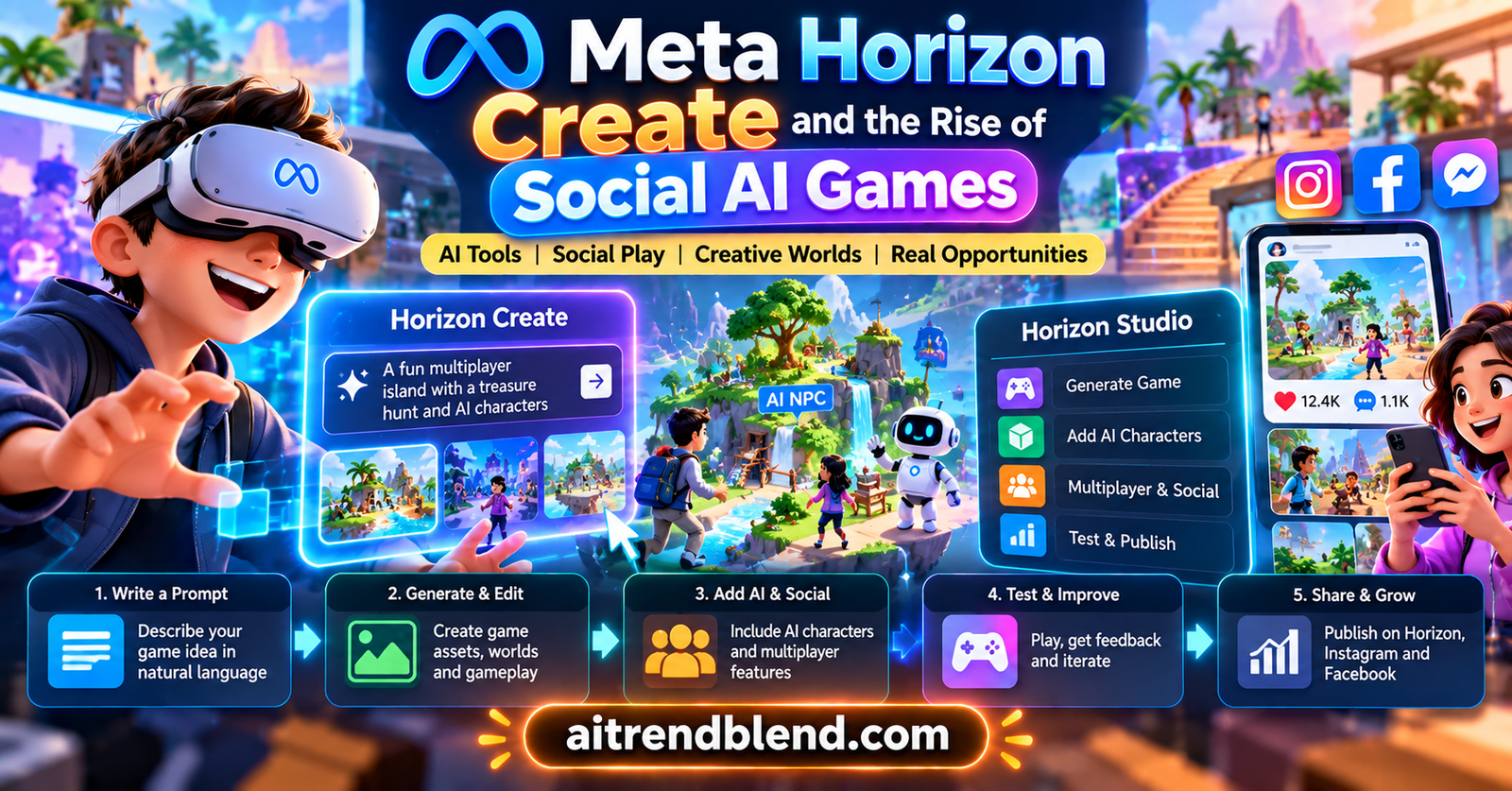
Meta introduced Horizon Create and Horizon Studio at Connect. Its 24 September announcement describes AI assisted creation of 2D and 3D mobile games. Create is the phone app and Studio is the browser environment. Early access is rolling out gradually through a waitlist. The source does not establish universal access or a confirmed launch in Pakistan.
Meta says published games become eligible for distribution across Facebook, Instagram, and Horizon. It also describes publication review and age ratings, while leaving further monetization details for later. Eligibility is the operative word. An eligible game has a possible distribution route, not an assured audience or income.
These are announced capabilities, checked on 11 October 2026. This article has not tested the tools. The design examples, measurement method, and code below are independent editorial proposals. They are not claims about a hidden recommendation formula, a product benchmark, or features available to every account.
Why the conversation has moved beyond generating a game
AI game creation is receiving attention across several products, but a developer has two separate problems. The game has to exist, and someone has to decide to play it. Solving the first problem more quickly does not automatically solve the second. A playable result can still be difficult to explain, awkward to control, or forgettable after the first attempt.
Meta gives discovery its own official session on reaching players. The session listing covers Horizon, Instagram, and Facebook. That emphasis makes this a useful topic for October, even though the announcement happened in September. There is no verified public measure here showing that this is the most viral game development topic. The stronger claim is that it belongs to an active discussion about AI creation and social distribution.
For this article, the design hypothesis is straightforward. A game introduced through a short social encounter should make its central action understandable before asking for much commitment. That hypothesis needs testing with actual players. It does not mean every game must be short, simple, or built around a leaderboard. It means the invitation should be clear enough that a new player can choose whether to continue.
Readers exploring production tools can start with the Game Dev archive and our guide to AI tools for building a game. Here the focus is the transition from seeing an idea to understanding it through play. That gives this article a distinct role beside guides to asset generation and development workflows.
Horizon Create and Studio serve different moments
Meta’s broader Connect recap describes Create as a mobile tool for prompting and remixing. Studio combines prompts with visual editing, asset replacement, and parameter controls on the web. The same source says projects can move in either direction with their assets, systems, and iteration history.
| Interface | What Meta describes | A useful editorial use case |
|---|---|---|
| Horizon Create | Mobile prompting and remixing | Capture a small idea and inspect its basic appeal |
| Horizon Studio | Browser prompting and more direct editing | Refine layout, readability, and a specific behavior |
| Project handoff | Work can move between the two interfaces | Preserve a shared design brief across editing sessions |
Choose a working situation before choosing an interface. On a phone, you might be judging whether a tap feels natural or whether an object is visible under your thumb. At a larger screen, you might be comparing scene spacing or checking several variants. The useful distinction is the task you can perform well in each setting.
A shared project does not eliminate the need for a clear decision record. If you adjust the obstacle spacing in one session and the boat speed in another, write down what each change was meant to achieve. Otherwise you can preserve all the files while losing the reasoning that made the design coherent.
The player should understand the invitation before the creator asks for commitment.
Editorial design principle from aitrendblend
Design the first minute around one decision
Imagine an original game called Harbor Nudge. A small boat moves toward a dock. Holding a control turns the boat gently, and releasing it lets the boat travel forward. The player chooses between a safe wide approach and a faster narrow opening. The point is not a large ocean or realistic sailing. It is a readable choice with an outcome the player can understand.
Start the player near the decision. A first attempt should reveal what the control does, what the obstacle means, and what counts as arrival. You can introduce more routes later. At the beginning, extra menus and background explanations compete with the one relationship that matters, the connection between input and motion.
The first minute is a design lens, not a scientifically established limit or a platform requirement. Some games need a longer introduction. Use this lens to expose unnecessary waiting and unclear instructions. If the player cannot tell why the boat moved, making the harbor prettier will not resolve the problem.
A starter prompt for a small social game
Build an original mobile game called Harbor Nudge. Show a small boat approaching a clearly marked dock in a single visible play area. Let the player steer with one simple touch control. Offer a wide safe approach and a narrow shortcut. Make the boat respond visibly to input. Give clear feedback when the boat arrives or hits an obstacle. Keep the first version focused on one route choice. Use simple shapes and readable contrast before adding decorative assets.
This is a proposed prompt, not one tested in Horizon. Its purpose is to make the design brief concrete. It identifies a choice, an input, and an outcome. If the generated interpretation introduces a complicated upgrade system or a long narrative, ask whether those additions help the intended first encounter. Remove them when they obscure it.
Give the player a recoverable first mistake. A collision can stop the boat and show the route it took, allowing the next attempt to feel informed. An immediate failure with no readable cause teaches little. The goal is not to make success automatic. It is to make improvement imaginable.
Make the preview and the playable game agree
A good preview makes a promise about the interaction. If the clip shows careful steering around an obstacle, the game should let the arriving player try that interaction without a long detour. If the clip shows a cooperative rescue, a solitary collection task will feel unrelated even when both use the same art.
Write a one sentence promise before editing promotional material. For Harbor Nudge, it might be that a tiny steering adjustment can save a difficult approach. Then select a real moment that shows the relationship between adjustment and outcome. The player should recognize the advertised challenge when play begins.
Our guide to game trailers with Kling covers a different production task. Whatever tools you use for promotion, separate concept footage from representative gameplay. A polished cinematic can introduce a setting, but it cannot demonstrate a mechanic that the playable version does not contain.
Make the invitation understandable without sound. A muted viewer should still see the boat, the obstacle, and the destination. Avoid tiny labels that carry the entire explanation. This is an editorial design recommendation for the proposed game, not a claim about a platform algorithm favoring silent clips.
Design touch controls around the view they obscure
A finger is both an input device and an obstruction. In the example game, placing the most important obstacle directly beneath the steering area would make the challenge harder to read for reasons unrelated to skill. Put the decision area where the player can see it while interacting, then test with more than one hand position.
A mouse simulation can help you inspect logic, but it does not settle how touch feels. Watch whether people tap repeatedly when holding is expected, whether they drag when the game expects a stationary touch, and whether releasing produces a visible result. These observations can reveal a mismatch between the control metaphor and the behavior.
Use multiple cues for important states. A successful docking could change the boat’s position, display a clear success mark, and update the result text. Color can support that message without carrying it alone. Optional audio can reinforce the outcome. A player should not need perfect color discrimination or active sound to identify what happened.
When requesting revisions, describe the visible issue. Ask for the destination to remain unobstructed during steering or for the held input to show a persistent indicator. Requests such as make it more intuitive are difficult to assess because they do not state which misunderstanding should disappear.
Give replay a purpose beyond another score
A restart button makes another attempt possible. The design has to make that attempt desirable. Harbor Nudge could show the route just taken and leave the narrow opening visible. The player can then form a specific intention for the next attempt, such as turning earlier or choosing the safer approach.
Do not add randomness merely to make each attempt different. If obstacle placement changes before the player understands the control, the reason for success or failure becomes harder to interpret. A stable opening can help people learn. Variation can arrive after they have a useful mental model of the action.
A social challenge should remain understandable when someone arrives alone. For example, a friend’s result can provide context, but the player should still see their own objective. Avoid making an invitation the only route to ordinary progress. Voluntary comparison is a stronger design starting point than compulsory sharing.
If you later add competitive results, decide what is being compared. A shorter completion time under the same conditions is different from a high score earned on a different route. Label the comparison honestly. Technical support for sharing or multiplayer does not decide whether the underlying competition is meaningful.
Measure the opening without pretending to know the algorithm
Separate what you can observe inside your game from what a distribution platform may observe outside it. Your own prototype might record that a scene loaded, the player made a meaningful input, a round ended, and a replay began. It might not expose the number of feed impressions or the reasons a recommendation was shown.
Do not invent missing denominators. If you only know how many playable sessions loaded, you can calculate the share of those sessions that reached a first action. You cannot call that an impression conversion rate. The label should describe the actual population being measured.
These are proposed ratios for an ordered first round funnel. Each count includes unique sessions that reached all preceding stages. A zero denominator produces an undefined rate, not a zero performance score. The metrics are descriptive. They do not identify the cause of a player leaving or prove that a design change improved the experience.
| Observed pattern | Possible explanation | What to inspect |
|---|---|---|
| Loads without a first action | Unclear control, interruption, or an unresponsive scene | Watch the arrival and first input |
| Actions without a completed round | Confusion, difficulty, a defect, or a long session | Review the route and exit moment |
| Completion without replay | Satisfaction, boredom, or a need to leave | Ask what the player wanted next |
| Replay without later return | An enjoyable brief encounter without lasting interest | Inspect return data separately if available |
For a fair comparison between revisions, hold the invitation and player group as steady as practical. A more attractive clip can bring in people with different expectations, changing the funnel even when the game is identical. Keep build identifiers in your records and describe who participated. A small informal test is useful for finding problems, but it should not be presented as a population level result.
A creator brief that protects the game’s identity
An original game can lose its character through a series of individually reasonable suggestions. One revision adds coins, another adds quests, and a third adds a pet collection. The project becomes larger while the original pleasure becomes harder to find. Keep a short statement of what the game is trying to make the player feel.
For Harbor Nudge, the statement could be quiet tension followed by a satisfying correction. That description helps decide whether a new effect belongs. A small wake behind the boat might clarify movement. A busy reward animation over the harbor might obscure the next decision. The brief gives you a reason to accept one and reject the other.
Preserve the calm steering challenge and the visible route choice. Improve the feedback for a successful approach without adding currencies, daily rewards, collection systems, or new screens. Show the boat’s final position and make the replay option clear. Keep the destination visible throughout the round. Describe any change that alters the existing mechanic.
Again, this is an editorial prompt template. Adapt it to the controls the tool actually exposes. Meta’s creator session page introduces a demonstration of the mobile and web workflow. Consult that official material for product behavior rather than assuming that every suggestion in a design brief maps to an available setting.
Once the mechanic communicates clearly, develop a consistent visual language. The Stable Diffusion asset workflow and sprite sheet comparison provide related reading. An attractive asset should support scale, motion, and visibility in the actual scene. Judge it at playing size, not only as an isolated image.
What remains uncertain before a serious release
The reviewed announcement does not settle every production question. This article does not verify project export, pricing, region specific availability, detailed earning terms, or the exact depth of editable game logic. Check those matters through current official documentation and your actual account before making a commitment that depends on them.
There is no independent test here of generation speed, reliability, or the consistency of editing across devices. There is also no measured evidence that the proposed harbor game would attract an audience. It is a worked design example. Its value is that you can examine each decision rather than accepting a vague promise of engagement.
The official announcement describes review and age related protections. Those processes do not remove the creator’s responsibility to inspect what the game actually displays and how it behaves. Keep records of asset origins and read the terms relevant to your intended use. Do not infer a particular license or commercial permission from the presence of a publish control.
Publication is also not the end of the work. You will need a way to reproduce a reported problem, identify the affected build, and decide whether a revision improves the experience. A game created with prompts still needs someone who understands the design well enough to make those decisions.
Where developers should focus next
Meta Horizon Create and Studio make social discovery an especially relevant design question. The useful response is to choose a small interaction that can explain itself through play. A creator who can state the invitation clearly has a better basis for evaluating an AI generated version than one who starts with an unlimited list of features.
The conceptual change is the closeness of the pitch and the interaction. A short clip can raise a question that the first attempt immediately answers. Treat those two moments as parts of one experience. The more faithfully the game fulfills its invitation, the easier it becomes to interpret what players do next.
The lesson transfers to educational activities, interactive demonstrations, and small browser experiences. People need to understand what an action will do and recognize what happened afterward. A narrow initial task can reveal confusion before a project accumulates expensive assets and complicated systems.
Access, production capability, and audience response remain separate uncertainties. A waitlist does not establish universal availability. A feature description does not establish reliability. A place in a distribution system does not establish demand. Test the particular assumptions your project depends on, using observations you can actually collect.
The next useful experiment is a modest one. Build a clear invitation, observe an unfamiliar player’s first attempt, and see whether they can explain what they would do differently. Then improve the part they misunderstood. A game earns another minute when its first minute gives the player a reason to care.
A small runnable example for measuring a play session
This original Python example summarizes an ordered first round funnel from a JSON event file. It is independent of Meta products and uses no Horizon API. It runs with the Python standard library. Save it as social_game_funnel.py and run it without arguments for the synthetic checks. To analyze your own export, pass the path to a JSON array containing session, event, and seconds fields.
The proposed events are loaded, first_action, round_complete, and replay_started. The script sorts each session by elapsed time, ignores duplicate stages, and counts a later stage only after the earlier one has occurred. It does not count repeat rounds within a session. Use a new session identifier for each fresh entry and a consistent elapsed clock. Avoid personal information in the export.
"""Independent editorial example. Not a Horizon SDK integration."""
import argparse
import json
import math
from collections import defaultdict

STAGES = ("loaded", "first_action", "round_complete", "replay_started")

def summarize(events):
    if not isinstance(events, list):
        raise ValueError("Input must be a JSON array")
    groups = defaultdict(list)
    for index, item in enumerate(events):
        if not isinstance(item, dict):
            raise ValueError("Each event must be an object")
        session = item.get("session")
        event = item.get("event")
        seconds = item.get("seconds")
        if not isinstance(session, str) or not session.strip():
            raise ValueError("session must be a nonempty string")
        if not isinstance(event, str) or event not in STAGES:
            raise ValueError("Unknown event")
        if (isinstance(seconds, bool)
                or not isinstance(seconds, (int, float))
                or not math.isfinite(seconds) or seconds < 0):
            raise ValueError("seconds must be finite and nonnegative")
        # Equal timestamps retain their input order.
        groups[session].append((seconds, index, event))

    counts = [0] * len(STAGES)
    for records in groups.values():
        next_stage = 0
        for _, _, event in sorted(records):
            if next_stage < len(STAGES) and event == STAGES[next_stage]:
                counts[next_stage] += 1
                next_stage += 1

    def ratio(numerator, denominator):
        return numerator / denominator if denominator else None

    return {
        "sessions_in_file": len(groups),
        "counts": dict(zip(STAGES, counts)),
        "rates": {
            "start_given_load": ratio(counts[1], counts[0]),
            "finish_given_start": ratio(counts[2], counts[1]),
            "replay_given_finish": ratio(counts[3], counts[2]),
        },
    }

def synthetic_checks():
    # Synthetic sessions stop at different points. Not product results.
    events = []
    for session, length in (("A", 4), ("B", 3), ("C", 2), ("D", 1)):
        for order, event in enumerate(STAGES[:length]):
            events.append({"session": session, "event": event,
                           "seconds": order * 10})
    events.append({"session": "A", "event": "first_action", "seconds": 11})
    result = summarize(list(reversed(events)))
    assert list(result["counts"].values()) == [4, 3, 2, 1]
    assert result["rates"]["start_given_load"] == 0.75
    assert math.isclose(result["rates"]["finish_given_start"], 2 / 3)
    assert result["rates"]["replay_given_finish"] == 0.5
    assert all(v is None for v in summarize([])["rates"].values())
    # Out-of-order actions cannot retroactively enter the funnel.
    malformed = [{"session": "X", "event": "first_action", "seconds": 0},
                 {"session": "X", "event": "loaded", "seconds": 1}]
    assert summarize(malformed)["counts"]["first_action"] == 0
    try:
        summarize([{"session": "X", "event": "loaded", "seconds": -1}])
    except ValueError:
        pass
    else:
        raise AssertionError("Negative elapsed time should be rejected")
    return result

def main():
    parser = argparse.ArgumentParser(description=__doc__)
    parser.add_argument("path", nargs="?", help="JSON event array")
    args = parser.parse_args()
    if args.path:
        with open(args.path, encoding="utf-8") as source:
            result = summarize(json.load(source))
    else:
        result = synthetic_checks()
        print("Synthetic checks passed. These are not product benchmarks.")
    print(json.dumps(result, indent=2, allow_nan=False))

if __name__ == "__main__":
    main()
The synthetic check deliberately creates a small funnel so the arithmetic is easy to inspect. Its output is not an estimate of player behavior. In a real study, define the session boundary, document event failures, and keep the same definitions across builds. If your runtime cannot expose an event reliably, report that limitation rather than filling the gap with an assumption.
Counts alone cannot tell whether someone left because of boredom, satisfaction, or an interruption. Combine the summary with observation and a short question about the player’s intention. Use the result to choose the next investigation, not as an automatic instruction to make every session longer.
Frequently asked questions
What is Meta Horizon Create?
Meta describes Horizon Create as a mobile app for making and revising games through AI assisted prompts. Check the official early access information before planning a project.
How is Horizon Studio different?
Studio is the browser interface with more direct editing controls. Meta describes project movement between Studio and Create.
Can I publish a game directly to Instagram and Facebook?
Meta describes eligible distribution across its platforms after publishing. This does not guarantee access, approval, reach, or revenue for a particular creator.
Are the tools available to everyone in Pakistan?
The reviewed sources do not establish universal availability in Pakistan. Check the official access page and your account rather than assuming access from an announcement.
Will AI generated games automatically go viral?
No evidence supports that promise. A clear invitation, satisfying interaction, and voluntary replay are design goals to test, not guarantees of popularity.
Is the Python example a Horizon integration?
No. It analyzes an independent event format using the Python standard library. The included data is synthetic and does not measure a Meta product.
Sources and editorial method
Meta. Horizon Create and Horizon Studio announcement. 24 September 2026.
Meta. Connect 2026 recap. 24 September 2026.
Meta. Creator session on Horizon Create and Horizon Studio. 30 September 2026.
Meta. Discovery and growth on Horizon session. 24 September 2026.
Sources checked on 11 October 2026. This article is based on official product material and independent editorial analysis. It is not a research paper reproduction or a hands on review. Session descriptions were consulted without claiming to have evaluated every demonstration in the videos. The proposed game, prompts, metrics, illustration, and code are original teaching material.
Related Game Dev reading
Explore more practical workflows in the Practical AI Tools pillar.