Adnan Saeed

Adnan Saeed is a deep learning researcher working on medical image analysis, with a focus on multimodal architectures, graph neural networks, and evidential deep learning for clinical imaging tasks. His peer reviewed research has appeared in journals across machine learning and biomedical signal processing. At AI Trend Blend he turns recent papers into clear, practical explainers, with an emphasis on what a method actually does and where it holds up, written for readers who want depth without the hype.

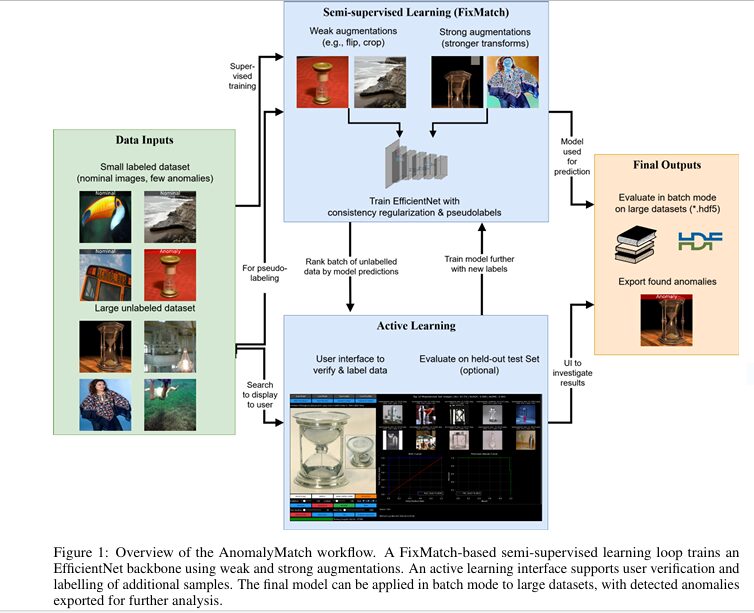
Discover Rare Objects with AnomalyMatch AI

Imagine finding a single unique galaxy among 100 million images—a cosmic needle in a haystack. This daunting task faces astronomers daily. But what if an AI could pinpoint these rarities while slashing human review time by 90%? Enter AnomalyMatch, the breakthrough framework transforming anomaly detection in astronomy, medical imaging, industrial inspection, and beyond. The Anomaly Detection Crisis […]

Discover Rare Objects with AnomalyMatch AI Read More »
FixMatch Shows How Little Supervision Semi Supervised Learning Actually Needs

FixMatch Shows How Little Supervision Semi Supervised Learning Actually Needs

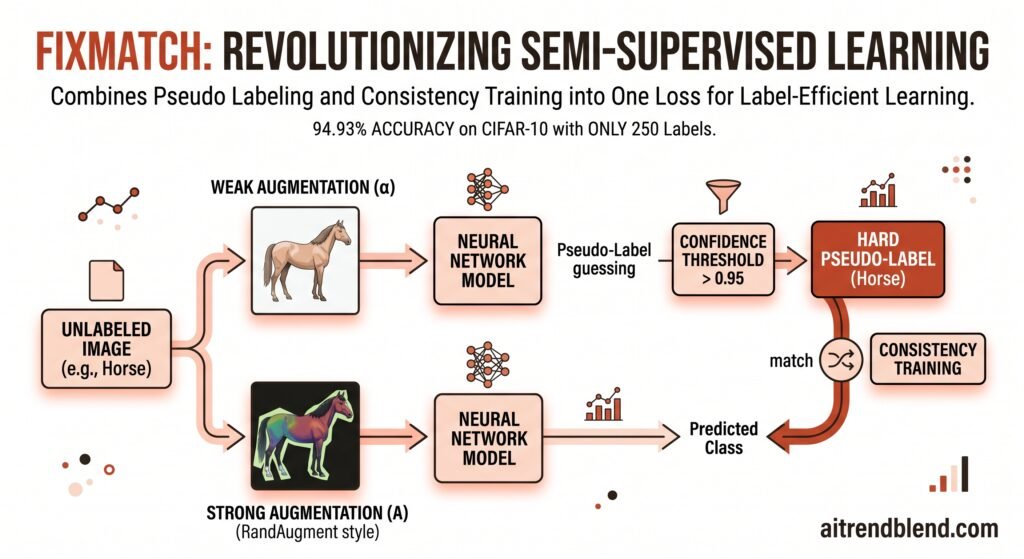
Analysis by the aitrendblend editorial team · Pillar 9, Semi supervised and label efficient learning · Source paper arXiv:2001.07685 FixMatch semi supervised learning pseudo labeling consistency regularization CIFAR-10 RandAugment CTAugment The full FixMatch pipeline runs on a single shared model with two views of the same unlabeled image. Picture a lab with five thousand unlabeled

FixMatch Shows How Little Supervision Semi Supervised Learning Actually Needs Read More »

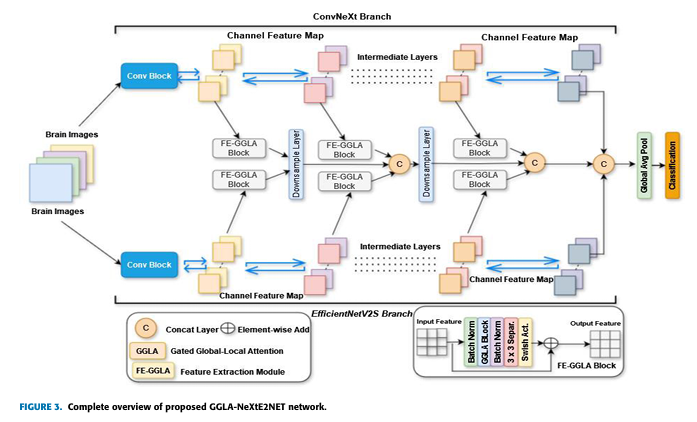
Complete overview of proposed GGLA-NeXtE2NET network.

What 99.62% Accuracy on Brain Tumor MRI Actually Means

Analysis by the aitrendblend editorial team  ·  AI for medical imaging and healthcare  ·  About 18 minutes Brain Tumor MRI Gated Attention Dual Branch Ensemble EfficientNetV2S ConvNeXt ESRGAN Augmentation Benchmark Validity Three tumor classes, one healthy class, and a model that gets all but four of them right. The interesting question is what the remaining

What 99.62% Accuracy on Brain Tumor MRI Actually Means Read More »

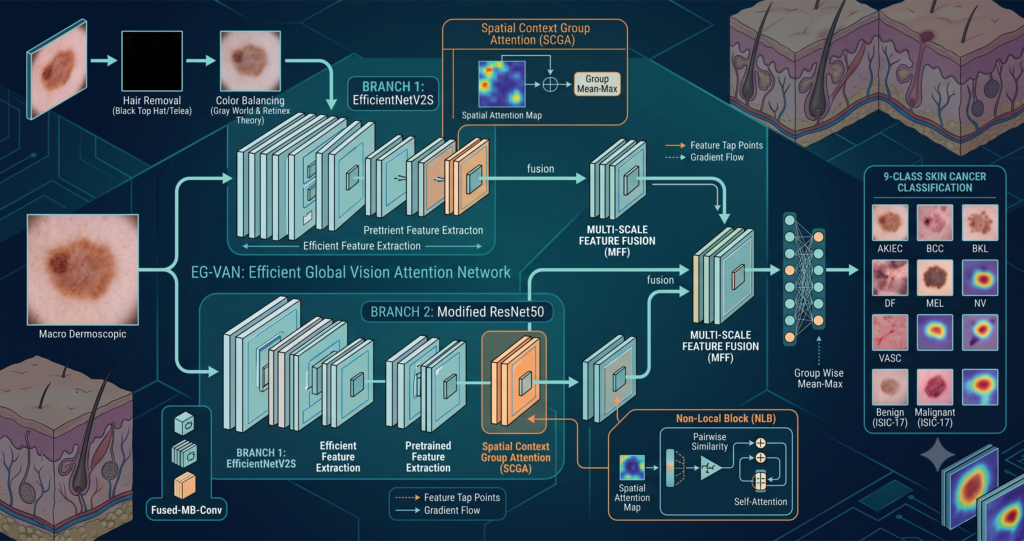
EG-VAN Explained, Dual Branch Attention for Skin Cancer Scans

EG-VAN Explained, Dual Branch Attention for Skin Cancer Scans

AI FOR MEDICAL IMAGING AND HEALTHCARE · 14 MIN READ · Analysis by the aitrendblend editorial team. skin cancer classification dual branch network EfficientNetV2S ResNet50 attention HAM10000 Grad-CAM A dermoscopic lesion moving through a dual branch classifier. Image styling is illustrative of the pipeline described in the paper. A dermatologist looking at a mole under

EG-VAN Explained, Dual Branch Attention for Skin Cancer Scans Read More »

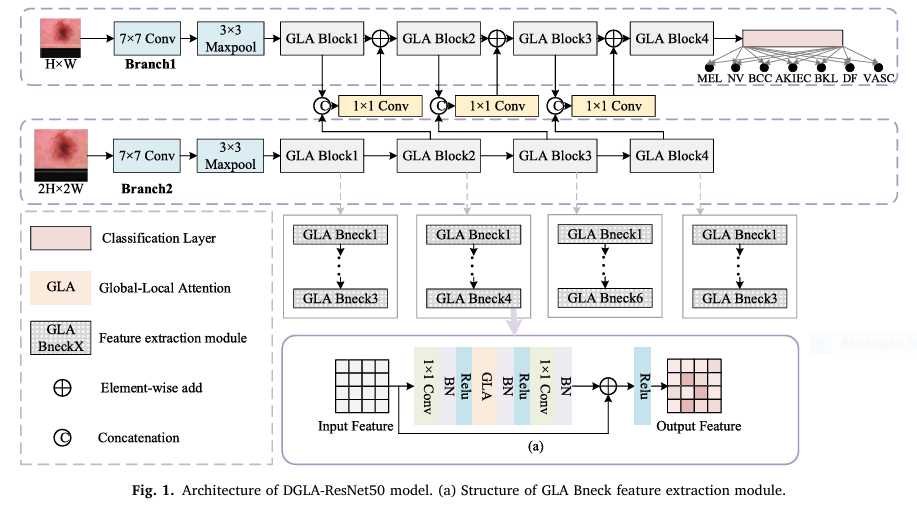
Architecture of DGLA-ResNet50 model. (a) Structure of GLA Bneck feature extraction module.

Enhancing Skin Lesion Detection Accuracy

Skin cancer continues to be one of the fastest-growing cancers worldwide, with early detection being critical for effective treatment. Traditional diagnostic methods rely heavily on dermatologists’ expertise and dermoscopy, a non-invasive skin imaging technique. However, the manual nature of dermoscopy makes the process time-consuming and subjective. To overcome these limitations, the research paper titled “Skin

Enhancing Skin Lesion Detection Accuracy Read More »

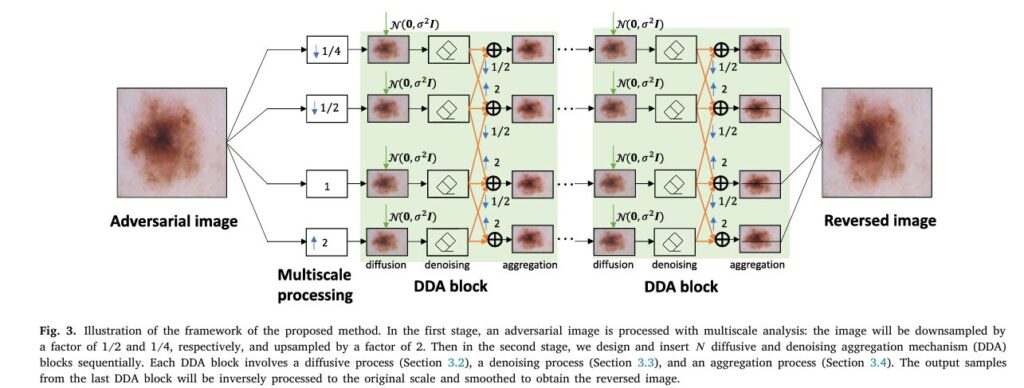
Illustration of the framework of the proposed method. In the first stage, an adversarial image is processed with multiscale analysis: the image will be downsampled by a factor of 1/2 and 1/4, respectively, and upsampled by a factor of 2. Then in the second stage, we design and insert 𝑁 diffusive and denoising aggregation mechanism (DDA) blocks sequentially. Each DDA block involves a diffusive process (Section 3.2), a denoising process (Section 3.3), and an aggregation process (Section 3.4). The output samples from the last DDA block will be inversely processed to the original scale and smoothed to obtain the reversed image.

Skin Cancer AI Combats Adversarial Attacks with MDDA

In recent years, deep learning has revolutionized dermatology by automating skin cancer diagnosis with impressive accuracy. AI-powered systems like convolutional neural networks (CNNs) can now detect melanoma and other lesions with expert-level precision. However, alongside these advancements arises a critical vulnerability: adversarial attacks. These are subtle, often imperceptible image perturbations that can mislead even the

Skin Cancer AI Combats Adversarial Attacks with MDDA Read More »

Why LungCT-NET Stacks Four Networks Instead of Trusting One

Why LungCT-NET Stacks Four Networks Instead of Trusting One

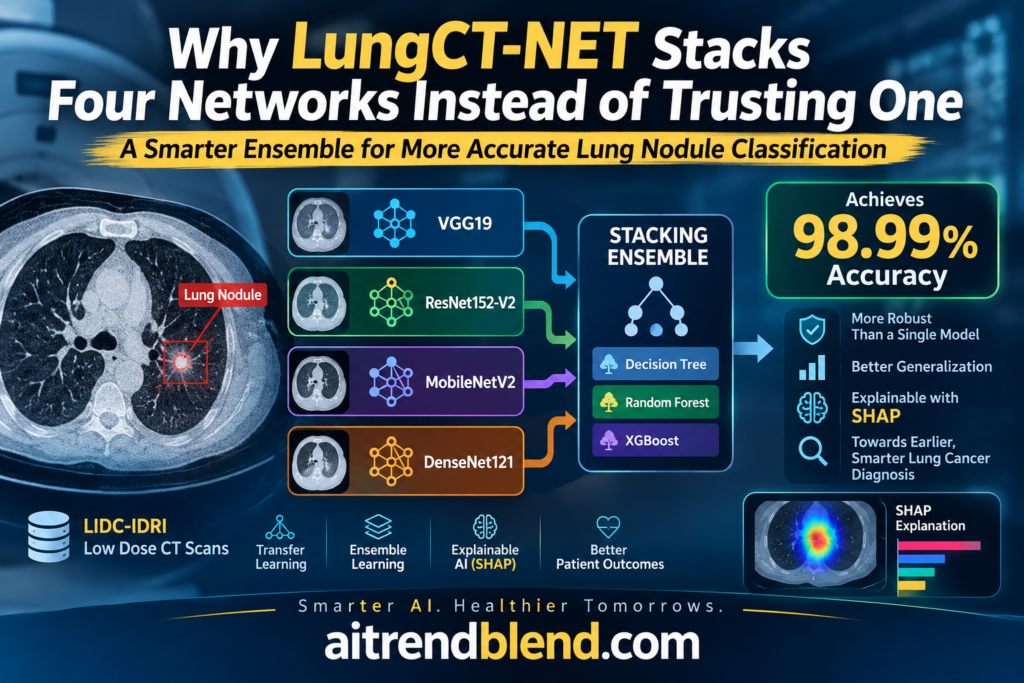
Analysis by the aitrendblend editorial team · 13 minute read Lung Cancer Transfer Learning Ensemble Learning Explainable AI Four different networks look at the same nodule and disagree slightly. That disagreement, it turns out, is useful. A single deep learning model asked to sort lung nodules into benign or malignant will usually get most of

Why LungCT-NET Stacks Four Networks Instead of Trusting One Read More »

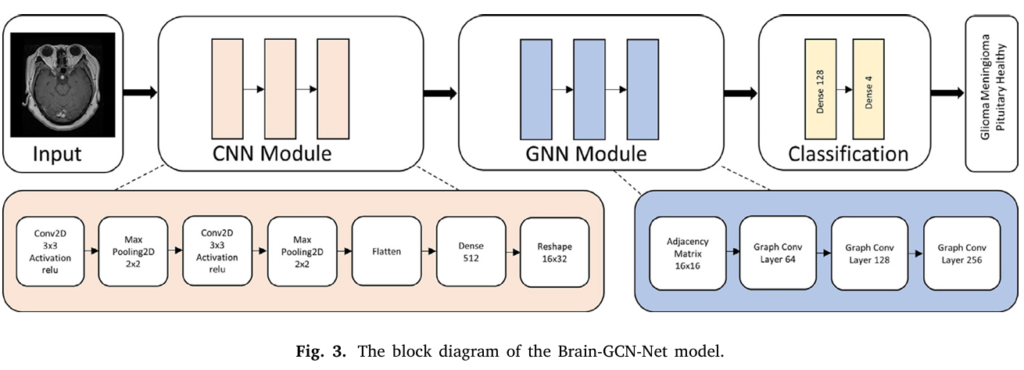
The block diagram of the Brain GCN Net model for Brain Tumor Diagnosis.

How Brain GCN Net Combines CNN and GNN for MRI Tumor Classification

Medical imaging and diagnostic AI · Deep learning architecture review · 14 minute read Graph Neural Networks Brain Tumor Classification CNN GNN Fusion MRI Analysis PyTorch Walkthrough Analysis by the aitrendblend editorial team. Medical review pending, see note below. A hybrid CNN and graph convolution pipeline turns four hundred and twenty four pixel regions of

How Brain GCN Net Combines CNN and GNN for MRI Tumor Classification Read More »

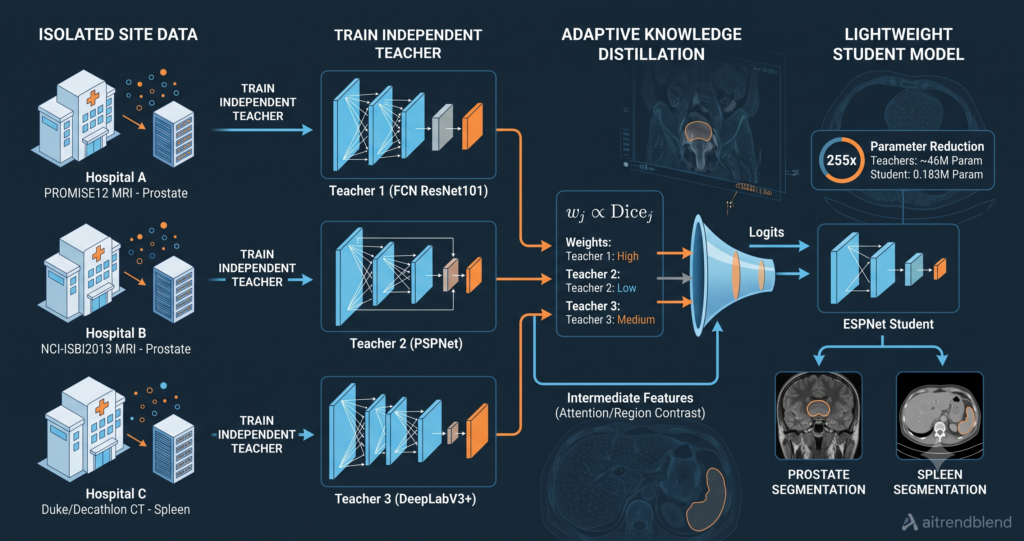
How Adaptive Multi-Teacher Knowledge Distillation Enables Lightweight Medical Segmentation with Limited Site Data.

How Adaptive Multi-Teacher Knowledge Distillation Enables Lightweight Medical Segmentation with Limited Site Data

Analysis by the aitrendblend editorial team. Published originally in Knowledge-Based Systems, volume 315, 2025, article 113196. Open access under a CC BY 4.0 license. Medical Imaging Knowledge Distillation MRI Segmentation CT Segmentation University Rovira i Virgili Adaptive multi-teacher distillation, separate hospital data into a single lightweight segmentation model Three hospitals, three teachers, zero shared patient

How Adaptive Multi-Teacher Knowledge Distillation Enables Lightweight Medical Segmentation with Limited Site Data Read More »