Adnan Saeed

Adnan Saeed is a deep learning researcher working on medical image analysis, with a focus on multimodal architectures, graph neural networks, and evidential deep learning for clinical imaging tasks. His peer reviewed research has appeared in journals across machine learning and biomedical signal processing. At AI Trend Blend he turns recent papers into clear, practical explainers, with an emphasis on what a method actually does and where it holds up, written for readers who want depth without the hype.

97% Smaller, 93% as Accurate: Revolutionizing Retinal Disease Detection on Edge Devices

Retinal diseases like Diabetic Retinopathy (DR), Glaucoma, and Cataracts cause irreversible vision loss if undetected early. Tragically, 80% of cases occur in low-resource regions lacking diagnostic tools. But a breakthrough from Columbia University flips the script: a pocket-sized AI system that detects retinal anomalies with 93% of expert-level accuracy while using 97.4% fewer computational resources. This isn’t just innovation—it’s a lifeline for […]

97% Smaller, 93% as Accurate: Revolutionizing Retinal Disease Detection on Edge Devices Read More »
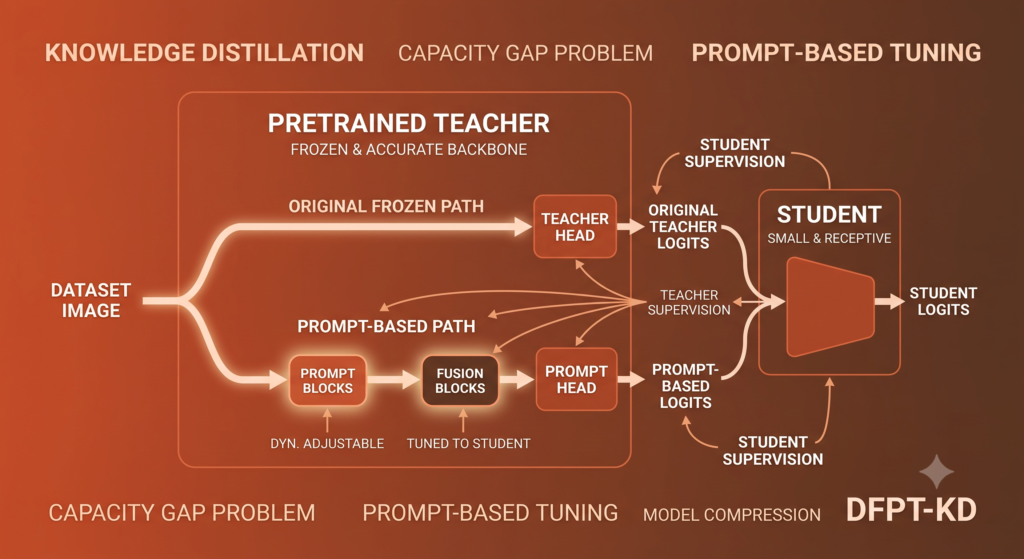
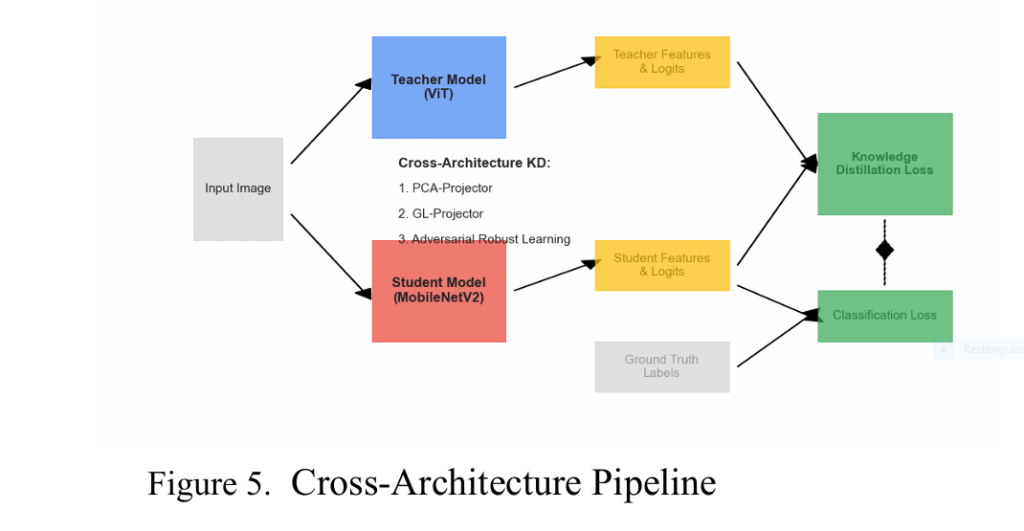
Dual Forward Path Teacher Knowledge Distillation Explained

Analysis by the aitrendblend editorial team · Pillar 2, Knowledge distillation and model compression · Source paper on arXiv, identifier 2506.18244 knowledge distillation capacity gap prompt tuning model compression CIFAR-100 A pretrained teacher with two forward paths, one frozen and accurate, one tuned to match the student. Source, Li et al., 2025. Picture a graduate

Dual Forward Path Teacher Knowledge Distillation Explained Read More »

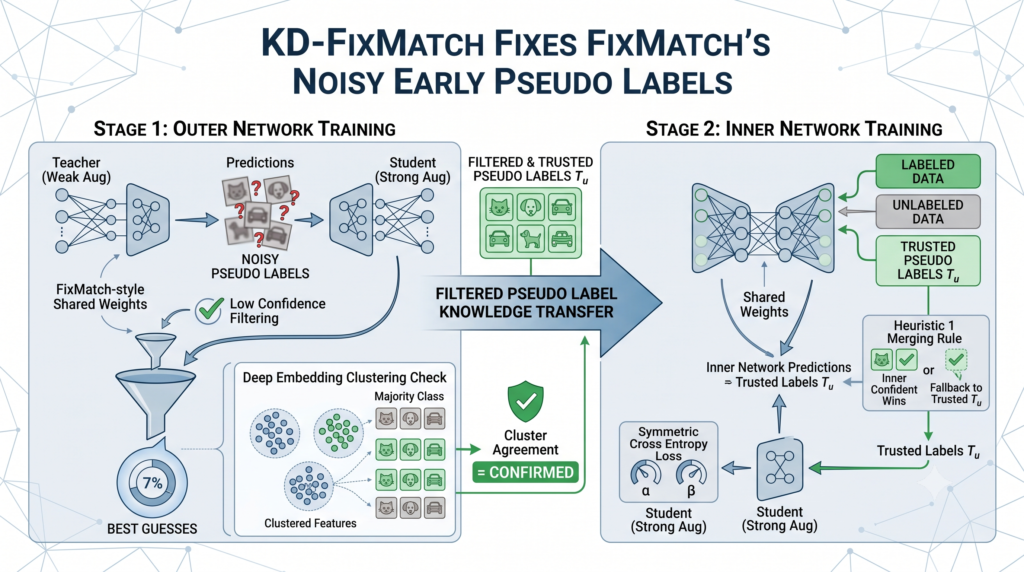
KD-FixMatch Fixes FixMatch's Noisy Early Pseudo Labels.

KD-FixMatch Fixes FixMatch’s Noisy Early Pseudo Labels

Knowledge Distillation Semi Supervised Learning 8 min read Analysis by the aitrendblend editorial team An outer network’s best guesses become the inner network’s head start, once they clear two separate filters. A retailer sorting product photos into defective and acceptable piles runs into a wall almost every computer vision team eventually hits. Good images are

KD-FixMatch Fixes FixMatch’s Noisy Early Pseudo Labels Read More »

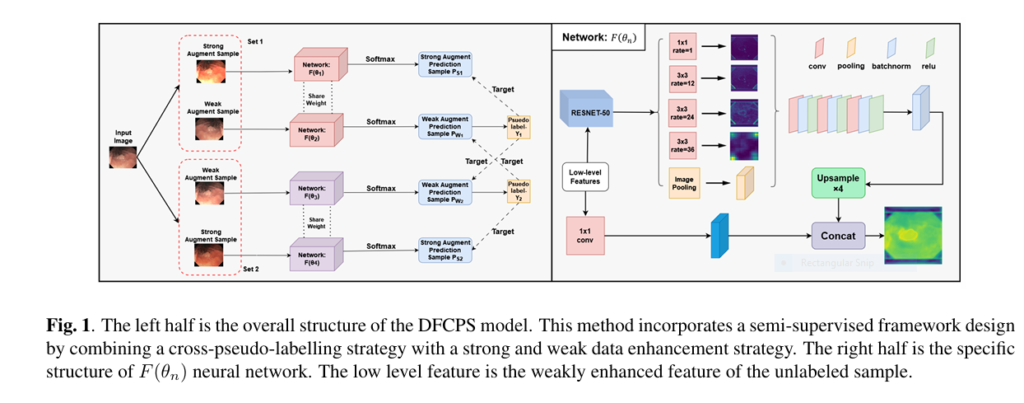
DFCPS AI model accurately segmenting gastrointestinal polyps in endoscopic imagery with minimal labeled data.

Revolutionizing Healthcare: How DFCPS’ Breakthrough Semi-Supervised Learning Slashes Medical Image Segmentation Costs by 90%

Medical imaging—CT scans, MRIs, and X-rays—generates vast amounts of data critical for diagnosing diseases like cancer, cardiovascular conditions, and gastrointestinal disorders. However, manual analysis is time-consuming, error-prone, and costly , leaving clinicians overwhelmed. Enter Deep Feature Collaborative Pseudo Supervision (DFCPS) , a groundbreaking semi-supervised learning model poised to transform medical image segmentation. In this article,

Revolutionizing Healthcare: How DFCPS’ Breakthrough Semi-Supervised Learning Slashes Medical Image Segmentation Costs by 90% Read More »

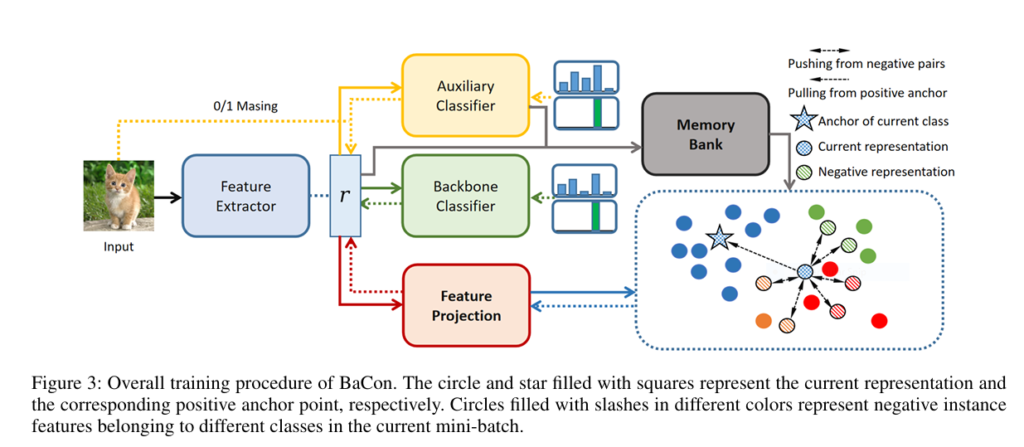
llustration showing balanced feature clusters vs. imbalanced clusters in machine learning, highlighting BaCon's contrastive learning mechanism.

7 Powerful Reasons Why BaCon Outperforms and Fixes Broken Semi-Supervised Learning Systems

Semi-supervised learning (SSL) has revolutionized how we handle data scarcity, especially in deep learning. But what happens when your labeled and unlabeled data aren’t just limited — they’re also imbalanced? The answer, for many existing SSL frameworks, is catastrophic performance. Enter BaCon — a new feature-level contrastive learning approach that boosts performance while addressing the

7 Powerful Reasons Why BaCon Outperforms and Fixes Broken Semi-Supervised Learning Systems Read More »

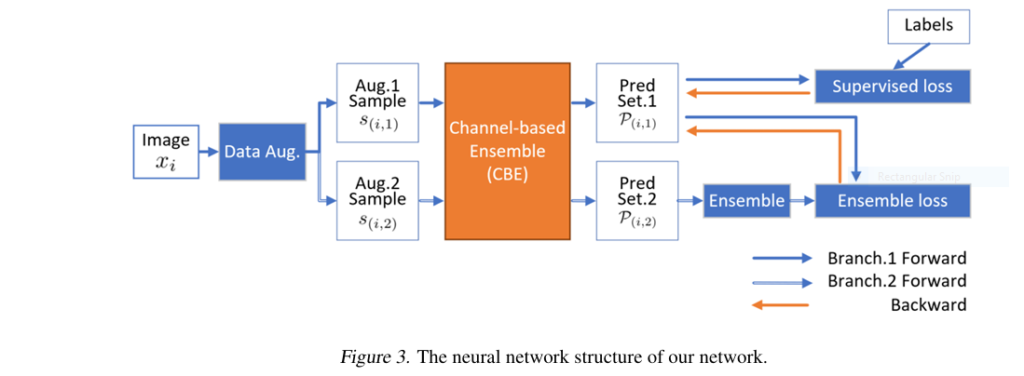
1 Breakthrough Fix: Unbiased, Low-Variance Pseudo-Labels Skyrocket Semi-Supervised Learning Results (CIFAR10/100 Proof!)

Struggling with noisy, unreliable pseudo-labels crippling your semi-supervised learning (SSL) models? Discover the lightweight, plug-and-play Channel-Based Ensemble (CBE) method proven to slash error rates by up to 8.72% on CIFAR10 with minimal compute overhead. This isn’t just another tweak – it’s a fundamental fix for biased, high-variance predictions. Keywords: Semi-Supervised Learning, Pseudo-Labels, Channel-Ensemble, Unbiased Low-Variance, FixMatch Enhancement,

1 Breakthrough Fix: Unbiased, Low-Variance Pseudo-Labels Skyrocket Semi-Supervised Learning Results (CIFAR10/100 Proof!) Read More »

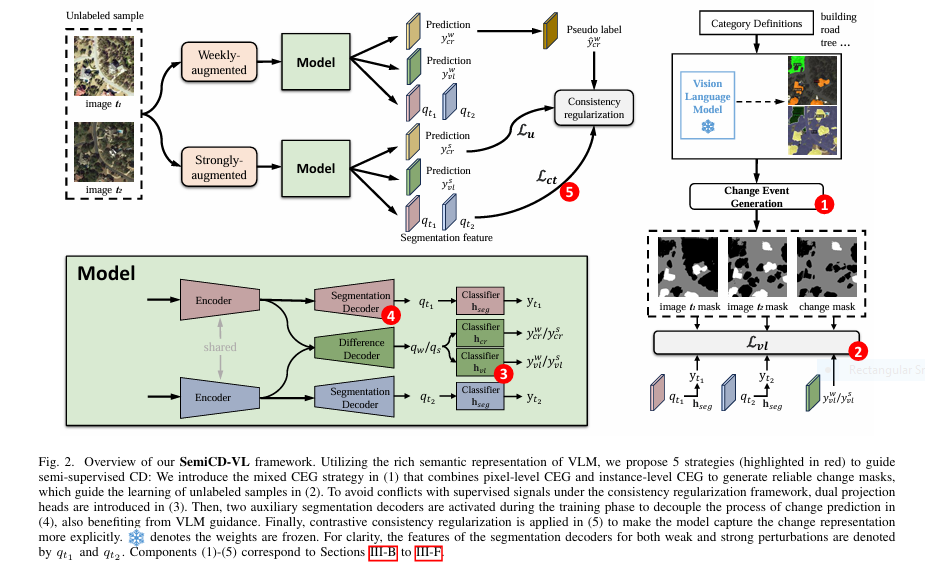
SemiCD-VL architecture overview showing VLM guidance, dual projection heads, and contrastive regularization.

Revolutionize Change Detection: How SemiCD-VL Cuts Labeling Costs 5X While Boosting Accuracy

Change detection—the critical task of identifying meaningful differences between images over time—just got a seismic upgrade. For industries relying on satellite monitoring (urban planning, disaster response, agriculture), pixel-level annotation has long been the costly, time-consuming bottleneck stifling innovation. But a breakthrough AI framework—SemiCD-VL—now slashes labeling needs by 90% while delivering unprecedented accuracy, even outperforming fully supervised models. The Crippling

Revolutionize Change Detection: How SemiCD-VL Cuts Labeling Costs 5X While Boosting Accuracy Read More »

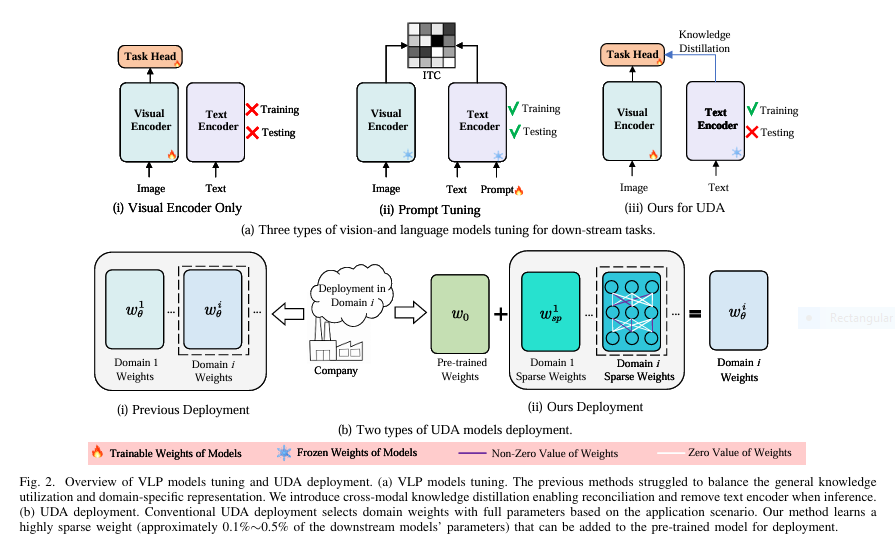
CMKD: Slash 99% Storage Costs & Dominate UDA Challenges

Unsupervised Domain Adaptation (UDA) faces two persistent roadblocks: effectively leveraging powerful modern foundation models and the crippling storage overhead of deploying multiple domain-specific models. A groundbreaking approach merges Vision-Language Pre-training (VLP) like CLIP with innovative techniques—Cross-Modal Knowledge Distillation (CMKD) and Residual Sparse Training (RST)—to smash these barriers, achieving state-of-the-art results while reducing deployment parameters by over 99%. Why Traditional Revolutionizing Unsupervised

CMKD: Slash 99% Storage Costs & Dominate UDA Challenges Read More »

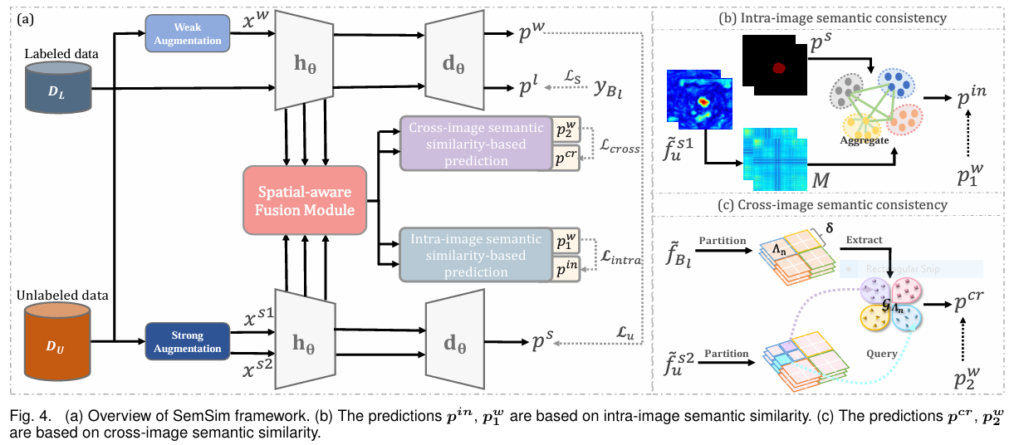
SemSim Adds Semantic Similarity to FixMatch Segmentation

Analysis by the aitrendblend editorial team, based on the published paper and an independent read of its claims. Not a substitute for advice from a licensed clinician or radiologist. Medical Imaging AI Semi Supervised Learning Cardiac MRI Segmentation Skin Lesion Segmentation Prostate MRI Segmentation SemSim rebuilds FixMatch around semantic similarity rather than raw pixel agreement,

SemSim Adds Semantic Similarity to FixMatch Segmentation Read More »

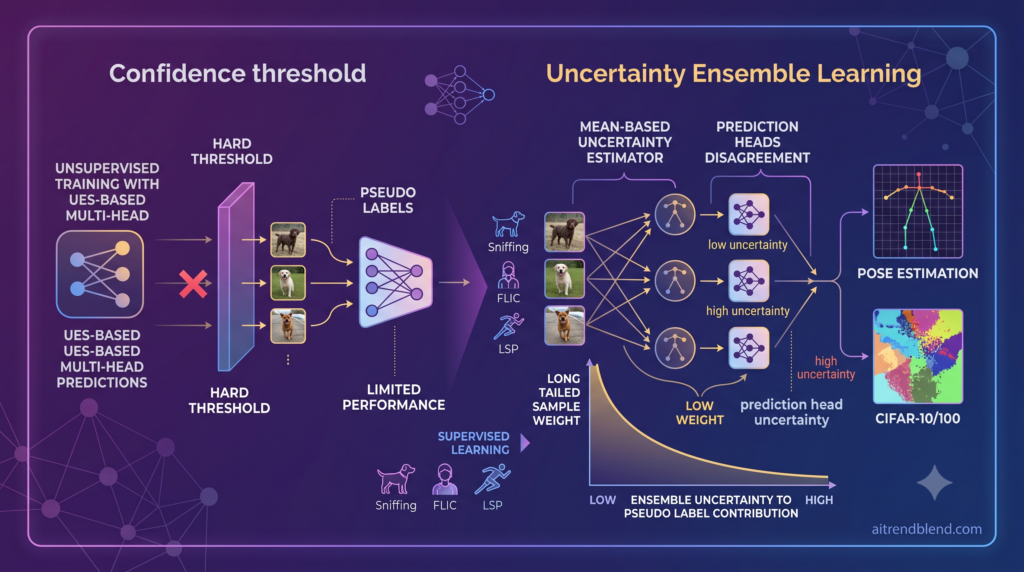
Long Tailed Weights Beat Thresholds For Pseudo Labels

Analysis by the aitrendblend editorial team · Probabilistic methods · Source paper posted March 2025 Semi Supervised Learning Uncertainty Estimation Ensemble Learning Pose Estimation Pseudo Labels Instead of relying on a hard confidence cutoff, UES introduces long tailed weights derived from ensemble uncertainty, ensuring even the least trustworthy pseudo labels still contribute valuable signal to

Long Tailed Weights Beat Thresholds For Pseudo Labels Read More »