Machine Learning

Machine learning sits at the core of everything we cover at AI Trend Blend. This section gathers our research breakdowns, method explainers, and practical analyses across supervised, self-supervised, and generative learning, with a steady focus on the ideas that actually move results rather than the noise around them. You will find work spanning optimization, model architectures, training dynamics, and the theory that explains why modern systems behave the way they do, written for readers who want depth without filler.

SUP-Net: Deep Learning Fixes Doppler Ultrasound Aliasing by Upsampling the Raw Signal

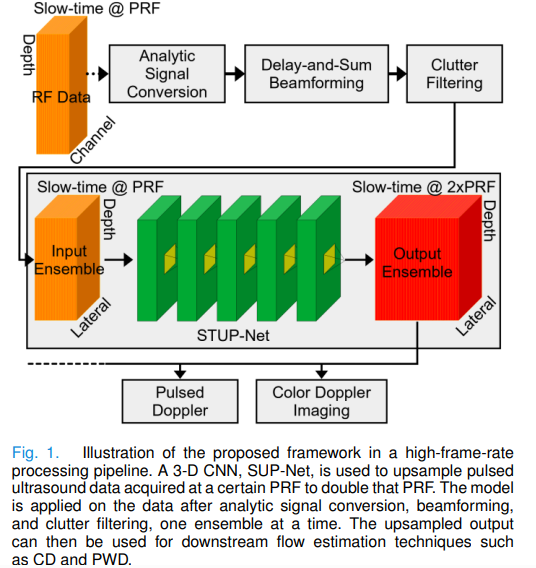
SUP-Net: Deep Learning Fixes Doppler Ultrasound Aliasing by Upsampling the Raw Signal

University of Waterloo researchers built SUP-Net, a 3D convolutional U-Net that fixes Doppler ultrasound’s fundamental speed limit by upsampling the raw slow-time signal — before any Doppler processing occurs — allowing color Doppler and pulse wave Doppler to work reliably…

SUP-Net: Deep Learning Fixes Doppler Ultrasound Aliasing by Upsampling the Raw Signal Read More »
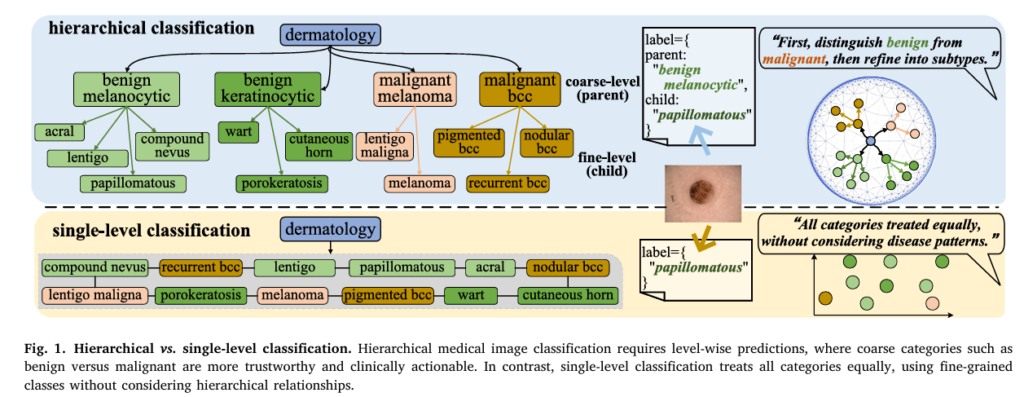
H2CL: Dual-Geometry Hyperbolic-Euclidean Image-Text Learning for Medical Hierarchical Classification.

H2CL: Dual-Geometry Hyperbolic-Euclidean Image-Text Learning for Medical Hierarchical Classification

A UNSW Sydney team built H²CL — a dual-geometry image-text framework that simultaneously operates in Euclidean and hyperbolic spaces, combining group contrastive learning with a hyperbolic entailment loss, to classify medical images across clinical taxonomies. The result: 7% accuracy gains…

H2CL: Dual-Geometry Hyperbolic-Euclidean Image-Text Learning for Medical Hierarchical Classification Read More »

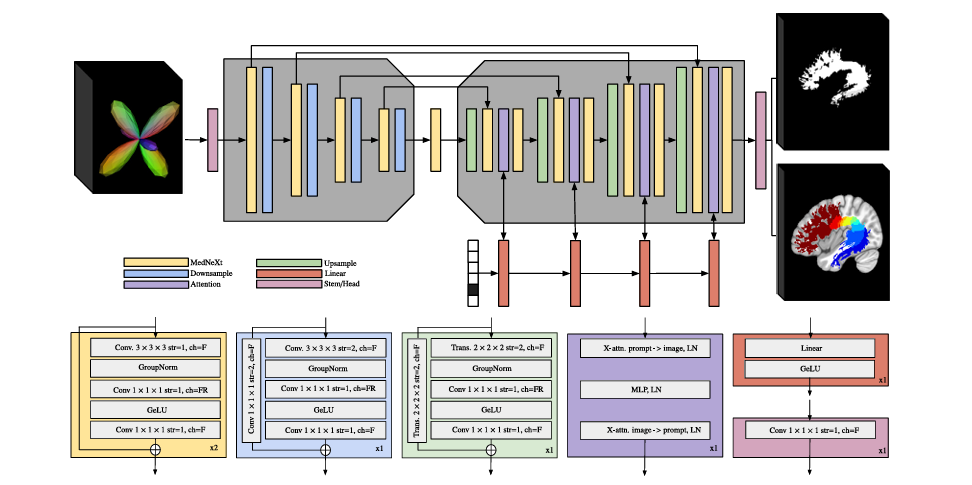
BundleParc: Tractography-Free White Matter Bundle Parcellation with MedNeXt + Cross-Attention

BundleParc: Tractography-Free White Matter Bundle Parcellation with MedNeXt + Cross-Attention

Researchers at Université de Sherbrooke built a prompt-conditioned MedNeXt encoder-decoder that reads fiber orientation maps and outputs anatomically consistent white matter parcellations in seconds — without generating a single streamline — outperforming all competing methods on reproducibility across healthy subjects,…

BundleParc: Tractography-Free White Matter Bundle Parcellation with MedNeXt + Cross-Attention Read More »

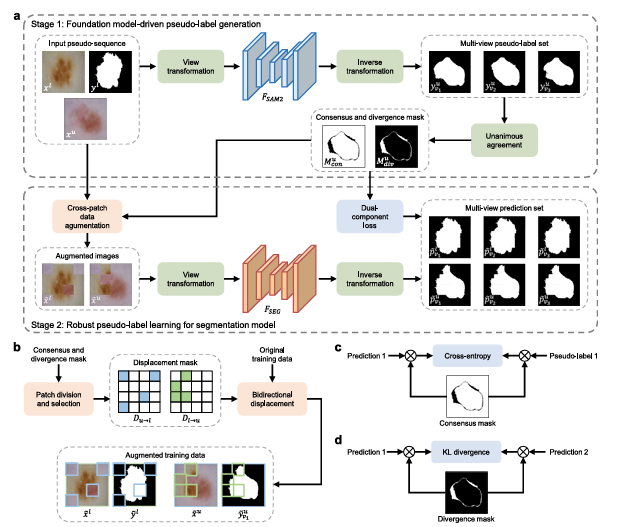
YoloSeg: One Labeled Image Is All You Need for Medical Image Segmentation.

YoloSeg: One Labeled Image Is All You Need for Medical Image Segmentation

A team at the Chinese Academy of Sciences built a framework that achieves segmentation accuracy within 3% of fully-supervised models across ten diverse medical datasets — using exactly one manually annotated image per task. SAM2 does the label propagation; a…

YoloSeg: One Labeled Image Is All You Need for Medical Image Segmentation Read More »

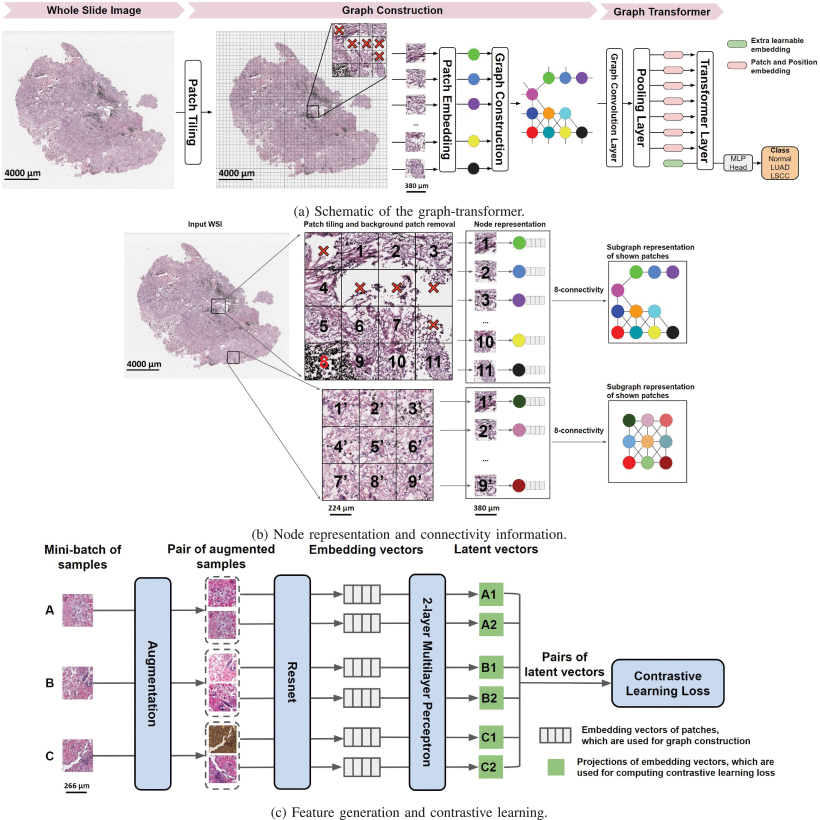
GTP: The Graph-Transformer That Reads Whole Slide Pathology Images Like a Pathologist

GTP: The Graph-Transformer That Reads Whole Slide Pathology Images Like a Pathologist

A team at Boston University built GTP — a Graph-Transformer for Pathology that fuses graph convolutional networks with vision transformers to classify gigapixel whole slide images of lung cancer at 91.2% accuracy, plus a novel GraphCAM technique that highlights exactly…

GTP: The Graph-Transformer That Reads Whole Slide Pathology Images Like a Pathologist Read More »

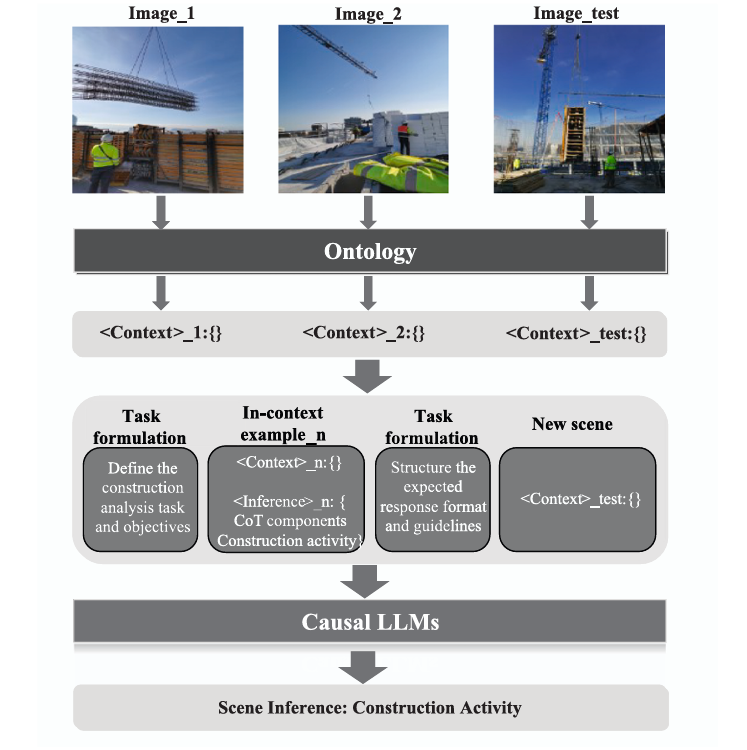
Ontology-Based LLM Prompting for Construction Activity Recognition: 73.68% Accuracy With No Training Data.

Ontology-Based LLM Prompting for Construction Activity Recognition: 73.68% Accuracy With No Training Data

Researchers at Technische Universität Berlin and Qingdao University of Technology achieved 73.68% construction activity recognition accuracy using pure prompting — no labeled training data, no fine-tuning, just a domain ontology, structured visual extraction, and carefully engineered in-context examples.

Ontology-Based LLM Prompting for Construction Activity Recognition: 73.68% Accuracy With No Training Data Read More »

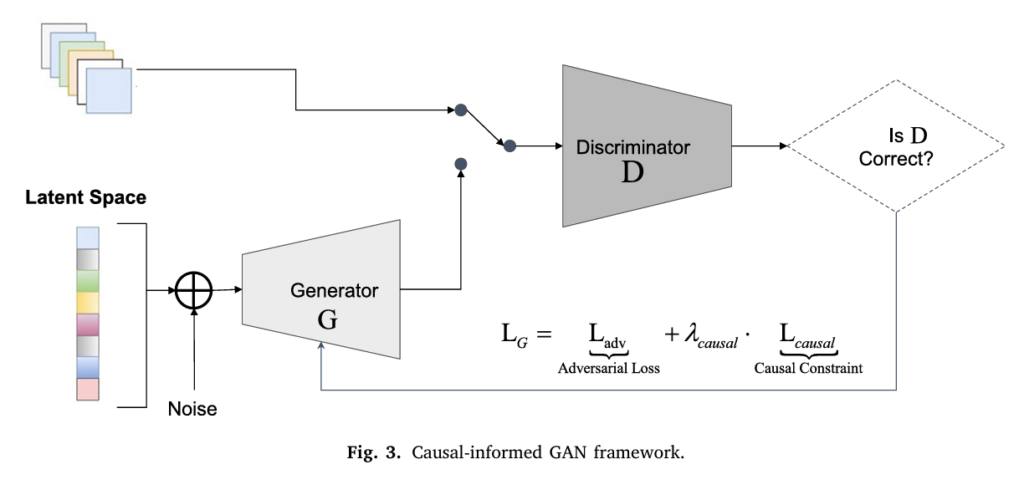
Causal-Informed GAN for Changeover Time Prediction in Customized Manufacturing.

Causal-Informed GAN for Changeover Time Prediction in Customized Manufacturing

A Carnegie Mellon team embedded causal inference directly into a Generative Adversarial Network to predict sequence-dependent changeover times for products the factory has never seen before — cutting production waste by up to 25% and finally making job-shop scheduling work…

Causal-Informed GAN for Changeover Time Prediction in Customized Manufacturing Read More »

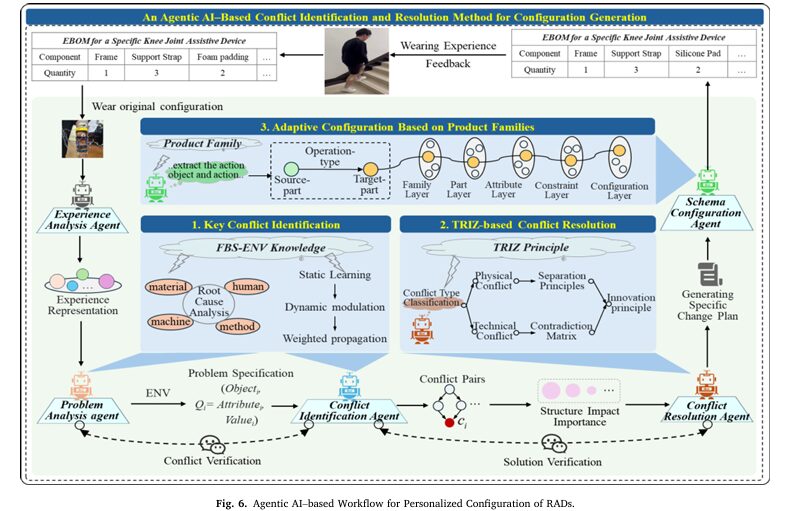
Agentic AI for Personalized Knee Braces: How sEMG, Facial Expressions, and LLMs Combine to Configure Rehab Devices

Donghua University’s five-agent AI system cross-checks muscle signals against facial expressions and verbal reports to configure personalized rehabilitation braces — catching cases where patients exaggerate, suppress, or simply can’t articulate their discomfort accurately. It achieves 0.88 parameter accuracy versus 0.13…

Agentic AI for Personalized Knee Braces: How sEMG, Facial Expressions, and LLMs Combine to Configure Rehab Devices Read More »

PARNet: Dual-Encoder Crack Detection with Dynamic Alignment and Residual Fusion.

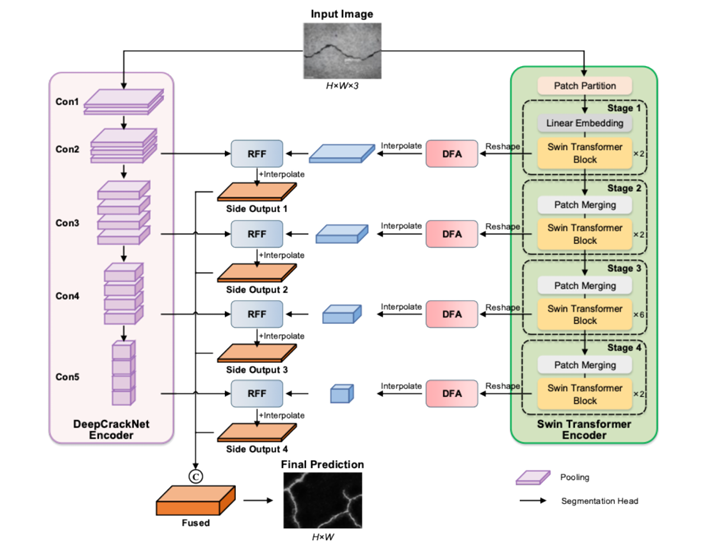
PARNet: Dual-Encoder Crack Detection with Dynamic Alignment and Residual Fusion

Researchers at Shandong University and Stony Brook University built PARNet, a dual-encoder architecture that runs CNN and Transformer feature extraction in strict parallel, aligns their outputs with dynamic attention, and fuses them through residual connections — achieving the best accuracy,…

PARNet: Dual-Encoder Crack Detection with Dynamic Alignment and Residual Fusion Read More »

Meta-TD3: Meta-Learning-Guided Vibration Control with Adaptive Experience Replay.

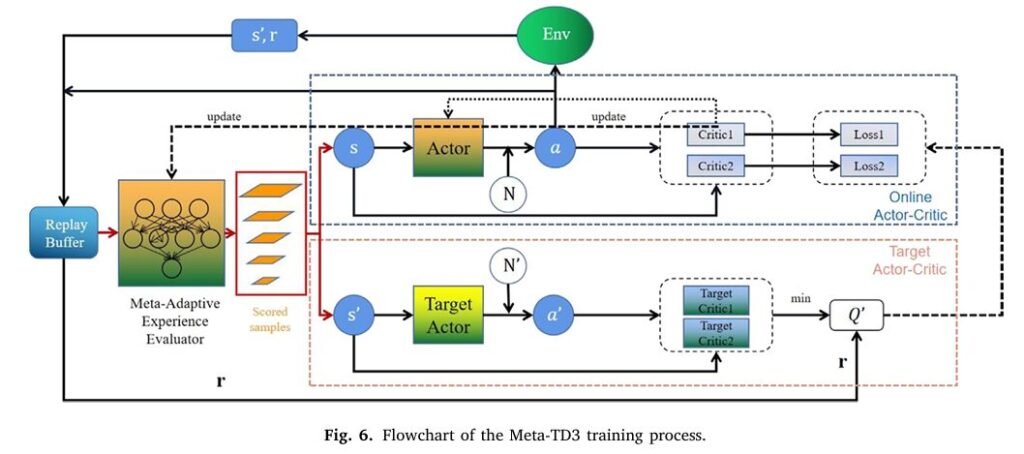
Meta-TD3: Meta-Learning-Guided Vibration Control with Adaptive Experience Replay

Beihang University researchers solved one of deep reinforcement learning’s most persistent headaches — bad experience replay — by training a lightweight meta-network to score every stored transition before sampling, cutting TD3’s training time by 52.3%, reducing peak vibration by 65%,…

Meta-TD3: Meta-Learning-Guided Vibration Control with Adaptive Experience Replay Read More »