
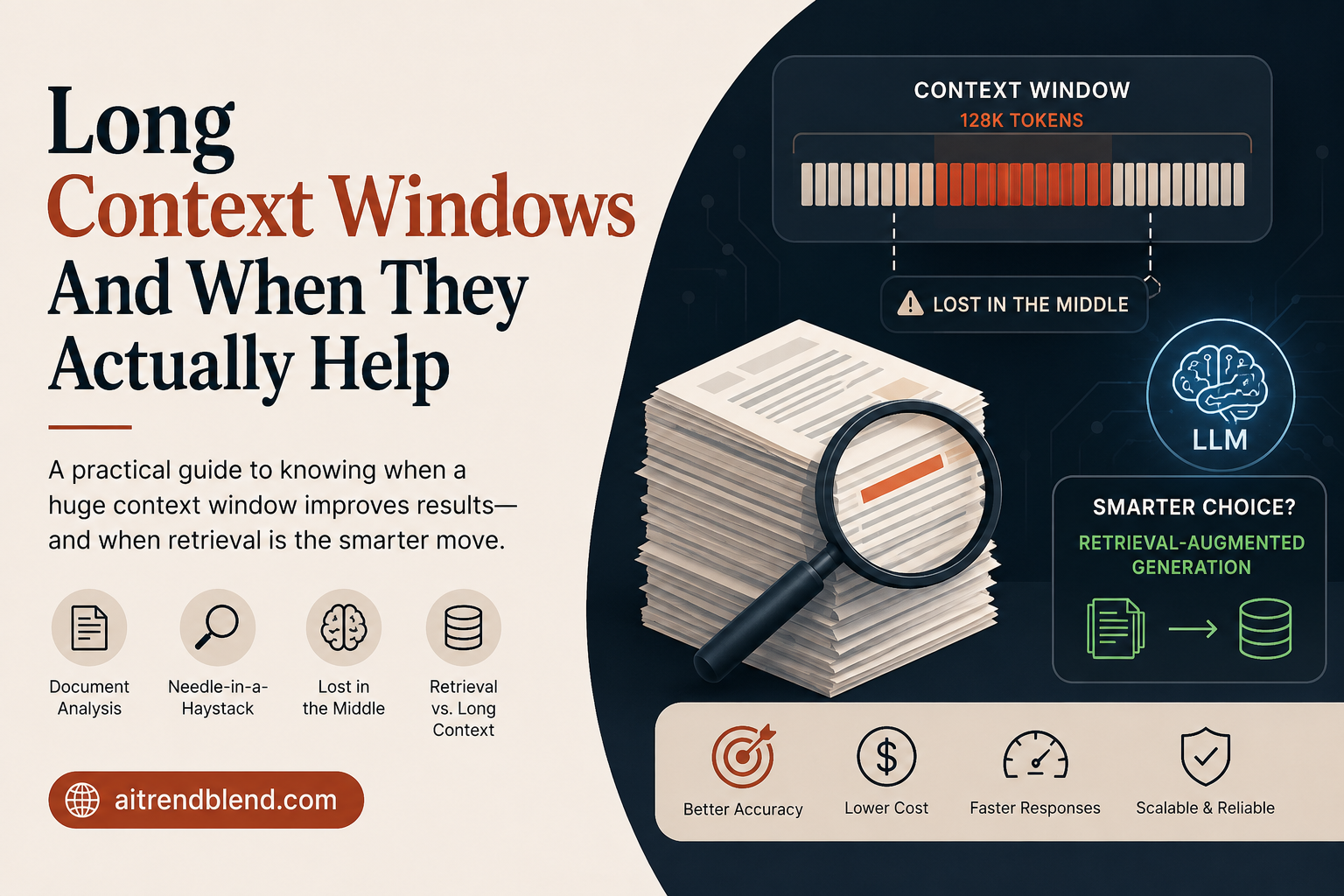
Key Points
- A large context window solves the problem of fitting information in front of the model. It does not solve the problem of the model noticing the right part of it.
- Tasks that need holistic understanding of a document, such as summarizing tone across a long report, benefit the most from long context.
- Tasks that need one specific fact out of a large pile still tend to work better with retrieval than with a full context dump.
- Cost and latency scale with tokens sent, so a habit of always pasting everything gets expensive fast for no real gain.
- The lost in the middle effect means information placed away from the start or end of a long prompt is recalled less reliably.
- The right default for most production systems is retrieval first, with long context reserved for tasks that genuinely need the whole document at once.
Context window size became a marketing number the same way megapixels once did for cameras. Every release announcement leads with a bigger figure, thirty two thousand tokens, then one hundred twenty eight thousand, then a million, each one presented as if it simply removes a limitation. And it does remove one limitation, which is that you used to have to manually chop documents into chunks to fit them in front of the model at all. What a bigger number does not automatically fix is whether the model actually uses everything you handed it with equal care.
None of this comes for free. Every extra token in the prompt costs money, adds latency, and gives the model more material to potentially lose track of. The practical question worth asking before you reach for a huge context window is not can this model technically fit my document. It almost certainly can. The question is whether the task actually benefits from having the whole thing present at once, or whether you would get a better and cheaper answer by finding the right three paragraphs first and only sending those.
What a bigger context window is actually good for
Tasks that require a view of the whole document
Some tasks genuinely cannot be chunked without losing something important. Summarizing the overall tone and argument of a long report, checking a contract for internal consistency across sections that reference each other, or reviewing a full pull request where a change in one file affects logic in another all require the model to hold the whole thing in mind at once. Chunk these and hand a model only pieces, and it will summarize each chunk fine while missing the way the pieces relate to each other. This is where a long context window earns its cost.
Multi turn conversations that need real memory
A long running conversation, especially one involving a complex piece of work like debugging a large codebase interactively over an hour, benefits from a context window large enough that early context does not get silently dropped. Without it, the model starts contradicting decisions it made twenty messages earlier because that part of the conversation fell out of its window entirely. A generous context window here is less about a single clever trick and more about avoiding a specific kind of memory failure that gets increasingly annoying the longer a session runs.
Cross referencing many related but distinct documents
Comparing several similar documents against each other, such as checking whether three vendor proposals cover the same requirements or whether a set of code files implement a consistent interface, benefits from having all of them available simultaneously so the model can draw direct comparisons rather than summarizing each one in isolation and hoping the comparison logic survives being pieced together afterward.
Where a huge context window quietly stops helping
Finding one specific fact in a large pile
If your actual task is answer a single question using one paragraph somewhere inside a five hundred page manual, dumping the entire manual into the context window is usually the wrong move, even though it technically fits. Research on long context recall has repeatedly found what is commonly called the lost in the middle effect, where models retrieve information from the start and end of a long context more reliably than from the middle. A retrieval step that finds the relevant paragraph first and sends only that, plus a bit of surrounding context, tends to produce a more reliable answer than sending everything and hoping the model finds the needle itself.
Cost and latency add up fast with no return
Every additional token you send costs money and adds processing time, and this scales linearly whether or not the model actually needed that token to answer your question. A support tool that pastes an entire knowledge base into every single query, when the actual answer lives in one article, is paying full price on every request for information the model never needed to see. Multiply that by thousands of daily queries and the difference between retrieval and full context dumping becomes a real budget line, not a rounding error.
Signal gets diluted by irrelevant material
Even when a model technically can locate the right fact inside a large context, surrounding it with a large amount of irrelevant material measurably increases the chance of a wrong or hedged answer compared to giving the model a smaller, more focused set of information. This is somewhat counterintuitive if you assume more context can only help, but it lines up with how attention mechanisms actually work. More tokens competing for attention means more opportunity for the truly relevant tokens to get diluted rather than highlighted.
| Task type | Better fit | Why |
|---|---|---|
| Whole document summary or tone check | Long context | Requires holding the entire structure in mind at once |
| Single fact lookup from a large corpus | Retrieval first | Only one small piece is relevant, everything else is noise |
| Multi turn technical conversation | Long context | Avoids losing earlier decisions as the session grows |
| High volume customer support queries | Retrieval first | Cost and latency scale with every token sent per query |
| Cross document comparison | Long context | Needs simultaneous access to compare across documents directly |
| Search across a large archive | Retrieval first | The lost in the middle effect makes full context recall unreliable |
A bigger context window gives a model more room to work in. It does not give the model a reason to look everywhere equally.Working principle behind this comparison
A simple test you can run yourself
Take a document you actually work with, something in the range of ten to twenty thousand words, and place one specific, checkable fact roughly in the middle third of it. Something concrete, a number, a date, a named condition, not something the model could guess from context. Ask a direct question that can only be answered from that one fact, using the full document as your prompt. Then run the same question again, but this time hand the model only the paragraph containing the fact along with a sentence or two of surrounding context. Compare accuracy and compare how confidently each answer is stated.
Run this a handful of times across different documents and you start to see the shape of your specific model’s weak spot rather than trusting a general claim about context windows. Some models handle mid document recall better than others, and the gap between models on this exact test tends to be larger than most people expect given how similar the marketing copy sounds.
Building a habit around this
The practical takeaway is not that long context is bad. It is that reaching for it by default, on every task, wastes money and quietly increases the odds of a wrong answer on the tasks that would have done better with a focused, retrieved chunk of text. A reasonable default for most production systems is retrieval first, with a fallback to full document context specifically for the tasks identified earlier, whole document summarization, multi turn technical sessions, and direct cross document comparison. Treat the long context window as a tool reserved for when the task genuinely requires it, not a replacement for thinking about what information the model actually needs to see.
Honest limitations of this framework
The lost in the middle effect and the general reliability of long context recall vary meaningfully between model providers and between versions of the same model family, and the gap has been closing over time as providers specifically train against this weakness. A test that shows a clear retrieval advantage today may show a smaller gap on a model released six months from now, so this is worth rechecking periodically rather than treating as a permanent rule.
This framework also does not cover cases where building a reliable retrieval pipeline is itself the harder engineering problem, which happens more often than people expect. A retrieval system needs good chunking, a decent embedding model, and a sensible ranking step to actually outperform a long context dump. For a small one off task, the engineering cost of setting up retrieval properly can exceed the cost of simply pasting the document in, even if the long context approach is technically less efficient per query.
Conclusion
The size of a context window is one of the easiest numbers to put on a slide and one of the hardest to translate into an honest sense of what actually improves for a given task. A bigger window solves a real problem, which is that documents used to have to be manually cut into pieces before a model could see them at all. It does not solve a different problem, which is whether the model treats every part of what you handed it with equal attention, and it clearly does not, based on how consistently the middle of a long context underperforms the edges across model families.
The tasks that genuinely benefit from a large context window share a common shape. They require the model to reason across the whole document rather than locate one fact within it, whether that means judging overall tone, maintaining a long running technical conversation, or comparing several related documents directly against each other. Tasks that only need one specific answer buried somewhere in a large pile of text tend to do better, and cost less, when a retrieval step finds the relevant piece first.
This distinction transfers cleanly to a wide range of practical systems beyond chat interfaces. It applies to how you design a customer support tool, how you build an internal search assistant over company documentation, and how you decide whether a coding assistant needs the entire repository in view or just the handful of files actually touched by the current change. In every case the underlying question is the same. Does this task need the whole document to reason correctly, or does it need one accurate piece of it.
The honest limitation is that none of this framework replaces actually testing your own documents and your own model of choice, because the size of the middle of context weakness genuinely differs between providers and shifts with every new release. What this framework gives you is a way to ask the right question before defaulting to whichever option feels more impressive on paper.
As context windows keep growing toward the low millions of tokens, expect the marketing conversation to keep leading with the number while the harder, more useful question stays the same. Not how much can this model technically hold, but how reliably does it use what you actually gave it. Run the mid document test on whatever model you rely on, keep the result somewhere you will actually look at again, and revisit it the next time a provider announces a bigger number.
Test Your Own Model’s Context Recall
Try running the mid document recall test described above on a document you actually work with, then compare it against a retrieval first approach before deciding which one belongs in your workflow.
Frequently Asked Questions
Does a bigger context window always produce better answers
No. A bigger context window only helps on tasks that genuinely require reasoning across an entire document at once. For tasks that need one specific fact from a large amount of text, a focused retrieval step usually produces a more reliable answer than sending everything.
What is the lost in the middle effect
It describes the tendency of language models to recall information placed near the beginning or end of a long context more reliably than information placed in the middle third. The size of this effect varies between models and has been shrinking as providers train specifically to address it.
Should I use retrieval augmented generation instead of long context
For high volume tasks where each query only needs a small piece of a large knowledge base, retrieval first is usually cheaper and more reliable. Long context is worth the cost when the task genuinely needs the whole document present at once, such as summarizing overall tone or comparing multiple documents directly.
How can I test whether my model handles long context well
Place a specific checkable fact in the middle third of a document you actually use, ask a question that can only be answered from that fact, and compare the accuracy of the full document prompt against a version where you hand the model only the relevant paragraph.
Does long context cost more than retrieval
Generally yes, because cost scales with the number of tokens sent per request. Sending an entire document on every query when only a small part is relevant adds up quickly at scale compared to retrieving just the needed section first.
Will this problem go away as context windows keep growing
The raw size limit is becoming less of a constraint, but a larger window does not by itself fix how evenly a model attends to everything inside it. The gap has been narrowing across newer models, so it is worth retesting periodically rather than assuming today’s result holds indefinitely.
Related Reading
This analysis is an original practical framework built by the aitrendblend editorial team from direct testing patterns and general prompt engineering practice.