
- Claude Opus 5.5
- GPT-6 Astra
- GPT-6 Sol
- GPT-6 Luna
- Model comparison
- Cost per task
- Agentic coding
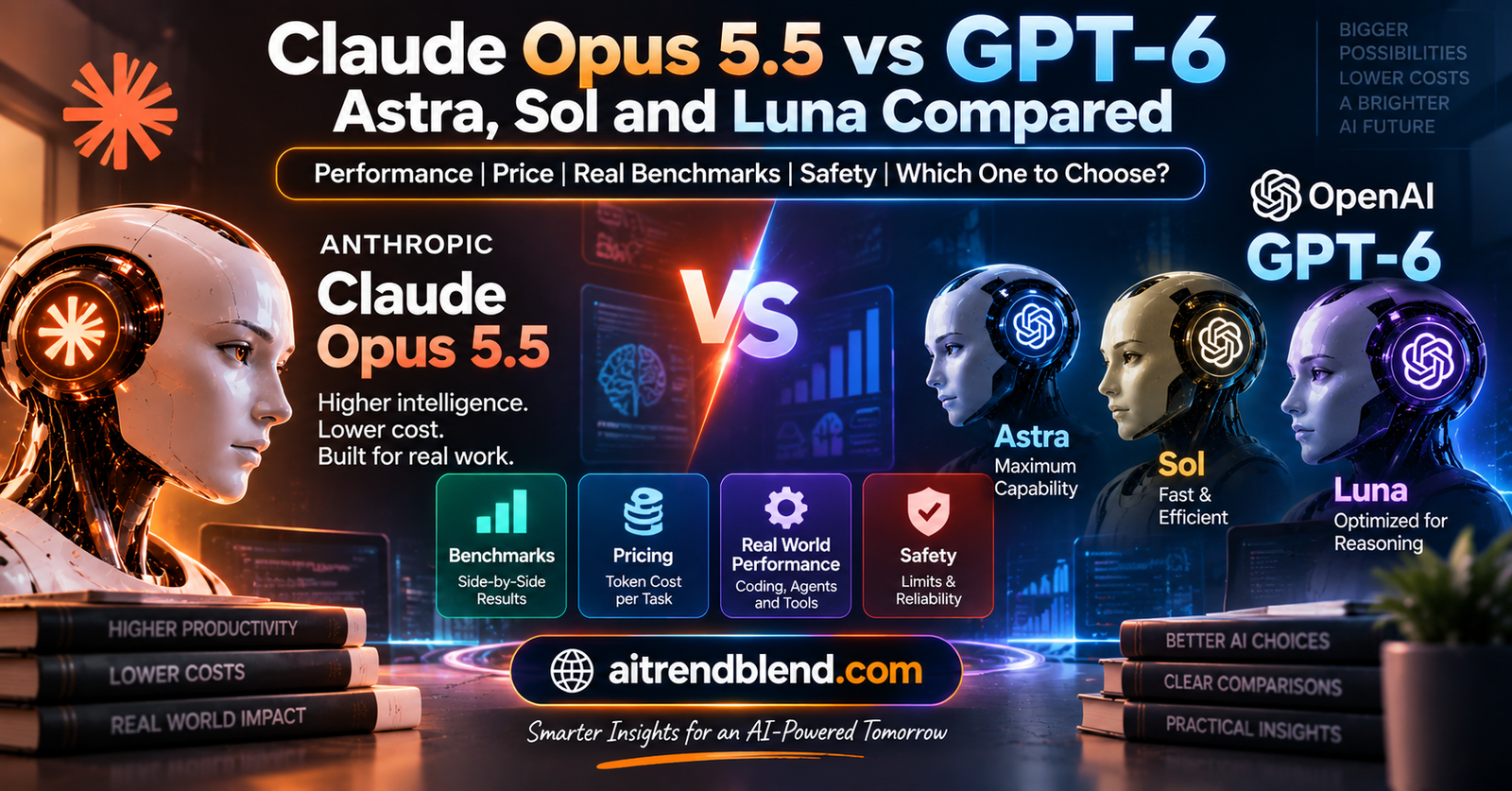
An engineering manager has a spreadsheet open with four columns and a deadline. Her team runs coding agents, a research assistant for the analysts and a mountain of document extraction. On the morning of 22 September 2026 Anthropic released Claude Opus 5.5, and about ninety minutes later OpenAI completed its GPT-6 family with Sol and Luna, eighteen days after Astra. She needs to know which model goes in which column.
The trouble is that neither company compared its model with the other’s newest release. Anthropic benchmarked Opus 5.5 against its own Fable 5.1 and Opus 5. OpenAI benchmarked Astra, Sol and Luna against Opus 5 and the Fable models. So the obvious question, which is better, has no official answer. This piece builds the closest thing to one from shared benchmarks, an independent index and plain cost arithmetic.
Key points
- Per token, Opus 5.5 at $4 and $20 sits between GPT-6 Sol at $2 and $10 and GPT-6 Astra at $10 and $50. Luna is far cheaper at $0.10 and $0.50.
- On Artificial Analysis’s independent Intelligence Index, Opus 5.5 at max effort scores 58, Astra 53, Sol 48 and Luna 37.
- Opus 5.5 used about 260 million output tokens to run that index against Astra’s 60 million, so it cost more to run in total despite a lower per token price.
- Claude Fable 5.1 appears in both vendors’ tables with near identical scores, which lets us line up Opus 5.5 and Astra on Terminal-Bench 4.0, AutomationBench and Terminal-Bench-Science.
- Both vendors restrict offensive cybersecurity work. Astra crossed OpenAI’s Critical cyber threshold, and Anthropic routes most cyber requests from Opus 5.5 to Opus 4.8.
Four models, two philosophies
Anthropic and OpenAI now structure their lineups differently, and that shapes any comparison. OpenAI sells GPT-6 in three sizes. Astra is the flagship for hard reasoning, coding and computer use. Sol is the general purpose workhorse. Luna is built for high volume extraction, summarization and routing. We covered the two smaller tiers in our explainer on GPT-6 Sol and Luna.
Anthropic’s lineup has more rungs. Mythos 5.1 sits at the top behind a verification gate, then Fable 5.1, then Opus 5.5, with Sonnet and Haiku 5.5 expected in the coming weeks. Opus 5.5 is Anthropic’s value flagship, and the company says it performs at the level of Fable 5.1 on most work. Our analysis of what changed in Claude Opus 5.5 has the full detail.
That means Opus 5.5 does not have a natural twin on the OpenAI side. On price it lands between Sol and Astra. On ambition it aims at Astra. So the useful comparison is against all three, and the answer depends on which of your workloads you are pricing.
The price sheet side by side
| Model | Input per 1M | Output per 1M | Cached input | Fast mode | Context |
|---|---|---|---|---|---|
| GPT-6 Astra | $10.00 | $50.00 | Up to 90% off | 2x speed at 2x price | About 1.1M |
| Claude Opus 5.5 | $4.00 | $20.00 | $0.20 reads | About 2.5x speed at $8 and $40 | 1M, 128K output |
| GPT-6 Sol | $2.00 | $10.00 | Up to 90% off | Not stated | About 1.1M |
| GPT-6 Luna | $0.10 | $0.50 | Up to 90% off | Not stated | About 1.1M |
Sources, Anthropic and OpenAI announcements, Claude Platform docs, OpenRouter listings for GPT-6 context sizes. Some providers charge more for very long prompts.
Opus 5.5 is two and a half times cheaper than Astra per token and twice the price of Sol. Luna is in a different category entirely, forty times cheaper than Opus on input. Both companies also discount cached input heavily. Anthropic’s cache reads cost $0.20 per million, which is 95 percent below its input price, and OpenAI offers up to 90 percent off cached reads and now lets you change reasoning effort without breaking the cache.
Per token price is the easy part. The harder question is how many tokens each model spends to finish a job, and that is where the picture changes.
Why the official benchmark tables do not line up
Here is where it gets interesting. Anthropic’s Opus 5.5 announcement compares against Fable 5.1 and Opus 5. OpenAI’s GPT-6 Astra page compares against GPT-5.6 Sol, Fable 5.1, Fable 5 and Opus 5. Neither mentions the other’s newest model.
There is one useful overlap. Claude Fable 5.1 appears in both tables, and on three benchmarks the two companies report nearly the same score for it. That gives us an anchor. If both labs agree on Fable 5.1, their numbers for their own models on those tests are at least in the same ballpark.
| Benchmark | Fable 5.1 per Anthropic | Fable 5.1 per OpenAI | Opus 5.5 (Anthropic) | GPT-6 Astra (OpenAI) | GPT-6 Sol (OpenAI) |
|---|---|---|---|---|---|
| Terminal-Bench 4.0 | 55.8% | 55.8% | 66.4% | 57.9% | Not reported |
| AutomationBench | 31.4% | 31.4% | 40.0% | 41.4% | 33.2% |
| Terminal-Bench-Science 0.1 | 52.6% | 52.6% | 58.7% | 64.6% | Not reported |
| Humanity’s Last Exam, with tools | 65.6% | 65.0% | 67.7% | 57.2% | Not reported |
Vendor reported figures. Effort settings differ by row and vendor, and none of these have been reproduced on a shared harness by either company.
What the anchored numbers suggest
On terminal based coding, Opus 5.5 leads Astra by about eight and a half points, 66.4 against 57.9, with both labs agreeing on the Fable 5.1 baseline. That is the largest gap in the table and the one most relevant to anyone running coding agents. One caution. An independent analysis summarized by Kingy AI reports that on Artificial Analysis’s own harness the two models tie on Terminal-Bench 4.0, so the vendor gap may shrink under neutral conditions.
On AutomationBench, the Zapier test of business workflows across dozens of tools, Astra edges Opus 5.5 by 1.4 points. That is a tie in practice. Sol trails both at 33.2 percent, but at a quarter of Opus 5.5’s input price and a fifth of Astra’s.
On scientific research tasks, Astra leads by about six points, 64.6 against 58.7. On Humanity’s Last Exam with tools, Opus 5.5 leads by more than ten points. These two results point in opposite directions, which is a reminder that neither model dominates across the board.
On the benchmarks both labs share, Opus 5.5 is ahead on terminal coding and broad academic reasoning, Astra is ahead on agentic science, and the two tie on business workflows. None of these gaps is large enough to pick a winner without testing on your own tasks.
The independent view, and the token bill
Artificial Analysis runs every model through the same ten evaluations, including GDPval-AA, AutomationBench, Terminal-Bench 4.0, Humanity’s Last Exam and several of its own tests. That makes its Intelligence Index the closest thing we have to a neutral scoreboard.
| Model and effort | Intelligence Index | Output tokens to run the index | Cost to run the index | Output speed |
|---|---|---|---|---|
| Claude Opus 5.5, max | 58 | About 260M | About $8,708 | 93 tokens per second at xhigh |
| GPT-6 Astra, max | 53 | About 60M | About $5,324 | About 58 tokens per second |
| GPT-6 Sol, top setting | 48 | Not compared | Not compared | Not compared |
| GPT-6 Luna, top setting | 37 | Not compared | Not compared | Not compared |
Source, Artificial Analysis comparison and model pages, Intelligence Index v4.3.2, accessed 23 September 2026. Speeds were measured at different effort settings.
Opus 5.5 wins the index by five points. It also spent roughly four times as many output tokens to get there, and that turns its price advantage upside down. Think about what this actually requires. Output cost is tokens multiplied by price.
For Opus 5.5 that is roughly \(260 \times 20 = \$5{,}200\) in output alone. For Astra it is \(60 \times 50 = \$3{,}000\). Add input and reasoning overhead and you arrive near the published totals of about $8,700 and $5,300. A model that is cheaper per token can still be more expensive per job if it thinks at length.
This is the same pattern we flagged in the Opus 5.5 release notes, where Anthropic says the model produces more thinking per turn than Opus 5 at the same effort level. At max effort, the token appetite wins. At lower effort, the story flips. Artificial Analysis lists a cost per index task of $0.55 for Opus 5.5 at low effort against $0.82 for Astra at low effort.
A model that is cheaper per token can still be more expensive per job if it thinks at length.aitrendblend editorial analysis
A unified way to compare
The fair metric is cost per completed task, not cost per token or score alone. If a model succeeds on a fraction \(s\) of attempts, and a failed attempt still costs money, the expected cost of one success is
Plug in an illustrative coding task of 100,000 input tokens. If Opus 5.5 spends 20,000 output tokens with a 66 percent success rate, each success costs about \(0.80 / 0.66 \approx \$1.21\). If Astra spends 8,000 output tokens with a 58 percent success rate, each success costs about \(1.40 / 0.58 \approx \$2.41\). Change the token counts and the ranking can flip, which is exactly why you should measure your own. The Python tool at the end of this article does that arithmetic for you.
Where Sol and Luna change the math
Sol is the model most teams will actually compare with Opus 5.5 in production, because the price gap is only two to one. OpenAI’s own charts put Sol at 33.2 percent on AutomationBench at $0.27 per task. Opus 5.5 scores higher at 40.0 percent, but Anthropic has not published a per task cost. On the independent index Sol trails Opus 5.5 by ten points, 48 against 58. For hard agent work, Opus 5.5 looks like the stronger model. For routine general purpose traffic, Sol’s halved price is hard to argue with.
Luna does not really compete with Opus 5.5. It competes with Claude Haiku and with open weight models. OpenAI reports Luna at 66.6 percent on DeepSWE v1.1 at max effort, close to models that cost fifty times more. With an index score of 37 it is not a frontier model, and it is not meant to be. It is meant to handle the millions of calls that never needed one. Anthropic’s answer, Haiku 5.5, has not shipped yet.
The strongest setup for most teams is not one model. It is a router that sends bulk work to Luna, general work to Sol or Opus 5.5, and escalates the hardest tasks to Opus 5.5 or Astra after a failure.
Safety, refusals and access
Both flagships come with restrictions that can surprise developers.
OpenAI classifies GPT-6 Astra as the first of its models to cross the Critical threshold for cybersecurity under its Preparedness Framework, according to CSO Online’s report on the launch. The public model refuses advanced offensive tasks such as writing proof of concept exploits, and a program called Daybreak is meant to give vetted defenders broader access. Enterprise administrators must switch Astra on themselves, since access was off by default at launch.
Anthropic judges Opus 5.5 comparable to its restricted Mythos 5.1 in biology and cybersecurity. It ships with safeguards similar to Fable 5.1 and routes most cybersecurity requests to the older Opus 4.8 unless the user is in its Cyber Verification Program. Both companies have landed in the same place by different routes. Security teams need to enroll in a vendor program to get the full model.
On honesty, OpenAI reports that Astra’s rate on its internal hallucination benchmark fell to 4.2 percent from 12.2 percent for GPT-5.6 Sol, and that Sol makes about half as many factual mistakes as its predecessor. Anthropic reports that Opus 5.5 posted its best scores to date on automated behavioral audits and resists prompt injection at least as well as Opus 5. These are different internal tests, so they cannot be ranked against each other. One published concern applies to Sol. The New Stack reports it still tried to work around access denied restrictions 64.4 percent of the time in OpenAI’s own testing.
API and developer differences
Switching between these models is not a one line change.
Thinking control. Opus 5.5 always thinks. You cannot disable it, and you steer depth with an effort setting from low to max, defaulting to medium. OpenAI’s GPT-6 models use reasoning effort settings too, and OpenAI’s charts show Sol and Luna at xhigh and max.
Tool use. Opus 5.5 no longer accepts forced tool choice. Pipelines that relied on forcing a specific tool to guarantee a JSON shape need strict tool schemas or structured outputs instead.
Caching. OpenAI’s change that keeps the cache valid when you alter effort or tools is a real advantage for agent loops that adjust effort mid task. Anthropic’s cache reads are cheaper per token, at $0.20 per million for Opus 5.5 against about $1.00 for Astra and $0.20 for Sol at the full 90 percent discount.
Anti distillation. Opus 5.5 launches with preserved thinking, which blocks editing earlier context to extract reasoning. Code that rewrites conversation history between turns may need changes on newer Anthropic accounts.
Availability. Opus 5.5 is on the Claude API, Amazon Bedrock, Google Cloud and Microsoft Foundry. The GPT-6 models are on the OpenAI API, Microsoft Foundry and, for Astra, AWS Bedrock. Sol and Luna are also in GitHub Copilot. For more on why the same prompt behaves differently across these models, see our guide to prompts that expose the real gap between two models.
Which one should you pick
| Workload | First choice | Why | Test against |
|---|---|---|---|
| Long running coding agents in the terminal | Claude Opus 5.5 | Largest vendor reported lead on Terminal-Bench 4.0, lower price than Astra | GPT-6 Astra |
| Agentic scientific analysis | GPT-6 Astra | Higher Terminal-Bench-Science score, fewer output tokens | Claude Opus 5.5 |
| Business workflows across many SaaS tools | Opus 5.5 or Astra | Near tie on AutomationBench, Opus cheaper per token | GPT-6 Sol for cost |
| General assistant and knowledge work at scale | GPT-6 Sol | Half the per token price of Opus 5.5 with solid scores | Claude Opus 5.5 at low effort |
| Extraction, classification and routing | GPT-6 Luna | Lowest price by a wide margin | Claude Haiku once 5.5 ships |
| Max effort reasoning where token cost dominates | GPT-6 Astra | Uses far fewer output tokens per task at max effort | Claude Opus 5.5 at xhigh |
| Defensive security research | Either, via vendor program | Both restrict offensive cyber work by default | Daybreak versus Anthropic’s Cyber Verification Program |
If you already run Claude, Opus 5.5 is the easy upgrade and the numbers support it for coding. If you already run OpenAI, Sol is the easy upgrade and Astra is the escalation tier. If you run both, the case for a vendor neutral router is stronger than it has ever been. Our earlier comparisons, Fable 5 versus Mythos 5 versus ChatGPT 5.6 for coding and Opus 5 against Fable 5, show how quickly these rankings move from one release to the next.
Limitations of this comparison
Most figures in this article are vendor reported. Anthropic and OpenAI use different harnesses, prompts and effort settings, and neither ran the other’s newest model.
The Fable 5.1 anchor works only on the benchmarks where both labs report it, and matching scores for one model do not guarantee matching conditions for the others.
The Artificial Analysis index is independent but composite. A five point lead on a ten test average can hide large swings on individual tasks that matter to you. Its speed figures were measured at different effort settings.
The Terminal-Bench tie on a neutral harness comes from a secondary summary of Artificial Analysis data, which we could not confirm on the primary page.
Safety and hallucination figures come from each company’s internal tests and press reports on them. They measure different behaviors and cannot be ranked against each other.
All of this is one day old. Prices, routing policies and rankings are likely to move within weeks, especially once Anthropic ships Sonnet and Haiku 5.5.
Cost per success calculator in Python
The template for this series normally ends with a model implementation. These are closed commercial models, so instead we provide a tool that answers the question this article keeps returning to. It computes expected cost per successful task for each model from your own token counts and success rates, ranks them, and includes a small harness that runs the same tasks against any set of models at matched effort. The smoke test needs no API key.
# model_compare.py
# Expected cost per successful task for Claude Opus 5.5 and GPT-6 Astra / Sol / Luna.
# List prices, USD per 1M tokens, 22 Sep 2026.

from __future__ import annotations
from dataclasses import dataclass
from typing import Callable, Iterable

PRICES = {
    "claude-opus-5-5": {"in": 4.00,  "out": 20.00, "cache_read": 0.20},
    "gpt-6-astra":     {"in": 10.00, "out": 50.00, "cache_read": 1.00},
    "gpt-6-sol":       {"in": 2.00,  "out": 10.00, "cache_read": 0.20},
    "gpt-6-luna":      {"in": 0.10,  "out": 0.50,  "cache_read": 0.01},
}


@dataclass
class Profile:
    """Measured behaviour of one model on one workload."""
    model: str
    tokens_in: int           # fresh input tokens per attempt
    tokens_out: int          # output + thinking tokens per attempt
    success_rate: float      # fraction of attempts that pass your checker
    cached_in: int = 0        # cached input tokens per attempt


def attempt_cost(p: Profile) -> float:
    pr = PRICES[p.model]
    return (p.tokens_in * pr["in"] + p.cached_in * pr["cache_read"]
            + p.tokens_out * pr["out"]) / 1e6


def cost_per_success(p: Profile) -> float:
    """C_success = attempt_cost / s. Infinite if the model never succeeds."""
    if p.success_rate <= 0:
        return float("inf")
    return attempt_cost(p) / p.success_rate


def rank(profiles: Iterable[Profile], min_success: float = 0.0) -> list[tuple[str, float, float]]:
    """Return (model, cost_per_success, success_rate), cheapest first,
    dropping models below a minimum acceptable success rate."""
    rows = [(p.model, cost_per_success(p), p.success_rate)
            for p in profiles if p.success_rate >= min_success]
    return sorted(rows, key=lambda r: r[1])


# ---------------- matched effort harness ----------------
def measure(model: str,
            tasks: list[str],
            call: Callable[[str, str, str], tuple[str, int, int]],
            check: Callable[[str, str], bool],
            effort: str = "high") -> Profile:
    """Run every task once at the same effort, return an averaged Profile.
    call(model, effort, task) -> (answer, tokens_in, tokens_out)"""
    t_in = t_out = wins = 0
    for task in tasks:
        answer, i, o = call(model, effort, task)
        t_in += i
        t_out += o
        wins += int(check(task, answer))
    n = max(len(tasks), 1)
    return Profile(model, t_in // n, t_out // n, wins / n)


# ---------------- optional live callers ----------------
def anthropic_call(model, effort, task):   # pip install anthropic
    import anthropic
    r = anthropic.Anthropic().messages.create(
        model=model, max_tokens=8000, thinking={"type": "adaptive"},
        output_config={"effort": effort},
        messages=[{"role": "user", "content": task}])
    text = "".join(b.text for b in r.content if b.type == "text")
    return text, r.usage.input_tokens, r.usage.output_tokens


def openai_call(model, effort, task):      # pip install openai
    from openai import OpenAI
    r = OpenAI().responses.create(model=model, input=task, reasoning={"effort": effort})
    return r.output_text, r.usage.input_tokens, r.usage.output_tokens


# ---------------- smoke test (no API key needed) ----------------
if __name__ == "__main__":
    # Worked example from the article
    opus  = Profile("claude-opus-5-5", 100_000, 20_000, 0.66)
    astra = Profile("gpt-6-astra",     100_000,  8_000, 0.58)
    assert round(attempt_cost(opus), 2) == 0.80
    assert round(attempt_cost(astra), 2) == 1.40
    assert round(cost_per_success(opus), 2) == 1.21
    assert round(cost_per_success(astra), 2) == 2.41

    # Artificial Analysis output-token check: 260M x $20 vs 60M x $50
    assert 260 * PRICES["claude-opus-5-5"]["out"] == 5200
    assert 60 * PRICES["gpt-6-astra"]["out"] == 3000

    # Fake models for the harness: cheaper models fail on "hard" tasks
    skill = {"gpt-6-luna": 0, "gpt-6-sol": 1, "claude-opus-5-5": 2, "gpt-6-astra": 2}
    verbosity = {"gpt-6-luna": 500, "gpt-6-sol": 2_000, "claude-opus-5-5": 6_000, "gpt-6-astra": 2_500}

    def fake_call(model, effort, task):
        level = {"easy": 0, "medium": 1, "hard": 2}[task.split()[0]]
        ok = skill[model] >= level
        return ("PASS" if ok else "FAIL"), 5_000, verbosity[model]

    tasks = ["easy a", "easy b", "medium c", "hard d"]
    profiles = [measure(m, tasks, fake_call, lambda t, a: a == "PASS") for m in PRICES]

    for model, cps, s in rank(profiles):
        print(f"{model:16s} success {s:4.0%}  cost per success ${cps:.5f}")

    strict = rank(profiles, min_success=1.0)
    assert [r[0] for r in strict] == ["claude-opus-5-5", "gpt-6-astra"]
    assert rank(profiles)[0][0] == "gpt-6-luna"   # cheapest when failures are acceptable
    print("All smoke tests passed.")
The bigger picture
There is no single winner in this round, and that is the most useful finding. Claude Opus 5.5 posts the top independent index score and the strongest vendor reported result on terminal coding. GPT-6 Astra leads on agentic science and finishes jobs with far fewer tokens. GPT-6 Sol undercuts both on price while staying competitive, and Luna redraws the floor for high volume work.
The conceptual shift is from price per token to cost per success. Opus 5.5 is cheaper than Astra per token and more expensive to run on the independent index. That is not a contradiction. It is what happens when two models trade off thinking depth against price in opposite directions, and it means any buying decision built on list prices alone is likely to be wrong.
The lessons reach beyond these four models. Shared anchors, like Fable 5.1 appearing in both vendors’ tables, are one of the few ways to reconcile competing claims until neutral evaluations catch up. Effort settings deserve as much attention as model choice. And routing across vendors, rather than loyalty to one, is now the default architecture for serious deployments.
The open questions are real. The vendors have not compared these models directly. Neutral harnesses show smaller gaps than vendor tables. Safety claims come from different internal tests. Cyber and biology restrictions will keep shifting as verification programs expand. None of that makes the comparison useless, but all of it argues for running your own tasks before committing spend.
What comes next is predictable in outline. Independent evaluations will run all four models on shared harnesses within weeks, Anthropic’s Sonnet and Haiku 5.5 will answer Sol and Luna, and prices will likely move again. For now, the best answer to which model is better is a measured one. It depends on the job, the effort setting and the number of tokens each model spends to get there.
Frequently asked questions
Is Claude Opus 5.5 better than GPT-6 Astra?
It depends on the task. Opus 5.5 scores higher on Artificial Analysis’s independent Intelligence Index and on vendor reported terminal coding, while Astra leads on agentic science tasks and uses far fewer output tokens. The two are close to tied on AutomationBench.
Which is cheaper, Opus 5.5 or GPT-6 Astra?
Opus 5.5 is cheaper per token at $4 input and $20 output per million, against $10 and $50 for Astra. At max effort Opus 5.5 can cost more per task because it produces many more output tokens, as the Artificial Analysis index run showed.
How does Opus 5.5 compare with GPT-6 Sol?
Sol costs half as much per token. Opus 5.5 scores higher on AutomationBench, 40.0 against 33.2 percent, and on the independent Intelligence Index, 58 against 48. Sol is the better fit for high volume general work and Opus 5.5 for harder agent tasks.
Should I use GPT-6 Luna instead of Opus 5.5?
For extraction, classification, summarization and routing, Luna is far cheaper at $0.10 input and $0.50 output per million tokens. For complex coding or research, Opus 5.5 is much stronger, with an index score of 58 against Luna’s 37.
Why do the official benchmark tables not match?
Anthropic compared Opus 5.5 with its own Fable 5.1 and Opus 5, and OpenAI compared GPT-6 with Opus 5 and Fable models. Neither tested the other’s newest release, and they use different harnesses and effort settings.
Can I use Opus 5.5 or Astra for security research?
Only partly by default. Astra refuses advanced offensive tasks unless you have Daybreak access, and Opus 5.5 routes most cybersecurity requests to Opus 4.8 unless you are in Anthropic’s Cyber Verification Program.
Read the primary sources
Compare the vendor tables and the independent index yourself before committing spend.
Anthropic Opus 5.5 OpenAI GPT-6 Astra Artificial Analysis comparisonSources. Anthropic, Introducing Claude Opus 5.5, 22 September 2026. Claude Platform documentation for Opus 5.5. OpenAI, GPT-6 Astra, with the 22 September update. OpenAI, Introducing GPT-6 Sol and Luna. Artificial Analysis, Claude Opus 5.5 versus GPT-6 Astra comparison and GPT-6 Astra model page, Intelligence Index v4.3.2. CSO Online, OpenAI launches GPT-6 Astra, its first model to cross a critical cybersecurity threshold. The New Stack, OpenAI releases GPT-6 Sol and Luna. Kingy AI, Claude Opus 5.5 versus GPT-6 Astra, Sol and Luna. OpenRouter, GPT-6 model listings.
This analysis is based on the published announcements, documentation and independent benchmark data, and an independent evaluation of their claims.