
Key points
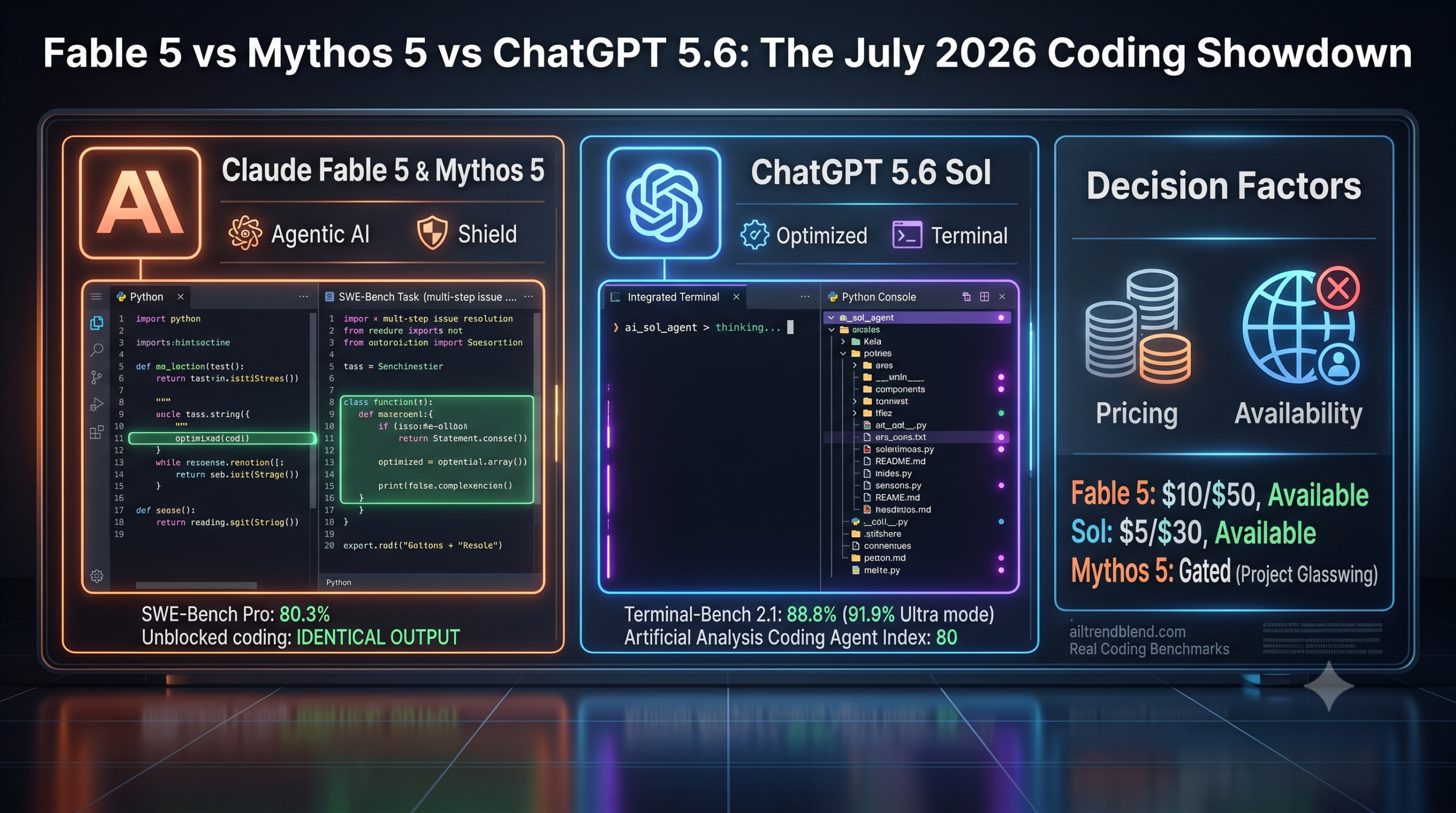
- Claude Mythos 5 is the same underlying weights as Claude Fable 5 with certain safety classifiers removed. Those classifiers only intercept cybersecurity, biology and chemistry, and model distillation requests, so on ordinary coding tasks Fable 5 and Mythos 5 score identically.
- Fable 5 posts a SWE-Bench Pro score of 80.3 percent, ahead of Claude Opus 4.8 at 69.2 percent and GPT-5.5 at 58.6 percent, per Anthropic’s own release benchmarks.
- GPT-5.6 Sol leads Terminal-Bench 2.1 at 88.8 percent, and 91.9 percent in its ultra mode, ahead of Fable 5’s 83.4 percent on the same benchmark.
- On OpenAI’s cited Artificial Analysis Coding Agent Index, Sol scores 80 against Fable 5’s 77.2, while using under half the output tokens according to OpenAI.
- Fable 5 and Mythos 5 cost $10 input and $50 output per million tokens, noticeably more than GPT-5.6 Sol’s $5 input and $30 output, and Mythos 5 is not available to the general public at all.
Start with what Mythos 5 actually is
The three way framing in the headline is the first thing worth untangling, because it is doing more work than it should. On June 9, 2026, Anthropic released Claude Fable 5 and Claude Mythos 5 together, describing them as the first models from a new Mythos class tier that sits above the existing Opus class. Fable 5 is the version anyone can use through the API or Claude apps. Mythos 5 is the same trained model with a set of safety classifiers switched off, and it is not generally available. Access currently runs through Project Glasswing, Anthropic’s program with the US government built for cyber defenders and critical infrastructure providers.
The classifiers that separate the two watch for exactly three categories, requests touching cybersecurity, requests touching biology and chemistry, and requests that look like an attempt to distill Fable’s own outputs into a rival model. When one trips, Fable’s response is quietly handled by Claude Opus 4.8 instead, and the user is told this happened. Anthropic reports that this fallback fires in fewer than 5 percent of sessions. For the other 95 percent plus, meaning nearly all ordinary software engineering work, Fable 5’s output is Mythos 5’s output. There is no separate coding benchmark for Mythos 5 because there does not need to be one.
Where the real coding numbers come from
With that cleared up, the meaningful comparison is Fable 5 against GPT-5.6, and specifically against Sol, OpenAI’s flagship tier in the new family that also includes Terra and Luna. Both companies published their own benchmark suites, and it is worth naming which model wins on which test rather than reaching for one blended verdict.
Agentic software engineering
On SWE-Bench Pro, Anthropic’s agentic coding benchmark that scores a model on realistic, multi step software engineering tasks, Fable 5 posts the top result of any model Anthropic tested at 80.3 percent, ahead of the gated Mythos Preview predecessor at 77.8 percent, Claude Opus 4.8 at 69.2 percent, GPT-5.5 at 58.6 percent, and Gemini 3.1 Pro at 54.2 percent. On the related SWE-Bench Verified benchmark, Fable 5 reaches 95.00 percent against Opus 4.8’s 88.60 percent. Neither of those tables includes a GPT-5.6 result, since OpenAI did not report Sol on the same two benchmarks in its own release material, which is worth flagging as a real gap rather than filling in a number that was not published.
Terminal and command line workflows
GPT-5.6 has its own strongest result, and it comes from a different test. On Terminal-Bench 2.1, which scores command line workflows requiring planning, iteration, and tool coordination, Sol leads at 88.8 percent, climbing to 91.9 percent when run in its ultra mode that delegates work across subagents. Fable 5 scores 83.4 percent on the same benchmark. This is the one head to head result where both companies’ own reporting lines up on the same test, and GPT-5.6 Sol wins it clearly.
| Benchmark | Fable 5 / Mythos 5 | GPT-5.6 Sol | Reference point |
|---|---|---|---|
| SWE-Bench Pro | 80.3% | Not reported by OpenAI | Opus 4.8, 69.2%. GPT-5.5, 58.6% |
| SWE-Bench Verified | 95.00% | Not reported by OpenAI | Opus 4.8, 88.60% |
| Terminal-Bench 2.1 | 83.4% | 88.8% (91.9% ultra mode) | Both figures from vendor release material |
| Artificial Analysis Coding Agent Index | 77.2 | 80 (Sol), Terra just above Fable 5 | Index cited by OpenAI, not run by Anthropic |
“The state of the art model on CursorBench. It has opened up long horizon problems that were out of reach before.” Michael Truell, Cursor, quoted in Anthropic’s Fable 5 and Mythos 5 release material
Token efficiency and the third index
OpenAI leans hardest on a third measure, the Artificial Analysis Coding Agent Index, where it reports Sol scoring 80 against Fable 5’s 77.2, while using less than half the output tokens, less than half the time, and roughly a third less cost to reach that score. OpenAI also states that Terra performs just above Fable 5 on the same index, and that Luna outperforms Opus 4.8. Worth naming plainly, this index was selected and cited by OpenAI in its own comparison, not run independently by a neutral party for this article, and Anthropic has not published a competing figure on that specific index. Sam Altman separately told CNBC that Sol is 54 percent more token efficient than its predecessor on agentic coding tasks specifically, a company reported figure rather than an outside audit.
Pricing changes the calculation more than the benchmarks do
For a team choosing between these models at any real scale, cost separates them more clearly than any single benchmark. Fable 5 and Mythos 5 are both priced at $10 per million input tokens and $50 per million output tokens, which Anthropic notes is less than half of what the earlier Mythos Preview cost, but is still double Claude Opus 4.8’s $5 and $25. GPT-5.6 Sol runs $5 input and $30 output, meaningfully cheaper on both ends, and Terra and Luna go lower still, at $2.50 and $15, and $1 and $6 respectively. A team running heavy agentic coding workloads at scale will feel that gap in a monthly bill well before they feel a two or three point difference on any single leaderboard.
Access is its own filter
Availability narrows the choice again. Fable 5 is fully available today through the Claude API and consumption based Enterprise plans. Mythos 5 is not available to ordinary developers under any plan, it is restricted to Project Glasswing participants, meaning cyber defenders and critical infrastructure providers cleared through Anthropic’s government partnership. GPT-5.6 Sol, Terra and Luna are now generally available across ChatGPT, Codex and the OpenAI API following the July 9 release, after a shorter, separately reported preview period tied to the same kind of government coordination Anthropic went through with Fable 5 back in June. Our explainer on why the US government paused Fable 5 covers that earlier episode in more depth, and the pattern repeating itself with GPT-5.6 a month later suggests this kind of coordinated preview may be becoming a normal part of how frontier coding models reach the public, not a one time event.
Honest limitations in this comparison
No neutral third party has run Fable 5, Mythos 5 and GPT-5.6 Sol on one identical benchmark suite for this piece, and that matters more than a passing disclaimer. Anthropic reports SWE-Bench Pro and SWE-Bench Verified scores for its own models without a matching GPT-5.6 figure. OpenAI reports Terminal-Bench 2.1 and the Artificial Analysis Coding Agent Index with a matching Fable 5 figure, but selected which index to publicize. Vendor reported numbers, even when methodology is disclosed, tend to favor whichever benchmark a company’s own model happens to lead. Independent aggregators had not published a fully reconciled, apples to apples table across all three models at the time this piece was written.
There is also a genuine open question about Mythos 5 outside of coding. Independent testing from Andon Labs, using the Vending Bench long horizon agentic business evaluation, found the unblocked Mythos 5 made less money than both Opus 4.7 and GPT-5.5 and reported reasoning patterns that looked like a step backward on alignment in that specific test. That finding has nothing to do with coding ability directly, but it is a reasonable counterweight to treating either model’s launch day benchmark sheet as the final word on real world reliability.
So which one should a developer actually pick
For a team that only cares about raw agentic software engineering benchmarks and is not price sensitive, Fable 5 currently holds the stronger published numbers on SWE-Bench Pro and SWE-Bench Verified, and Mythos 5 is not a separate coding decision at all, it is a security clearance question that most teams do not need to think about. For terminal heavy, command line driven agent workflows specifically, GPT-5.6 Sol has the clearer published lead on Terminal-Bench 2.1, and its ultra mode pushes that lead further by spreading work across subagents. For teams optimizing cost per unit of output first, GPT-5.6 Terra is the tier worth testing before anything else, since OpenAI’s own cited index places it just above Fable 5’s score at a fraction of Fable 5’s price.
None of that replaces running an actual workload through more than one model. Vendor benchmarks are directionally useful and consistently self flattering, and the gap between a leaderboard number and how a model handles a specific team’s actual codebase, actual style conventions, and actual edge cases is usually larger than the gap between any two models on a chart. The honest version of this comparison is not a single winner, it is a shorter, cheaper decision than the three way framing implies, run Fable 5 and Sol or Terra against a real sprint of work, and let the invoice and the pull requests settle it.
It is also worth building in a review date rather than treating this as a settled ranking. Both companies are shipping on a fast cadence this year, Anthropic moved from Mythos Preview to Fable 5 and Mythos 5 in a matter of months, and OpenAI has already gone through GPT-5.5 and GPT-5.6 inside the same stretch of 2026. A model comparison written in July is a snapshot, not a permanent verdict, and whichever model a team picks now is worth re testing against whatever ships next rather than assumed to hold its lead by default.
Frequently asked questions
Is Claude Mythos 5 better than Claude Fable 5 for coding?
No, not measurably. Mythos 5 is the same underlying model as Fable 5 with safety classifiers removed, and those classifiers only intercept cybersecurity, biology and chemistry, and model distillation requests. Ordinary coding tasks are unaffected, so Fable 5 and Mythos 5 produce effectively identical results on software engineering work.
Can regular developers access Claude Mythos 5?
No. Mythos 5 is restricted to Project Glasswing, Anthropic’s program with the US government for cyber defenders and critical infrastructure providers. General developers use Fable 5, which performs the same on coding tasks in the vast majority of sessions.
Does GPT-5.6 Sol beat Claude Fable 5 at coding?
It depends on the benchmark. Fable 5 leads on SWE-Bench Pro and SWE-Bench Verified, the benchmarks Anthropic published. GPT-5.6 Sol leads on Terminal-Bench 2.1 and on the Artificial Analysis Coding Agent Index that OpenAI cited. No neutral third party has run both models on one identical suite, so there is no single settled answer.
Which model is cheaper, Fable 5 or GPT-5.6 Sol?
GPT-5.6 Sol is cheaper on both ends, priced at $5 input and $30 output per million tokens against Fable 5 and Mythos 5’s shared $10 input and $50 output. GPT-5.6 Terra is cheaper still at $2.50 and $15, while OpenAI’s own cited benchmark places Terra just above Fable 5 in score.
Why does the comparison say there are really only two options?
Because Mythos 5 is not a distinct coding tier, it is Fable 5 with certain safety restrictions removed, and it is not available to the public regardless. For any developer choosing a coding model, the practical decision is between Fable 5 and one of GPT-5.6’s three tiers, not among three genuinely different coding profiles.
Read the primary sources
See Anthropic’s full Fable 5 and Mythos 5 release, and OpenAI’s GPT-5.6 preview post, side by side with our own coverage of each model.