Adnan Saeed

Adnan Saeed is a deep learning researcher working on medical image analysis, with a focus on multimodal architectures, graph neural networks, and evidential deep learning for clinical imaging tasks. His peer reviewed research has appeared in journals across machine learning and biomedical signal processing. At AI Trend Blend he turns recent papers into clear, practical explainers, with an emphasis on what a method actually does and where it holds up, written for readers who want depth without the hype.

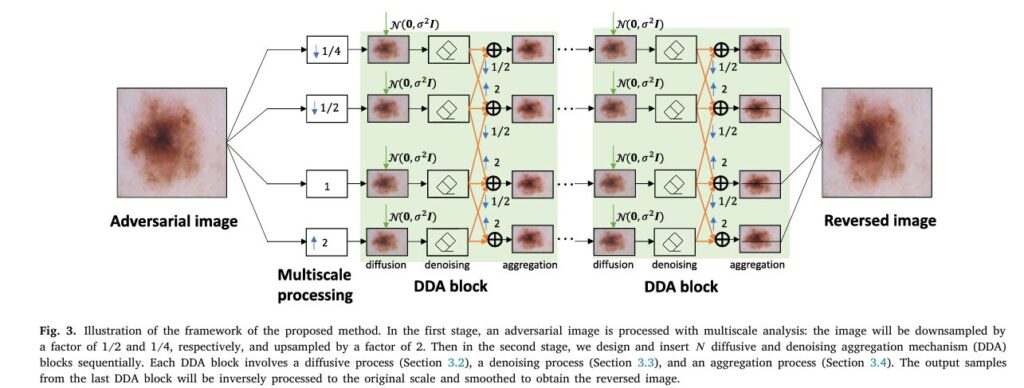
Illustration of the framework of the proposed method. In the first stage, an adversarial image is processed with multiscale analysis: the image will be downsampled by a factor of 1/2 and 1/4, respectively, and upsampled by a factor of 2. Then in the second stage, we design and insert 𝑁 diffusive and denoising aggregation mechanism (DDA) blocks sequentially. Each DDA block involves a diffusive process (Section 3.2), a denoising process (Section 3.3), and an aggregation process (Section 3.4). The output samples from the last DDA block will be inversely processed to the original scale and smoothed to obtain the reversed image.

Reversing Adversarial Attacks on Skin Cancer AI With Multiscale Noise

Skin cancer screening was one of the first places deep learning actually earned its hype. A 2017 Nature paper by Esteva and colleagues showed a convolutional network matching board certified dermatologists at distinguishing benign moles from malignant ones, and the…

Reversing Adversarial Attacks on Skin Cancer AI With Multiscale Noise Read More »

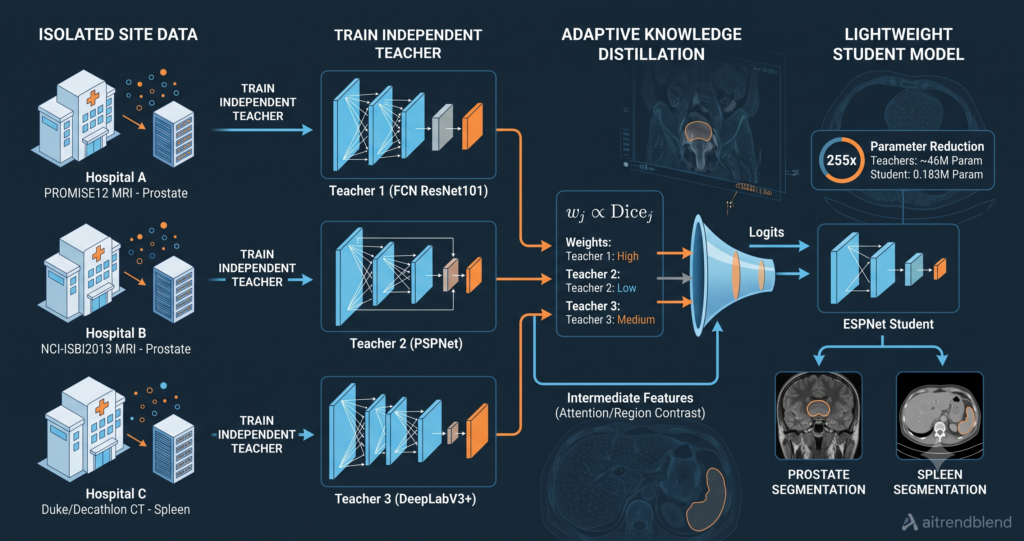
How Adaptive Multi-Teacher Knowledge Distillation Enables Lightweight Medical Segmentation with Limited Site Data.

How Adaptive Multi-Teacher Knowledge Distillation Enables Lightweight Medical Segmentation with Limited Site Data

A model trained to segment the prostate in MRI scans from one institution routinely fails when presented with scans from another hospital that uses a different scanner, a different field strength, or a different slice thickness. This is not a…

How Adaptive Multi-Teacher Knowledge Distillation Enables Lightweight Medical Segmentation with Limited Site Data Read More »