Federated Learning & AI Privacy

Federated learning, differential privacy, and privacy-preserving machine learning. We cover how models train across devices and institutions without centralizing data, what privacy guarantees actually cost in accuracy, and the benchmarks and frameworks shaping the field, always traced back to the original research.

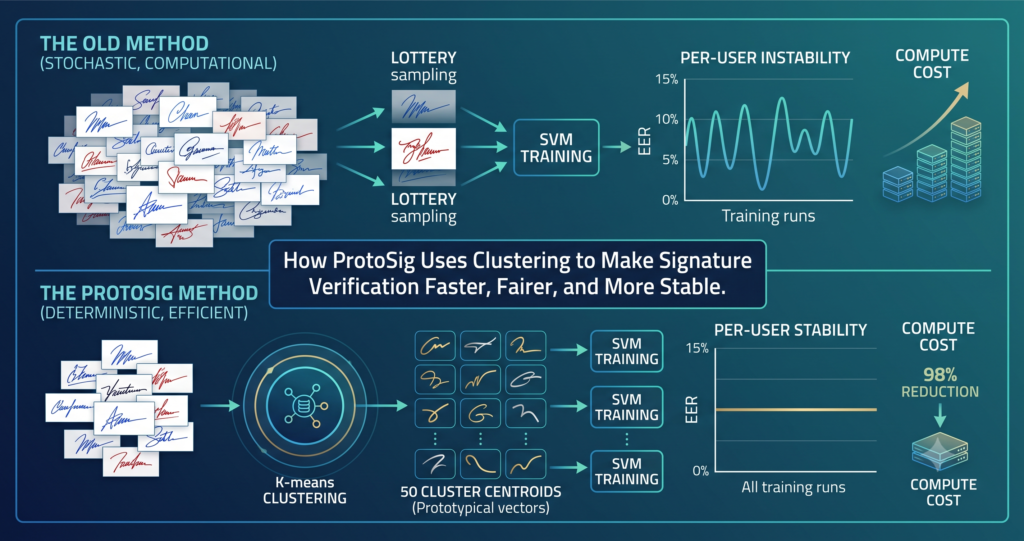
How ProtoSig Uses Clustering to Make Signature Verification Faster, Fairer, and More Stable.

How ProtoSig Uses Clustering to Make Signature Verification Faster, Fairer, and More Stable

ProtoSig replaces thousands of random forgeries with 50 clustered prototype signatures, cutting training compute by over 98% while matching verification accuracy — and making signature verification fairer and more stable.
How ProtoSig Uses Clustering to Make Signature Verification Faster, Fairer, and More Stable Read More »

Mean Aggregator Beats Robust Aggregators Under Label Poisoning Attacks on Heterogeneous Data.

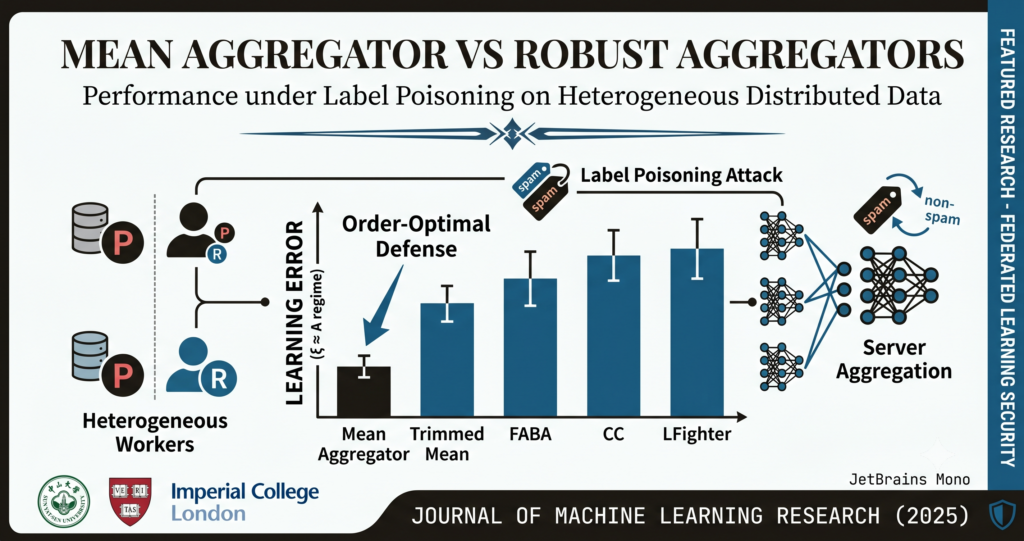
Mean Aggregator Beats Robust Aggregators Under Label Poisoning Attacks on Heterogeneous Data

A team from Sun Yat-Sen University, Harvard, and Imperial College London has flipped the conventional wisdom of Byzantine-robust distributed learning: when attacks are confined to label poisoning and data is heterogeneous enough, the plain old mean aggregator outperforms — and…

Mean Aggregator Beats Robust Aggregators Under Label Poisoning Attacks on Heterogeneous Data Read More »

The Blessing of Heterogeneity in Federated Q-Learning: Linear Speedup and Beyond.

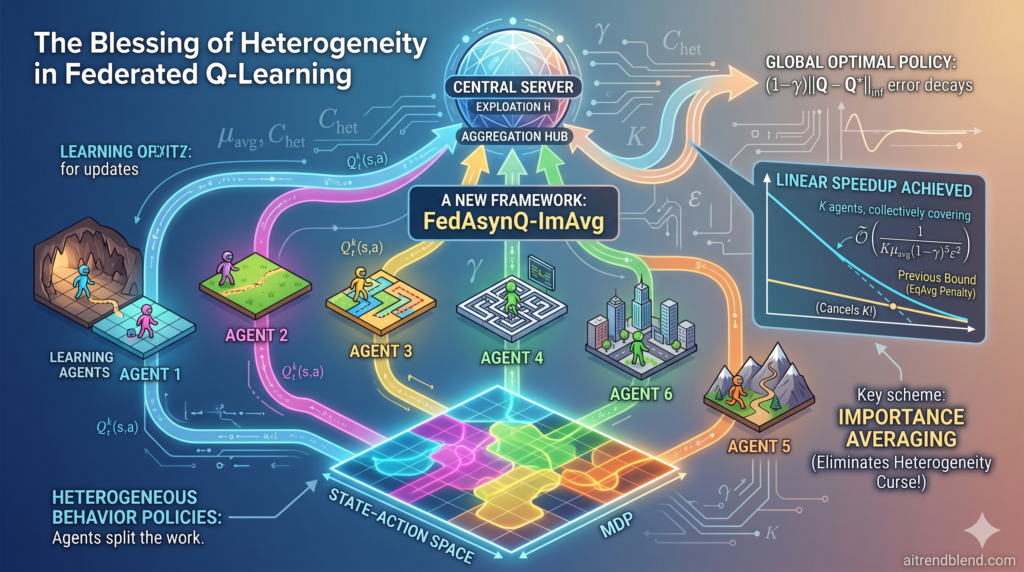
The Blessing of Heterogeneity in Federated Q-Learning: Linear Speedup and Beyond

A team from Carnegie Mellon University flipped conventional wisdom on its head — proving that agents with different behavior policies don’t just tolerate each other’s differences, they actively benefit from them. And a novel importance-averaging scheme eliminates the last remaining…

The Blessing of Heterogeneity in Federated Q-Learning: Linear Speedup and Beyond Read More »

Dist-SI: Selective Inference with Distributed Data via Randomized Lasso.

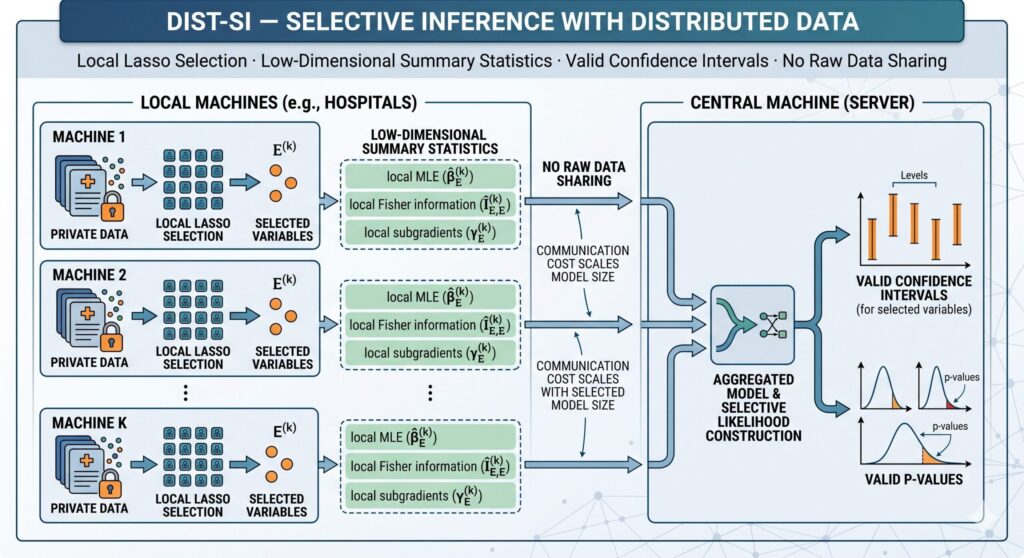
Dist-SI: Selective Inference with Distributed Data via Randomized Lasso

Sifan Liu (Stanford) and Snigdha Panigrahi (University of Michigan) introduce Dist-SI — a procedure that lets distributed machines run lasso independently, share only tiny summary statistics with a central server, and still produce valid confidence intervals and p-values as if…

Dist-SI: Selective Inference with Distributed Data via Randomized Lasso Read More »

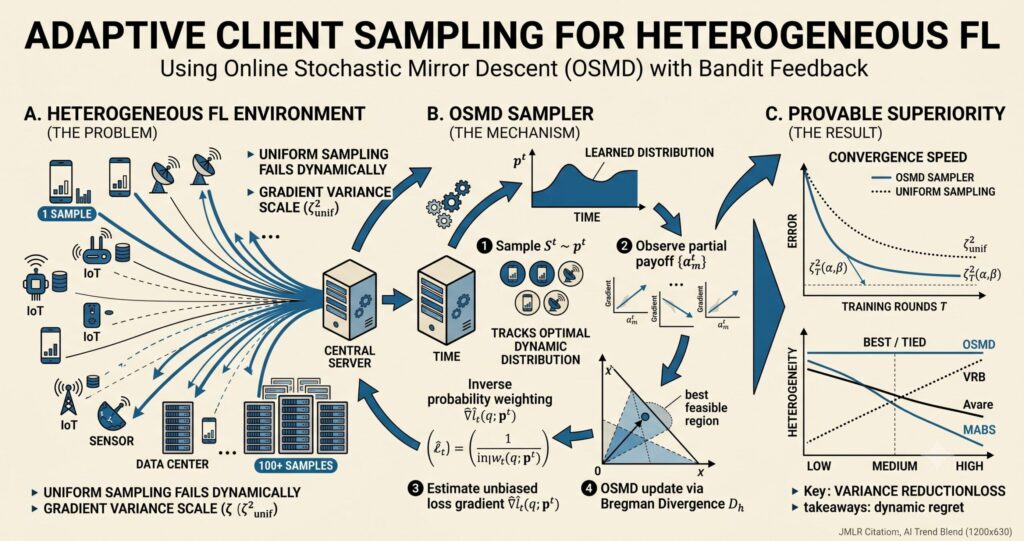
Adaptive Client Sampling in Federated Learning via Online Learning with Bandit Feedback.

Adaptive Client Sampling in Federated Learning via Online Learning with Bandit Feedback

A multi-institution team from the University of Chicago, NJIT, Ant Financial, Zhejiang University, and USC cast client selection as a non-stationary online learning problem — and built an adaptive sampler that provably beats uniform sampling by reducing the gradient variance…

Adaptive Client Sampling in Federated Learning via Online Learning with Bandit Feedback Read More »

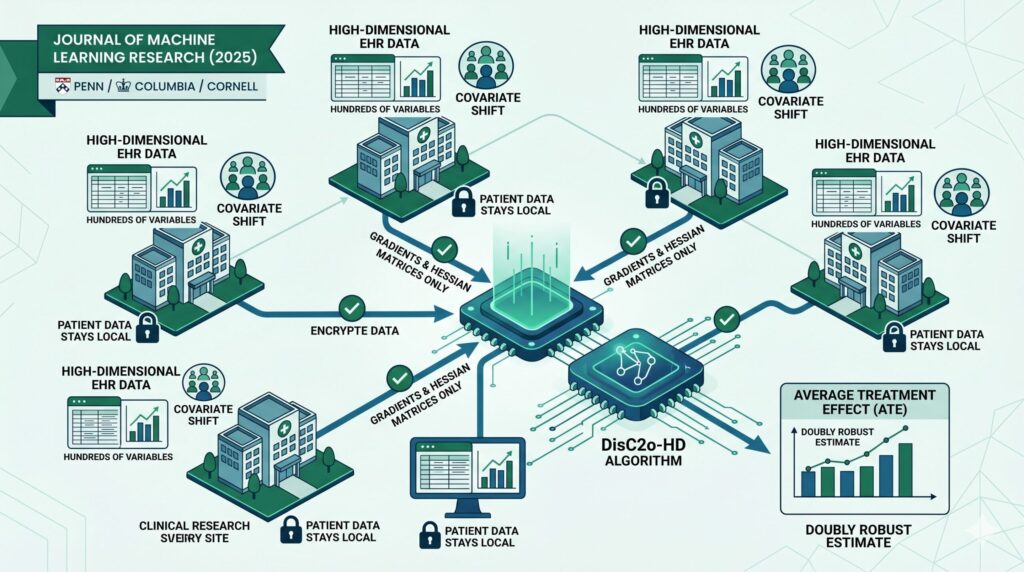
DisC2o-HD: Distributed Causal Inference with Covariate Shift for High-Dimensional Healthcare Data.

DisC2o-HD: Distributed Causal Inference with Covariate Shift for High-Dimensional Healthcare Data

A team from the University of Pennsylvania, Columbia University, and Cornell University has built a distributed algorithm that estimates causal treatment effects from high-dimensional electronic health records spread across multiple clinical sites — without ever sharing a single patient record…

DisC2o-HD: Distributed Causal Inference with Covariate Shift for High-Dimensional Healthcare Data Read More »

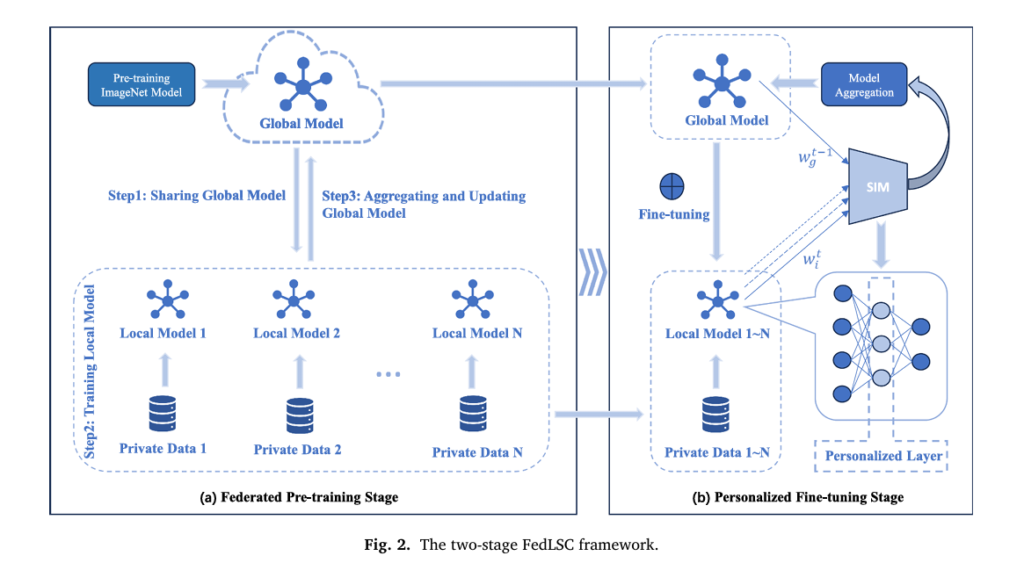
FedLSC: Federated Learning with Layer Similarity Comparison for Skin Cancer.

FedLSC: Federated Learning with Layer Similarity Comparison for Skin Cancer

Researchers at Southwest University built a two-stage federated learning framework that measures how similar different hospitals’ model updates are — layer by layer — then uses that similarity to allocate smarter aggregation weights and automatically pick which layers to keep…

FedLSC: Federated Learning with Layer Similarity Comparison for Skin Cancer Read More »