Graph Neural Networks

Research explainers on graph neural networks — GCNs, GATs, message passing, and graph-based representation learning.

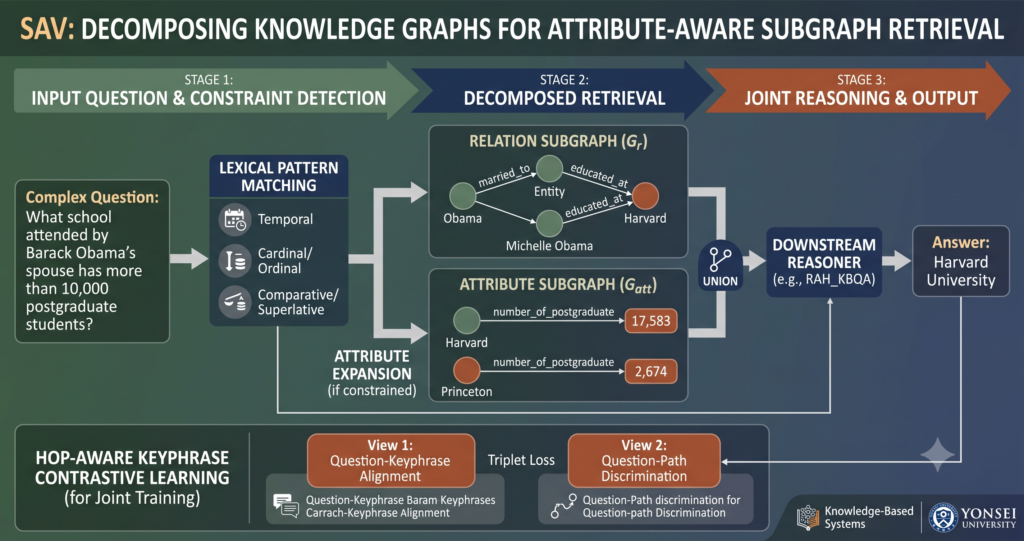
How SAV Adds Literal-Valued Attributes to Knowledge Graph Subgraph Retrieval for Complex Question Answering.

How SAV Adds Literal-Valued Attributes to Knowledge Graph Subgraph Retrieval for Complex Question Answering

Knowledge graph question answering systems typically ask a question, find the relevant topic entity in the graph, expand outward through entity-to-entity relations, and then hand the resulting subgraph to a reasoning module that identifies the answer. That pipeline works well…

How SAV Adds Literal-Valued Attributes to Knowledge Graph Subgraph Retrieval for Complex Question Answering Read More »

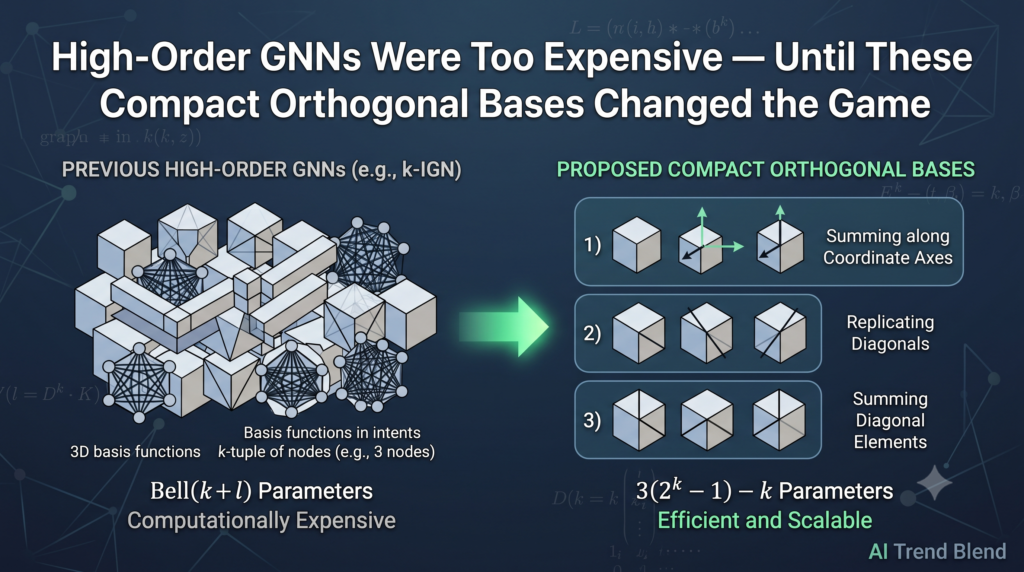
Orthogonal Bases for Equivariant Graph Learning with Provable k-WL Expressive Power.

Orthogonal Bases for Equivariant Graph Learning with Provable k-WL Expressive Power

Orthogonal Bases for Equivariant Graph Learning with Provable k-WL Expressive Power | AI Trend Blend Jia He and Maggie X. Cheng from Illinois Institute of Technology have found a way to build GNNs with the same k-WL and k-FWL expressive…

Orthogonal Bases for Equivariant Graph Learning with Provable k-WL Expressive Power Read More »

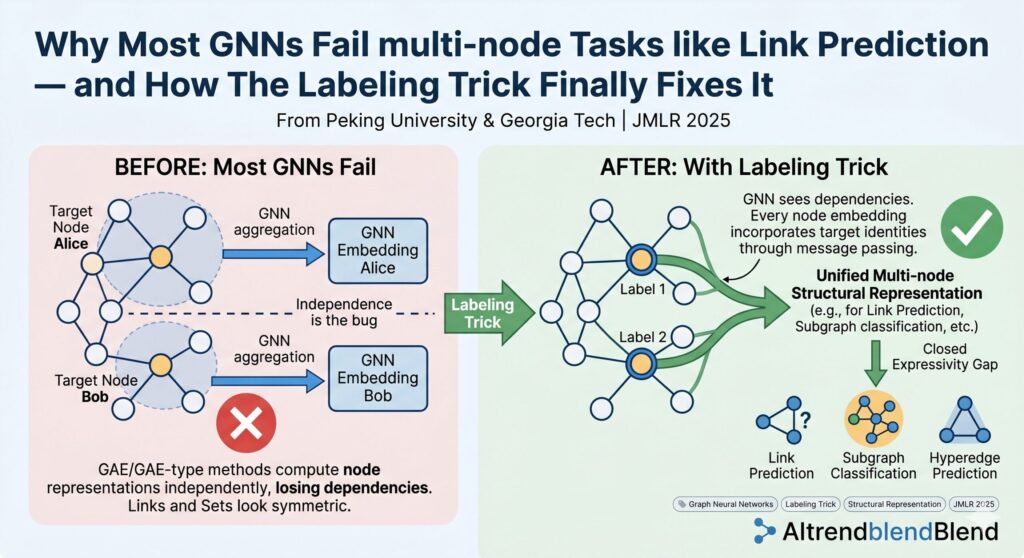
Improving Graph Neural Networks on Multi-node Tasks with the Labeling Trick

Improving Graph Neural Networks on Multi-node Tasks with the Labeling Trick

Improving Graph Neural Networks on Multi-node Tasks with the Labeling Trick | AI Trend Blend A team from Peking University and Georgia Tech has built a formal theory explaining why the most widely used GNN approach to multi-node tasks breaks…

Improving Graph Neural Networks on Multi-node Tasks with the Labeling Trick Read More »

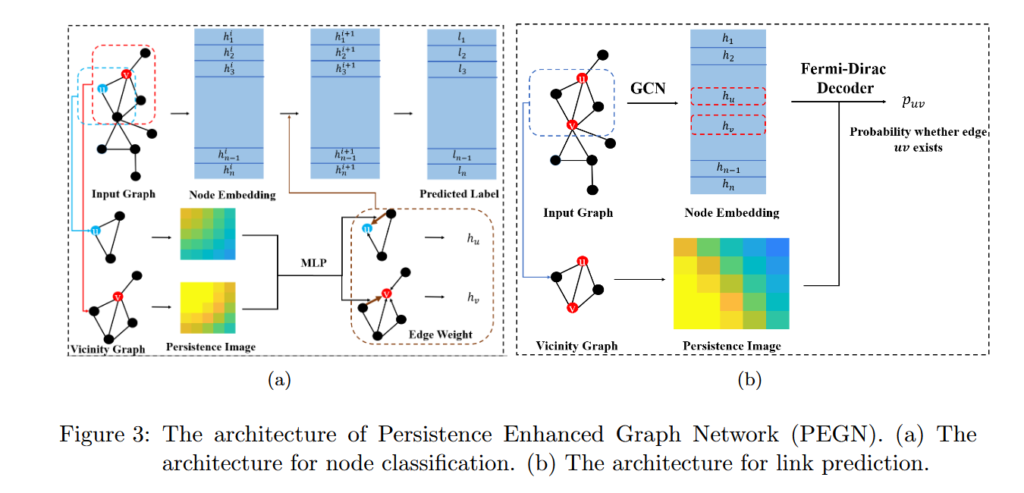
PEGN: How Persistent Homology Breaks the WL Barrier in Graph Neural Networks.

PEGN: How Persistent Homology Breaks the WL Barrier in Graph Neural Networks

PEGN: How Persistent Homology Breaks the WL Barrier in Graph Neural Networks | AI Trend Blend A multi-institution team spanning Peking University, UC San Diego, Stony Brook University, and Weill Cornell Medicine built PEGN — a framework that injects localized…

PEGN: How Persistent Homology Breaks the WL Barrier in Graph Neural Networks Read More »