Medical AI

Medical AI brings together our reporting on machine learning for clinical and biomedical problems, from diagnosis and prognosis to medical image analysis and decision support. Because mistakes in this domain carry a human cost, we pay close attention to evaluation, calibration, uncertainty, and the gap between benchmark numbers and bedside reliability. Expect grounded explainers of recent research rather than uncritical product announcements.

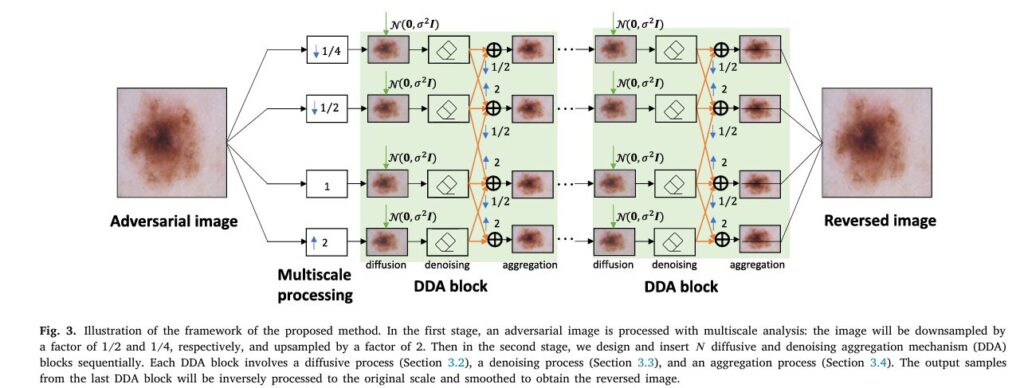
Illustration of the framework of the proposed method. In the first stage, an adversarial image is processed with multiscale analysis: the image will be downsampled by a factor of 1/2 and 1/4, respectively, and upsampled by a factor of 2. Then in the second stage, we design and insert 𝑁 diffusive and denoising aggregation mechanism (DDA) blocks sequentially. Each DDA block involves a diffusive process (Section 3.2), a denoising process (Section 3.3), and an aggregation process (Section 3.4). The output samples from the last DDA block will be inversely processed to the original scale and smoothed to obtain the reversed image.

Reversing Adversarial Attacks on Skin Cancer AI With Multiscale Noise

Skin cancer screening was one of the first places deep learning actually earned its hype. A 2017 Nature paper by Esteva and colleagues showed a convolutional network matching board certified dermatologists at distinguishing benign moles from malignant ones, and the…

Reversing Adversarial Attacks on Skin Cancer AI With Multiscale Noise Read More »