Adnan Saeed

Adnan Saeed is a deep learning researcher working on medical image analysis, with a focus on multimodal architectures, graph neural networks, and evidential deep learning for clinical imaging tasks. His peer reviewed research has appeared in journals across machine learning and biomedical signal processing. At AI Trend Blend he turns recent papers into clear, practical explainers, with an emphasis on what a method actually does and where it holds up, written for readers who want depth without the hype.

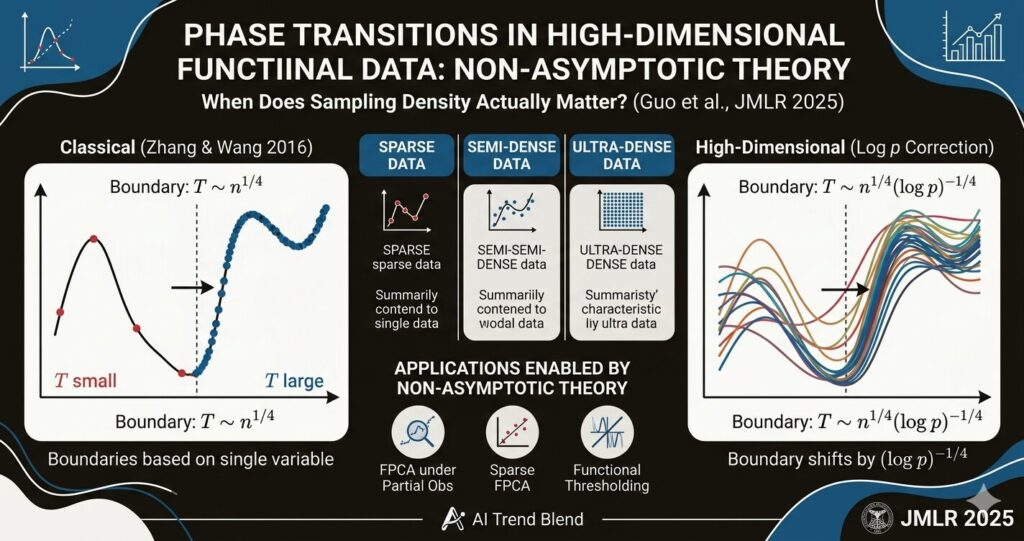
From Sparse to Dense Functional Data in High Dimensions: Phase Transitions Revisited.

From Sparse to Dense Functional Data in High Dimensions: Phase Transitions Revisited

A team from Renmin University of China, Tsinghua University, and the University of Hong Kong proved that the classical sparse-to-dense transition in functional data analysis shifts when the number of functional variables grows large — and derived the exact non-asymptotic…

From Sparse to Dense Functional Data in High Dimensions: Phase Transitions Revisited Read More »
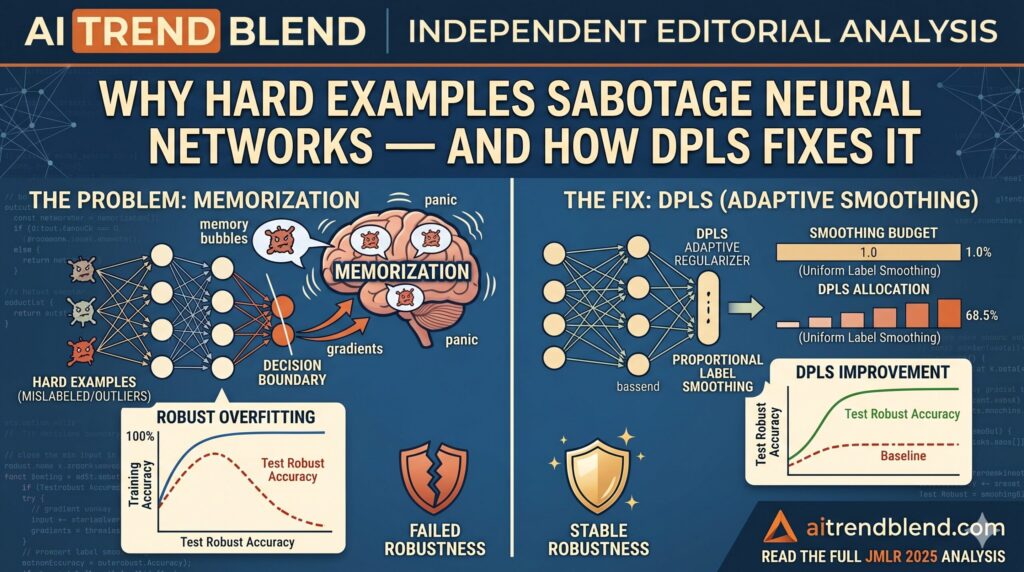
Why Hard Training Examples Hurt Neural Networks — And How DPLS Fixes It.

Why Hard Training Examples Hurt Neural Networks — And How DPLS Fixes It

A team from Seoul National University and Ewha Womans University pinpointed a root cause of robust overfitting — the model memorizes tricky outliers during adversarial training rather than learning from them. Their remedy, difficulty proportional label smoothing, costs almost nothing…

Why Hard Training Examples Hurt Neural Networks — And How DPLS Fixes It Read More »

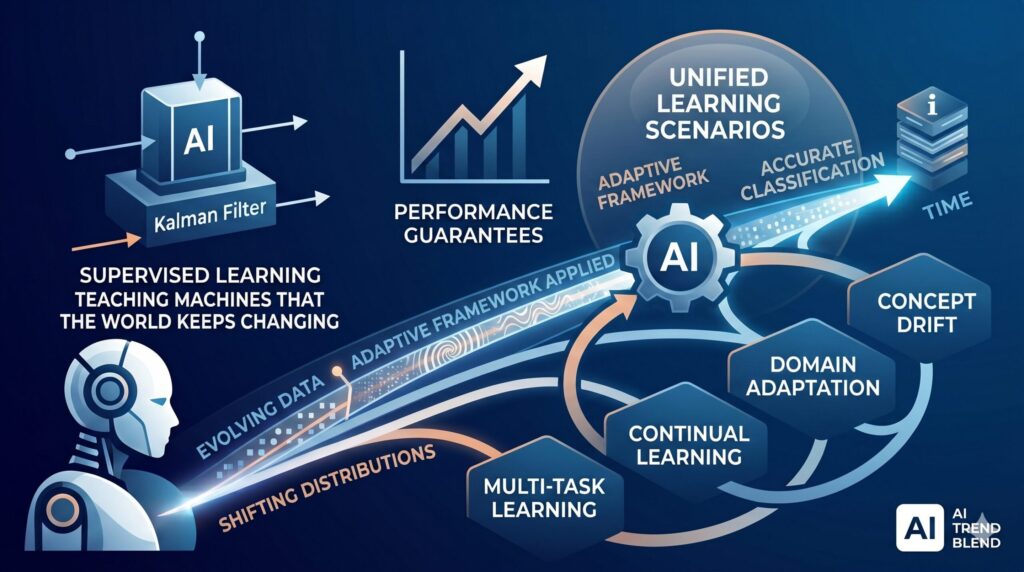
Teaching Machines That the World Keeps Changing: Supervised Learning with Evolving Tasks and Performance Guarantees

Teaching Machines That the World Keeps Changing: Supervised Learning with Evolving Tasks and Performance Guarantees

Verónica Álvarez, Santiago Mazuelas, and Jose A. Lozano show that a single Kalman-filter-based methodology can unify multi-task learning, continual learning, domain adaptation, and concept drift — while being the first to provide computable, tight error-probability guarantees and a closed-form characterization…

Teaching Machines That the World Keeps Changing: Supervised Learning with Evolving Tasks and Performance Guarantees Read More »

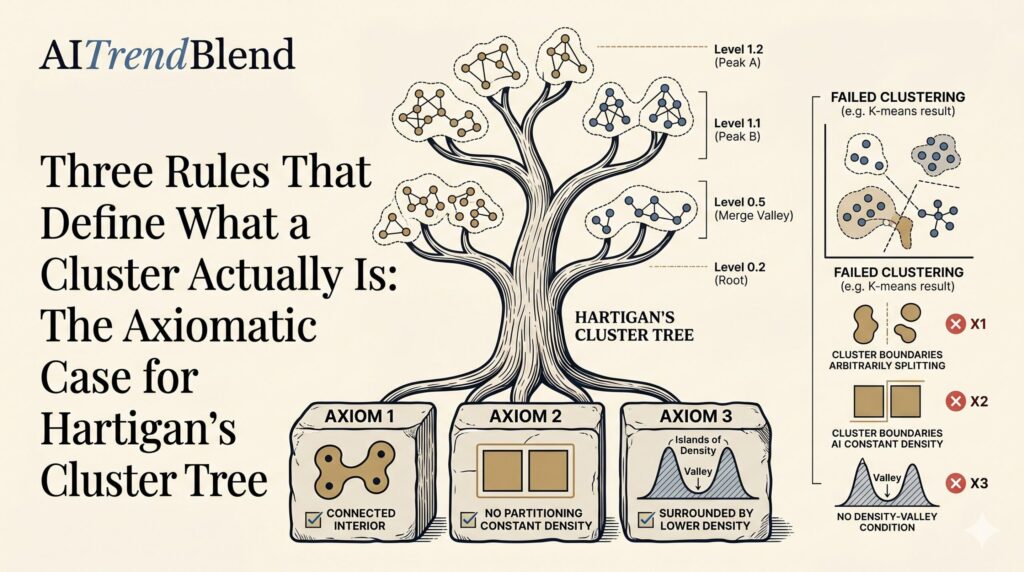
An Axiomatic Definition of Hierarchical Clustering: Why Hartigan Was Right All Along.

An Axiomatic Definition of Hierarchical Clustering: Why Hartigan Was Right All Along

Ery Arias-Castro and Elizabeth Coda from UC San Diego take an approach inspired by Lebesgue integration — starting from first principles — to show that three intuitive axioms about what a cluster ought to be uniquely recover Hartigan’s cluster tree,…

An Axiomatic Definition of Hierarchical Clustering: Why Hartigan Was Right All Along Read More »

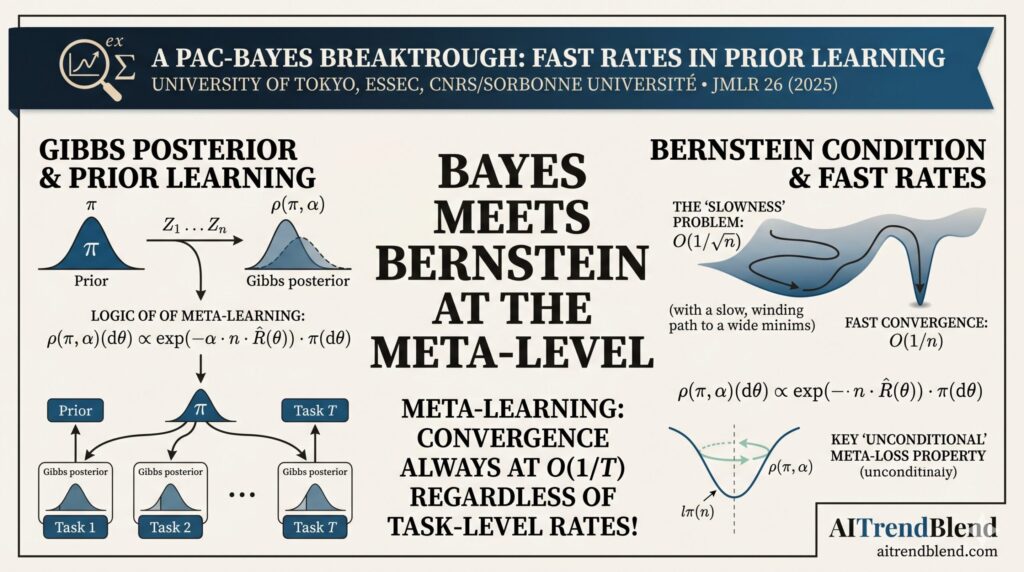
Bayes Meets Bernstein: Why Meta-Learning Finally Gets Fast — A PAC-Bayes Breakthrough.

Bayes Meets Bernstein: Why Meta-Learning Finally Gets Fast — A PAC-Bayes Breakthrough

A research team from three leading institutions has proven something nobody expected: when learning a prior across many tasks using the Gibbs algorithm, fast convergence rates are always guaranteed at the meta level — even when individual tasks refuse to…

Bayes Meets Bernstein: Why Meta-Learning Finally Gets Fast — A PAC-Bayes Breakthrough Read More »

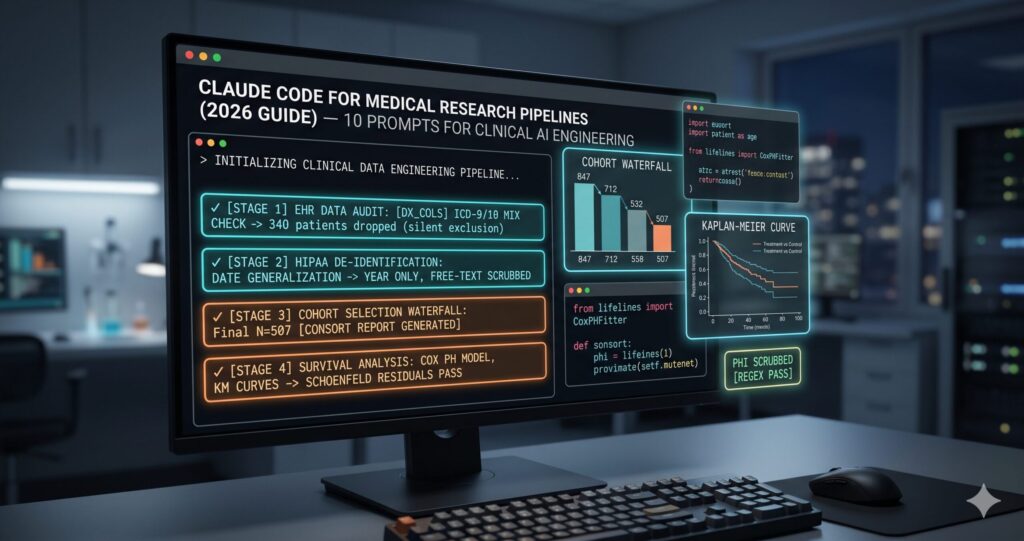
Claude Code for Medical Research Pipelines (2026 Guide) — 10 Prompts for Clinical AI Engineering.

Claude Code for Medical Research Pipelines (2026 Guide) — 10 Prompts for Clinical AI Engineering

Clinical data is unlike any other data an engineer works with. It arrives from systems designed for billing and care coordination, not analysis — which means inconsistent coding schemes, free-text fields where structured data should live, observation timestamps that reflect…

Claude Code for Medical Research Pipelines (2026 Guide) — 10 Prompts for Clinical AI Engineering Read More »

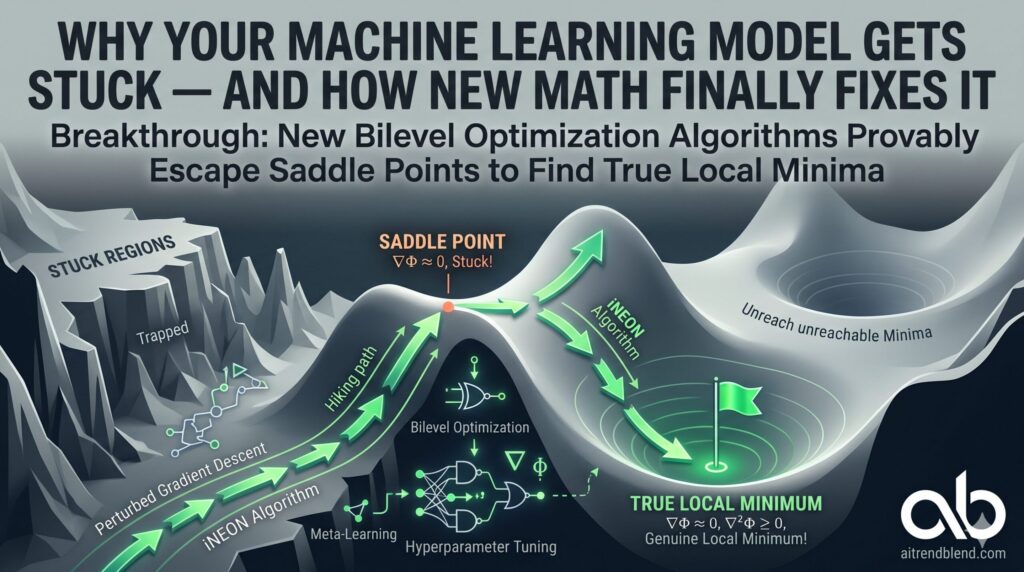
Escaping Saddle Points in Bilevel Optimization — A Breakthrough in Machine Learning Theory.

Escaping Saddle Points in Bilevel Optimization — A Breakthrough in Machine Learning Theory

A research team from three major U.S. universities has proven for the first time that bilevel optimization algorithms can reliably escape saddle points and find true local minima — solving a problem that has quietly undermined meta-learning, hyperparameter tuning, and…

Escaping Saddle Points in Bilevel Optimization — A Breakthrough in Machine Learning Theory Read More »

Liquid Biopsy and AI: Multi-Cancer Early Detection — 10 Claude Code Prompts (2026 Guide).

Liquid Biopsy and AI: Multi-Cancer Early Detection — 10 Claude Code Prompts (2026 Guide)

Liquid biopsy for multi-cancer early detection is one of the most consequential diagnostic innovations of the past decade — and one of the most computationally demanding. The signal you’re looking for is vanishingly small: at Stage I, circulating tumour DNA…

Liquid Biopsy and AI: Multi-Cancer Early Detection — 10 Claude Code Prompts (2026 Guide) Read More »

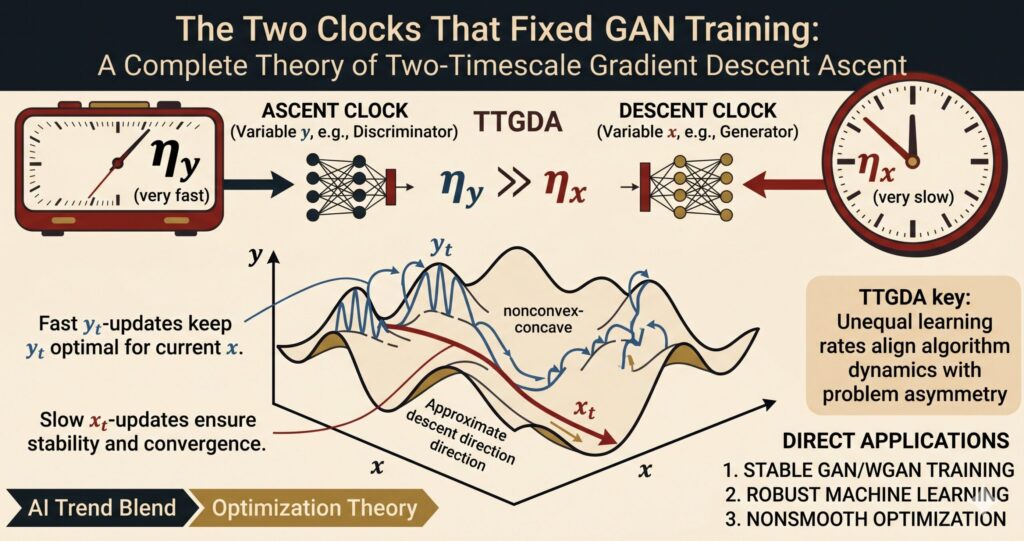
TTGDA: Two-Timescale Gradient Descent Ascent for Nonconvex Minimax Optimization.

TTGDA: Two-Timescale Gradient Descent Ascent for Nonconvex Minimax Optimization

Tianyi Lin, Chi Jin, and Michael I. Jordan from Columbia, Princeton, and UC Berkeley deliver the first rigorous nonasymptotic analysis of two-timescale gradient descent ascent — the algorithm that has powered GAN training in practice for years — establishing tight…

TTGDA: Two-Timescale Gradient Descent Ascent for Nonconvex Minimax Optimization Read More »

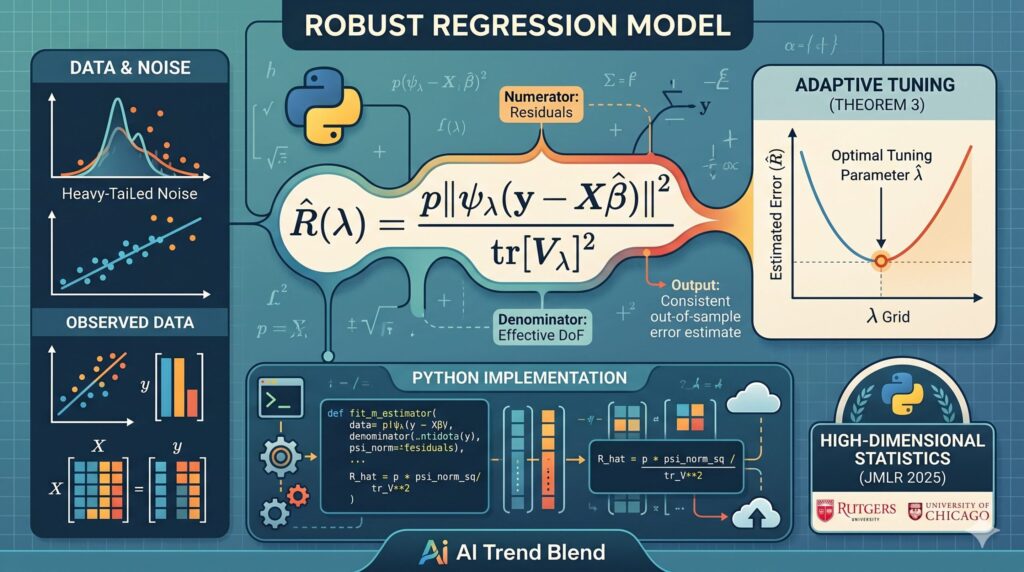
How to Tune a Robust Regression Model Without Knowing the Noise: Adaptive Error Estimation for Unregularized M-Estimators.

How to Tune a Robust Regression Model Without Knowing the Noise: Adaptive Error Estimation for Unregularized M-Estimators

Pierre C. Bellec (Rutgers) and Takuya Koriyama (Chicago Booth) prove that a simple, fully observable formula consistently estimates the prediction error of any Huber-class M-estimator in high dimensions — and that minimizing it over a grid of scale parameters automatically…

How to Tune a Robust Regression Model Without Knowing the Noise: Adaptive Error Estimation for Unregularized M-Estimators Read More »