
Analysis by the aitrendblend editorial team · Game Dev · Updated 11 October 2026
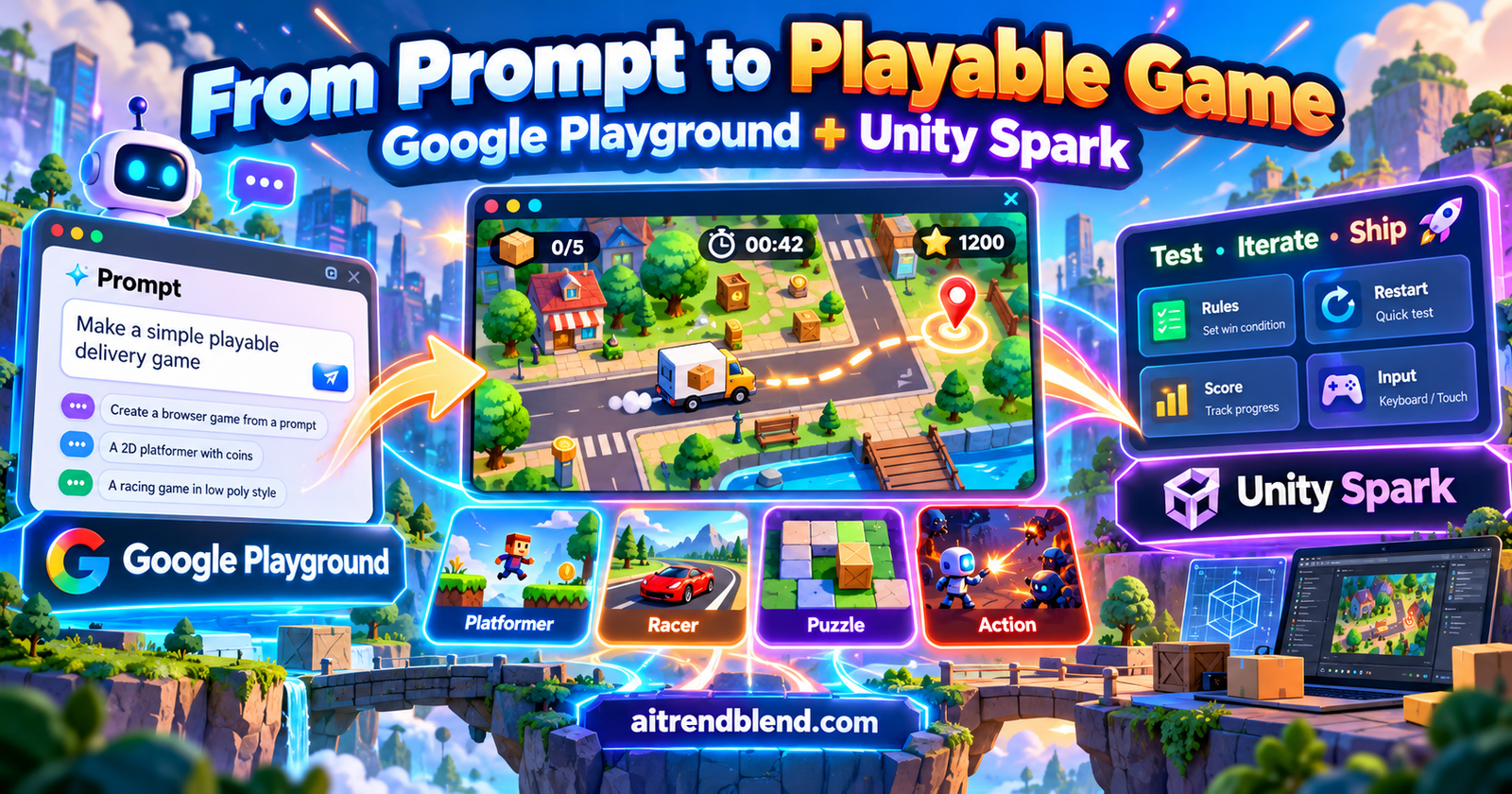
You ask an AI tool to build a tiny delivery game. A character moves, parcels appear, and a score climbs. Then you press restart and discover that the previous score survived. The first generation looked convincing. The second session exposed the actual work.
That is the useful lens for the latest conversation around Google Playground and Unity Spark. Their arrival makes this a good moment to ask how a developer should judge a generated game, beyond whether its first minute looks impressive.
What has actually been announced
Google introduced Playground on 7 October 2026. Its official announcement describes browser based game creation through natural language, with private projects, sharing, and community publishing. The initial rollout is for adults in the United States. Creation access is tiered by Google AI subscription. This launch statement does not establish availability in Pakistan or worldwide.
In its partnership announcement, Unity describes Spark as an expanded creation experience planned for later in 2026, with more advanced mechanics, 3D capabilities, and the Unity runtime. The current Spark page still displays Coming Soon and a waitlist. Treat the examples on that page as demonstrations, not proof that general creator access is open.
These are first party product sources checked on 11 October. This article is an editorial assessment and a suggested evaluation workflow. It is not a hands on review, a measured comparison, or a claim that either product has passed the tests below. No public model architecture or reproducible training recipe is established by these sources.
“Prompt it. Perfect it. Publish it.”
Unity Spark product page
The middle verb deserves the most attention. Generating an initial version is a milestone, but the design becomes yours through the changes you make and the faults you choose to fix. A creation system should be evaluated on that entire process.
Why this topic belongs beside the existing Game Dev guides
The Game Dev archive already covers individual production tasks, including character art, animation, scene capture, and trailers. The AI tools overview provides a broader starting point. This article asks a narrower question. How do you decide whether a generated playable prototype is dependable enough for your next stage?
That question also fits the Practical AI Tools pillar. A tool earns its place when it helps someone make a better decision or finish a task. For a solo developer, a rough playable idea can reveal whether a mechanic deserves another weekend. For a small team, it can make a design conversation concrete before anyone commissions finished assets.
Consider two possible experiments. One asks whether a slow character creates satisfying tension. Another asks whether collecting optional parcels makes the route more interesting. Those experiments need understandable rules and a repeatable setup. They do not need a cinematic opening, an elaborate inventory, or a permanent account system.
The practical opportunity is a shorter distance between a design question and evidence from play. The practical danger is mistaking the quantity of generated features for progress toward answering that question. A prototype with fewer features can teach you more if its behavior is easier to interpret.
Playground and Spark at a glance
| Question | Playground | Unity Spark |
|---|---|---|
| Position in the announcement | Experimental game creation platform | Planned expanded creation experience |
| Access evidence | Initial adult US rollout | Coming Soon page and waitlist |
| Developer evaluation task | Check whether a small playable idea survives revisions | Reassess control and workflow when creator access is available |
| Evidence missing here | Independent reliability and production speed measurements | Independent reliability and production speed measurements |
Read the comparison as a guide to evidence, not a ranking. There is no defensible winner when the evaluation conditions differ and no shared benchmark has been run. An announcement tells you what the company intends to offer. A demonstration shows a selected result. A repeatable trial shows what happened under specified conditions. Keep those categories separate in your own notes.
Begin with a game contract
Before opening a creation interface, write a compact agreement about how the game should behave. Call it a game contract if that makes it easier to remember. It is simply a list of rules that a person can check by playing. The contract should identify the player action, the source of difficulty, the reward, the ending, and the reset behavior.
For an original delivery game, the player might carry one parcel at a time across a small courtyard. Taking a longer route avoids an obstacle but consumes more time. Completing a delivery raises the score. The interesting question is whether the route choice creates a small but satisfying tradeoff. Every proposed feature should serve that question.
This framing gives your prompts a purpose. Instead of asking for a better game, ask for a particular rule and explain how success will be observed. If a change makes the movement feel better but breaks parcel collection, it has not satisfied the contract. Keep the improvement only after the broken rule is restored.
A first prompt you can adapt
Create an original small delivery game viewed from above. Use simple geometric shapes. The player moves around one courtyard, collects one parcel, and carries it to a marked destination. Award one point for each completed delivery. Show the score and remaining time clearly. End the round when time runs out. Restart must clear the score and restore the initial player position. Begin with movement, delivery, scoring, and restart only. Explain anything you cannot implement.
This is an editorial prompt template, not a prompt tested in Playground or Spark. Its value is that it narrows the interpretation space. It says what counts as a delivery and what restart means. You can replace the setting and mechanics while preserving that level of precision. Avoid a long list of cosmetic instructions until you know that the underlying loop works.
Change one rule and keep a baseline
Once the first version is playable, save a baseline using whatever preservation features the tool actually provides. If project export or version history is unavailable, keep the prompt text, a short recording, and a written description of the accepted behavior. Those records do not replace an editable project, but they preserve the design decisions you would otherwise have to reconstruct.
Request one meaningful revision at a time. For example, reduce movement speed while leaving scoring, round length, and parcel placement unchanged. Play again and check those supposedly unchanged rules. This turns iteration into a comparison you can understand. If you alter movement, camera, objectives, and art together, it becomes difficult to identify the source of an improvement or a failure.
A compact change log can contain the request, the expected effect, the observed result, and the decision to keep or reject it. Write the observed result before asking for another revision. Otherwise the conversation becomes a sequence of intentions with no reliable record of what the playable project actually does.
A revision prompt with a boundary
Change only the player movement so that releasing a movement key stops the character immediately. Preserve the scoring rule, round ending, parcel collection, destination, and restart behavior. After the change, describe which parts were modified and which still need checking through play.
The requested explanation is useful, but it is still a claim from the creation system. Confirm it through the game. A tool may describe the intended edit more clearly than the actual result. When the explanation and behavior differ, write down the behavior. That record is the basis for the next debugging request.
Test the moments between normal actions
A game can appear correct when you follow the expected route and fail when you combine ordinary actions in an unexpected order. Finish a delivery as the round ends. Restart while holding a movement key. Walk into the same parcel twice. Lose browser focus and return. These small transitions reveal more than another minute of smooth, uninterrupted movement.
For the delivery example, decide in advance what happens when delivery and timeout occur together. Either ordering can be a design choice, but it must be consistent and visible. If the score sometimes increases after the results screen appears, you need to determine whether that is the intended rule or a defect. Vague intentions cannot answer that question.
| Action | Expected observation | Why it matters |
|---|---|---|
| Collect the same parcel again | No extra parcel enters the inventory | Prevents duplicate rewards |
| Deliver with empty inventory | Score remains unchanged | Checks the reward condition |
| Try delivering after timeout | Score remains fixed | Checks the terminal state |
| Restart after earning points | Score, timer, inventory, and position reset | Checks the next session |
| Release a movement input | Movement follows the specified stopping rule | Checks control consistency |
| Return after focus loss | The chosen pause or resume policy is respected | Checks interruption handling |
These are proposed checks, not reported defects in either product. Adapt the expected observations to your design. A racing game needs different boundaries from a puzzle game, but both benefit from explicitly defining what happens when play pauses, ends, or restarts. The habit transfers even when the implementation tool changes.
Measure accepted progress instead of generation speed
A fast first result can hide a slow revision process. Record the time spent writing requests, waiting, playing, investigating failures, and repeating checks. You do not need a complicated analytics system. A simple session log is enough to distinguish time spent creating something useful from time spent repairing an accidental change.
The following accounting identity is an editorial planning aid. It is not a model loss function, a published benchmark, or an estimate of either product. Use your own measured times for each term.
Define accepted before starting the clock. For this example, it could mean that movement, delivery, timeout, and restart satisfy the written contract. Without that definition, the stopping point moves whenever an attractive new feature appears. You can spend a whole evening improving presentation while the original question remains unanswered.
If you compare a generated prototype with your usual workflow, give both the same scope and acceptance checks. Record your prior experience with each tool. Do not turn one personal trial into a universal productivity percentage. The useful result may simply be that one method helped you explore mechanics faster while another made later revisions easier to control.
Delay the asset pipeline until the loop earns it
When the route choice works, the next question is whether the presentation helps the player read it. Make the destination easy to distinguish from the starting point. Give the parcel a visible carried state. Make an obstacle recognizable without depending on a subtle color difference. These changes improve communication rather than merely decorating the scene.
The existing Stable Diffusion game asset guide is a useful next reading step for readers exploring an art workflow. Keep that task separate from the playable experiment. A concept image, a sprite, a textured model, and a collision shape serve different purposes. Looking appropriate does not demonstrate that an asset is ready for your intended interaction.
Use original placeholder designs while evaluating the mechanic. Once you begin selecting final assets, keep their source and permission information with the project. Check the actual product terms before treating an output as suitable for a commercial release. This article makes no ownership or licensing determination for Playground or Spark.
The same separation applies to marketing. A trailer can explain the premise beautifully while concealing a confusing control scheme. Our game trailer workflow belongs later in the process, after you have something representative to show. A prototype should first convince a player through interaction.
Choose the next destination deliberately
After the trial, make an explicit choice. You may keep the project as a small playable experiment. You may rebuild the tested mechanic in a familiar development environment. You may discard it because the central choice was dull. All three outcomes can justify the experiment if you learned something specific without committing to unnecessary production work.
Before choosing a longer project, investigate project export, editable logic, version recovery, supported input devices, performance inspection, and collaboration. These are evaluation questions, not confirmed features or missing features of the announced products. The sources reviewed here do not establish enough detail to answer every production question. Check the current documentation and your actual account before depending on a capability.
If export is essential to your plan, test the complete path before investing in a large prototype. If it is unavailable or insufficient, decide whether the experiment still has value as a design reference. A recording and rule specification can help a later rebuild, but they are not equivalent to portable source files.
For a learner, the transferable skills are precise specification, observation, debugging, and scope control. For an experienced developer, the interesting experiment is where this process reduces uncertainty in an existing workflow. Neither reader needs to decide that every future game will be made this way.
Limitations and unanswered questions
The evidence here supports a timely article about a new product direction. It does not support claims about average game quality, failure rates, development savings, or commercial success. There are no independent experiments in this article that compare the products under equal conditions. The manual checks and code example are proposals for evaluating behavior, not evidence about either service.
Availability and product scope can change. A page advertising forthcoming capabilities should not become a promise in your production schedule. Likewise, the existence of a playable demonstration does not establish support for every genre, device, workflow, or export target. Verify the particular capability your project depends on.
There is also a limit to what a rules test can tell you. A game may handle its score perfectly and still feel boring. Once basic correctness is established, watch someone unfamiliar with the project play without coaching. Ask what they thought the objective was, where they hesitated, and whether they wanted another attempt. Treat those observations as design evidence rather than a popularity forecast.
What game developers should take from this launch
Playground and the announced Spark expansion make prompt driven game creation a timely subject for developers to examine. The practical achievement worth pursuing is a playable answer to a clear design question. That is a smaller goal than generating an entire production, and a much more useful basis for a first experiment.
The conceptual shift is that a written request can become part of the development interface. Good specification therefore becomes more valuable. When a rule is ambiguous, the resulting behavior may be consistent with the prompt yet inconsistent with the game you imagined. Clarifying the rule is design work, even when someone else or something else writes the implementation.
The evaluation habits transfer beyond games. Interactive lessons, small simulations, and interface prototypes all contain states, transitions, and expectations. They benefit from the same discipline of keeping a baseline, changing one behavior, and checking what should remain stable. The particular creation system can change while those habits remain useful.
The limitations remain material. Announcements cannot establish everyday reliability, and a successful demonstration cannot answer every question about maintainability or access. Keep the scope small until the tool has shown that it can support the work you actually need to do. Use measurements from your own trial when deciding how much more time to invest.
Future evaluations should examine revision accuracy, recovery from failed edits, clarity of editable rules, and the path from prototype to a maintainable project. Those questions are more revealing than another comparison of attractive first generations. Start with one original mechanic, write its contract, and make the game earn its next feature.
A runnable rules example for your own prototype
The JavaScript below is an original, independent teaching example. It is not a Playground integration, a Spark API, a complete graphical game, or a reconstruction of proprietary software. It implements the delivery rules used above so that the expected behavior is concrete. Save it as delivery_rules.js and run it with Node.js. It requires no packages, account, or network connection.
The model has a bounded courtyard, one parcel location, one destination, a timer, and a terminal state. An expired round ignores subsequent actions until restart. If a tick expires the round before a delivery event, timeout wins. A graphical implementation must preserve the intended ordering while adding input handling and rendering. The assertions exercise the rules, including repeated collection and a complete reset.
"use strict";
// Independent editorial example, not a product SDK.
const INITIAL_TIME = 60;
const PARCEL = [1, 0];
const DESTINATION = [2, 0];
const at = (s, p) => s.x === p[0] && s.y === p[1];

function start() {
  return {x: 0, y: 0, score: 0, carrying: false,
          remaining: INITIAL_TIME, phase: "playing"};
}

function step(state, event) {
  if (event.type === "restart") return start();
  const s = {...state}; // Never mutate the caller's state.
  if (s.phase !== "playing") return s;
  if (event.type === "move") {
    const directions = {left: [-1, 0], right: [1, 0],
                        up: [0, -1], down: [0, 1]};
    const d = directions[event.direction];
    if (d) {
      s.x = Math.max(0, Math.min(4, s.x + d[0]));
      s.y = Math.max(0, Math.min(4, s.y + d[1]));
    }
  } else if (event.type === "collect") {
    if (at(s, PARCEL) && !s.carrying) s.carrying = true;
  } else if (event.type === "deliver") {
    if (at(s, DESTINATION) && s.carrying) {
      s.score += 1;
      s.carrying = false;
    }
  } else if (event.type === "tick") {
    if (!Number.isFinite(event.seconds) || event.seconds < 0)
      throw new Error("seconds must be finite and nonnegative");
    s.remaining = Math.max(0, s.remaining - event.seconds);
    if (s.remaining === 0) s.phase = "ended";
  }
  return s;
}

function assert(condition, message) {
  if (!condition) throw new Error(message);
}

const initial = start();
let s = step(initial, {type: "collect"});
assert(!s.carrying, "Cannot collect away from parcel");
s = step(s, {type: "move", direction: "right"});
s = step(s, {type: "collect"});
s = step(s, {type: "collect"});
s = step(s, {type: "deliver"});
assert(s.score === 0 && s.carrying, "Need destination");
s = step(s, {type: "move", direction: "right"});
s = step(s, {type: "deliver"});
s = step(s, {type: "deliver"});
assert(s.score === 1 && !s.carrying, "One parcel, one point");
assert(initial.x === 0 && initial.score === 0, "Input unchanged");

// Return for another parcel and expire while carrying it.
s = step(s, {type: "move", direction: "left"});
s = step(s, {type: "collect"});
s = step(s, {type: "move", direction: "right"});
s = step(s, {type: "tick", seconds: INITIAL_TIME});
s = step(s, {type: "deliver"});
assert(s.phase === "ended" && s.score === 1, "No late reward");
const endedX = s.x;
s = step(s, {type: "move", direction: "left"});
assert(s.x === endedX, "Terminal state ignores movement");
s = step(s, {type: "restart"});
assert(JSON.stringify(s) === JSON.stringify(start()), "Full reset");
s = step(s, {type: "move", direction: "left"});
assert(s.x === 0, "Courtyard boundary");
let rejected = false;
try { step(s, {type: "tick", seconds: -1}); }
catch (_) { rejected = true; }
assert(rejected, "Reject invalid elapsed time");
console.log("All delivery rule checks passed");
A passing run establishes only that this small rules example satisfies its assertions. It does not validate graphics, collision geometry, audio, browser focus, touch input, accessibility, or any generated project. To use the same idea elsewhere, map your actual game events to explicit transitions and write checks for the rules you consider essential. Keep the tests close to the design contract.
Frequently asked questions
What is Google Playground for game creation?
Google describes Playground as an experimental platform for creating and sharing playable games through text prompts.
Is Unity Spark publicly available now?
The Spark page checked on 11 October 2026 displays Coming Soon and a waitlist. Do not assume general creator access.
Can I use Google Playground in Pakistan?
The reviewed launch announcement specifies adults in the United States. It does not confirm access in Pakistan. Check the official availability information.
Should a beginner stop learning game development?
No. Understanding rules, input, state, debugging, and player feedback helps you evaluate a generated result and improve it deliberately.
Can I export a generated game into my usual project?
This article does not establish an export path. Verify the current documentation and test the complete workflow before depending on it.
Does this article include measured product test results?
No. It provides source based editorial analysis, proposed acceptance checks, and an independent JavaScript rules example.
Sources and editorial method
Maryam Karimzadehgan. Introducing Playground. Google. 7 October 2026. Official product announcement.
Unity. Google and Unity Partner on New AI Gaming Platform for the Next Era of Interactive Entertainment. 7 October 2026. Official partnership announcement.
Unity Spark product page. Checked 11 October 2026. Current product status.
This analysis is based on official product announcements and an independent editorial assessment of their claims. It is not based on a research paper or hands on product benchmarking. All example rules, prompts, evaluation criteria, and code are original editorial material.