
Claude vs ChatGPT 5, Which AI Wins for Agent Building
Your team has built on ChatGPT for two years. The new project is a customer facing agent with complex workflows, several tool integrations, and strict output constraints. Someone suggests evaluating Claude before you commit. Just before the architecture meeting, somebody asks the question everyone is quietly thinking. Is Claude actually better for this, or are we chasing hype. Nobody in the room has a confident, evidence based answer.
Key points
- Neither model wins everywhere. The right pick depends on what your agent actually has to do.
- Claude takes the edge on multi step planning, instruction and constraint adherence, and long context.
- ChatGPT 5 takes the edge on tool ecosystem breadth and cost at scale through the GPT-5 Mini tier.
- Three of the eight categories were a genuine tie, including prompt injection resistance and structured output.
- A mixed architecture, Claude as orchestrator and GPT-5 Mini as the high volume specialist, is a common and sensible 2026 pattern.
That question comes up constantly in 2026, and it deserves better than a vendor marketing answer. This article tests both models across eight categories that matter specifically for agent building. Not general capability, not creative writing, not customer satisfaction scores. The criteria are the ones that decide whether your agent works reliably in production. Tool use, multi step planning, instruction adherence, error recovery, long context, structured output, prompt injection resistance, and cost at scale.
Here is the short version of the verdict, stated upfront so you can decide whether to read the full analysis. Neither model wins everywhere. Claude has a meaningful edge for agents that need complex reasoning, long documents, and strict constraint adherence. ChatGPT 5 has a meaningful edge for teams inside the OpenAI ecosystem, code heavy agent tasks, and production deployments where the cost of the mini tier matters at scale. The right answer is almost always a decision, not a ranking.
The models being compared
This comparison evaluates Claude Opus 4.7 and Sonnet 4.6 from Anthropic against ChatGPT 5, also called GPT-5, from OpenAI, tested through the API in May 2026. For agent orchestration tasks, both labs’ premium models were used. For specialist and high volume tasks, the comparison includes Claude Sonnet 4.6 against GPT-5 Mini, which is the real world cost comparison for most production architectures.
Claude Opus 4.7 and Sonnet 4.6
- Context
- 200,000 tokens
- Thinking
- Extended thinking mode on Opus 4.7
- Tool use
- Native API tool calls
- Multimodal
- Text, images, documents
- Cost tier
- Opus premium, Sonnet mid, Haiku budget
- Strengths
- Reasoning, constraint adherence, long context
ChatGPT 5, also GPT-5
- Context
- 128,000 tokens approximately
- Thinking
- Built in chain of thought reasoning
- Tool use
- Function calling and Responses API tools
- Multimodal
- Text, images, audio via Realtime API
- Cost tier
- GPT-5 premium, GPT-5 Mini budget
- Strengths
- Ecosystem breadth, code, speed at scale
What this comparison is not
This is not a general intelligence benchmark. MMLU scores, HumanEval rankings, and chatbot arena ratings tell you about model capability in controlled conditions. This comparison tests specific behaviors that decide agent reliability in production, things like tool call accuracy, constraint adherence, and output format consistency under realistic prompting.
How we ran the evaluation
Fifty agent tasks per model, ranging from simple three step workflows to complex twelve step pipelines that involve several tool calls, dependency resolution, and structured output. Both models received comparable system prompts for each task type. All testing was done through the API, not the consumer chat interfaces, which can behave differently. The results represent editorial assessment based on output quality, format reliability, and failure rate across test runs, not a formal academic study.
Each of the eight categories below gets a winner badge. Claude edge, ChatGPT 5 edge, or tie. An edge means the difference was consistent and meaningful across multiple tasks. A tie means both models produced comparable results, either both strong or both weak in the same way. The scorecard at the end tallies the outcome.
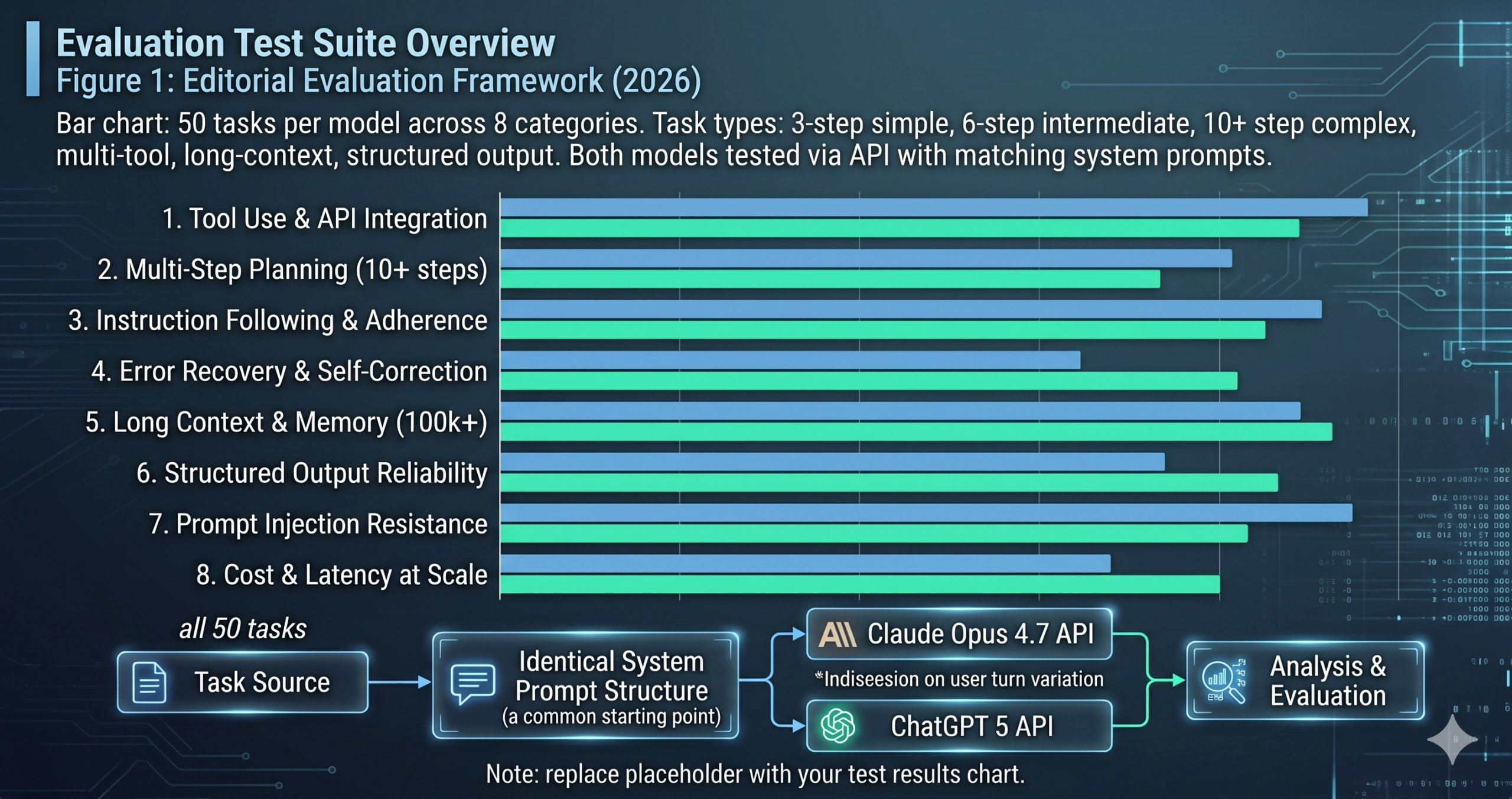
Head to head across 8 agent building categories
Tool use and API integration
- Conservative tool calling, rarely fires a tool unnecessarily
- Low hallucination rate on tool call parameter values
- Follows tool schemas precisely, even complex nested ones
- Shows its routing reasoning before calling, which is easier to audit
- Weakness. Smaller pre built integration ecosystem than OpenAI
- Function calling is mature and battle tested across three model generations
- Responses API provides richer tool types including web search and code interpreter natively
- Strong ecosystem of pre built tool integrations such as Zapier, browsing, and third party plugins
- Code Interpreter is exceptional for data heavy agent workflows
- Weakness. More aggressive, occasionally fires tool calls that were not strictly necessary
The OpenAI tool ecosystem is broader and more mature. Teams building agents that connect to third party services, run code natively, or need voice tool integration through the Realtime API will find ChatGPT 5 more ready out of the box. Claude’s advantage is reliability over breadth, fewer unnecessary calls and better schema adherence, which matters more for high stakes agents than for integration speed.
Multi step planning and task decomposition
- Extended thinking mode spends extra compute on hard planning decisions before committing
- Produces more coherent task hierarchies for ambiguous, open ended goals
- Better at holding the reasoning behind a plan across ten or more steps
- Identifies task dependencies more reliably, with fewer circular dependencies in generated plans
- Weakness. Extended thinking adds latency, so the first response on complex plans is slower
- Strong structured reasoning for well defined planning tasks
- Improved chain of thought handles multi step workflows well
- Faster plan generation for common task types
- Good at producing plans in structured formats such as Markdown, JSON, and numbered lists
- Weakness. Plans can drift from the original goal in deeply nested or ambiguous workflows, where the reasoning gets lost after eight or more steps
Extended thinking is the difference maker for complex orchestration. When the goal is ambiguous and the task hierarchy is deep, Claude’s additional reasoning pass produces more coherent and dependency aware plans. For simple, well defined workflows, both models perform comparably. You do not need Opus for a three step plan.
Instruction following and constraint adherence
- Rarely overrides explicit constraints with unsolicited helpful behavior
- Handles complex, layered, and occasionally contradictory instructions without resolution errors
- Holds a defined agent persona and scope boundary reliably across long sessions
- Constitutional AI training produces more consistent adherence to do not do this constraints
- Weakness. Can be overly cautious in genuine edge cases, which calls for extra prompt clarification
- Generally strong instruction following, a clear improvement over GPT-4o
- Good system prompt adherence for the first several turns of a session
- More willing to reason flexibly in ambiguous situations
- Can be better than Claude at resolving instruction conflicts pragmatically
- Weakness. Occasionally adds unsolicited content or expands scope beyond what was specified, especially when it judges the addition helpful
For production agents with strict scope boundaries, where the tool set is fixed, responses must fit a defined format, and certain topics are off limits, Claude’s constraint adherence is meaningfully more reliable. An agent that helpfully expands its own scope is not a reliable agent. ChatGPT 5’s flexibility is an asset in exploratory workflows where helpful divergence is acceptable.
Error recovery and self correction
- Prompted self verification loops work reliably, catching format violations and factual gaps
- Explicit about uncertainty, flagging gaps rather than papering over them with plausible content
- Good at recognizing when a previous tool call result was anomalous before proceeding
- Revision quality is high, since corrected outputs address the root cause rather than the symptom
- Weakness. The verification pass can be verbose, adding length without always adding value
- Excellent error recovery in code generation, helped by real execution feedback through Code Interpreter
- Strong at recognizing logical errors in its own prior output
- Catches formatting violations more consistently than GPT-4o did
- Self correction without prompting is more common, so it does not always need explicit verification instructions
- Weakness. Less explicit about uncertainty, and sometimes corrects silently, which makes it harder to audit what changed and why
Domain decides the winner here. For code heavy agents, the Code Interpreter feedback loop gives ChatGPT 5 a real edge, since it can run the code, see the error, and fix it in one step. For non code agents where auditability matters more than speed, Claude’s explicit uncertainty flagging is more valuable. Neither wins cleanly in the general case.
Long context and memory management
- The 200,000 token context window is the largest of any top tier model in this comparison
- Instruction adherence stays strong even at 150,000 or more tokens of conversation history
- System prompt authority holds across very long agent sessions, with less drift than competitors
- Well suited to document heavy agent workflows such as legal review, research synthesis, and codebase analysis
- Weakness. Cost rises substantially with very large contexts, which makes it expensive at scale
- The 128,000 token context window is substantial but about 38 percent smaller than Claude’s
- The OpenAI memory feature provides some cross session persistence at the user level rather than the session level
- Good coherence within the context window on most tasks
- Context management tools in the Responses API help with long session state
- Weakness. More likely to lose early session system prompt constraints in very long conversations, so instruction drift appears sooner
The 200,000 token window is not a marketing number. It is a genuine architectural advantage for agents that process long documents, accumulate large tool call histories, or run extended sessions. For most agent tasks under 50,000 tokens, the difference is irrelevant. For document heavy or long running workflows, it is decisive.
Structured output reliability
- Very reliable JSON output when the schema is shown inline in the prompt
- Consistent field naming, nesting depth, and null handling as specified
- Does not need a separate API parameter, since a schema in the prompt is enough
- Rarely produces text outside the JSON block when instructed not to
- Weakness. Structured output depends entirely on prompt clarity, so the schema must be explicit
- JSON mode is available as an API parameter, enforced at the response level rather than only the prompt level
- The Structured Outputs feature enforces exact schema compliance through an API parameter
- Strong schema adherence when Structured Outputs is enabled
- More forgiving of ambiguous schemas, filling gaps more confidently, which is useful or risky depending on context
- Weakness. You must explicitly enable JSON mode or Structured Outputs, since it is not inferred from prompt instructions alone
Both models are highly reliable for structured output when configured correctly. The Structured Outputs API parameter gives ChatGPT 5 a slight engineering edge, because schema enforcement at the response layer is more robust than at the prompt layer. Claude’s prompt based approach is equally reliable in practice, and it depends on prompt discipline.
Prompt injection resistance
- Constitutional AI training provides baseline resistance to direct instruction override attempts
- Treats conflicting instructions skeptically and is more likely to flag them than follow blindly
- Somewhat more resistant to role change injection such as you are now a different agent
- Still vulnerable to indirect injection through retrieved data without architectural controls
- Weakness. Not immune, since sustained adversarial prompting can succeed, so architectural controls are still required
- Strong system prompt enforcement, much more resistant than GPT-4o was
- Good resistance to direct injection through the user turn in tested scenarios
- OpenAI safety training provides baseline resistance comparable to Claude’s
- Similarly vulnerable to indirect injection through retrieved content
- Weakness. Baseline resistance does not remove the need for input sanitization, output validation, and tool call confirmation at the architecture layer
Both models have improved substantially on direct injection resistance. Neither model is reliably safe against indirect injection without architectural controls. Output sanitization, tool call validation, and confirmation requirements for irreversible actions are necessary whichever model you choose. Model level resistance is a factor, not a solution.
Cost and latency at production scale
- Opus 4.7 uses premium pricing, appropriate for orchestration calls where quality justifies the cost
- Sonnet 4.6 is competitive in the mid tier, with strong quality at meaningfully lower cost
- Haiku 4.5 is fast and low cost for simple specialist tasks
- The three tier structure gives good cost routing flexibility
- Weakness. No equivalent to the GPT-5 Mini ultra budget tier for very high volume, low complexity tasks
- GPT-5 full sits in the premium tier, with pricing comparable to Claude Opus 4.7
- GPT-5 Mini is significantly cheaper, with best in class cost efficiency for high volume specialist work
- Fast response times across both tiers, with a latency advantage on Mini in particular
- The Batch API provides additional cost savings for async, non real time tasks
- Weakness. GPT-5 Mini sacrifices some reasoning quality that matters for complex orchestration
At the orchestration layer, both models cost roughly the same. At the specialist execution layer, the GPT-5 Mini cost per token advantage is real and compounds at scale. Teams running thousands of specialist calls a day will find the ChatGPT 5 budget tier more economical than Claude Haiku. For mixed architectures, this is the key cost factor.
“Choosing the wrong model for the wrong reason costs more than choosing no model at all. The right choice follows from what the task actually requires, not from what model your team already has credentials for.”
aitrendblend editorial team, May 2026
The scorecard
Eight categories. Three possible outcomes per category. Here is where each model won, where they tied, and what the overall pattern means for your decision.
| Category | Claude | ChatGPT 5 | Result |
|---|---|---|---|
| Tool use and API integration | Reliable | Broader ecosystem | ChatGPT 5 Edge |
| Multi step planning | Extended thinking | Strong | Claude Edge |
| Instruction following | Strict adherence | Good, some drift | Claude Edge |
| Error recovery | Explicit, auditable | Code stronger | Tie, domain dependent |
| Long context and memory | 200k tokens | 128k, some drift | Claude Edge |
| Structured output | Prompt based | API enforced mode | Tie |
| Prompt injection resistance | Good baseline | Good baseline | Tie, both need controls |
| Cost and latency at scale | Three tier flexibility | Mini tier advantage | ChatGPT 5 Edge |
| Total | 3 wins | 2 wins | 3 ties |
When to choose which model
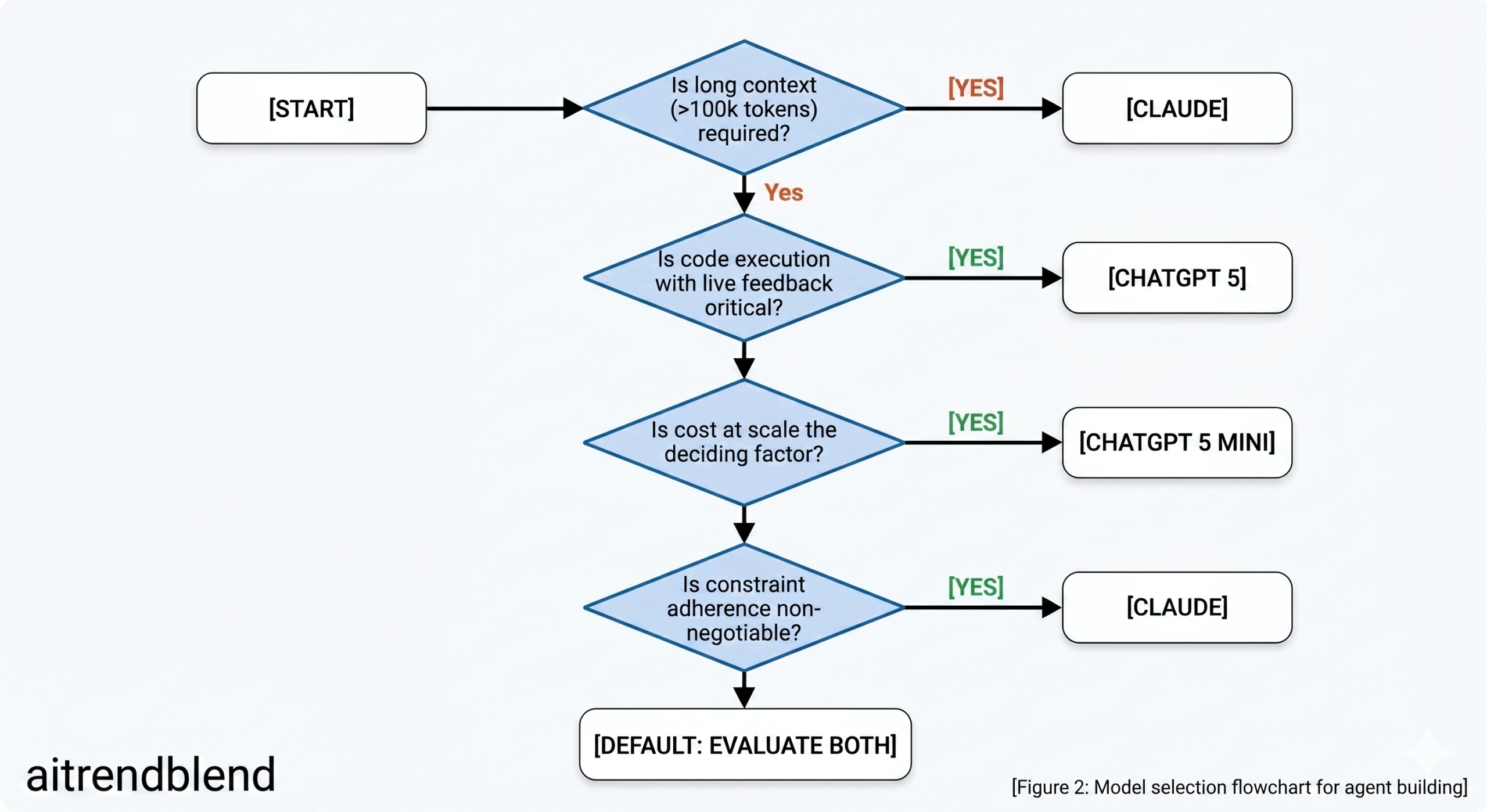
The scorecard shows Claude winning three categories and ChatGPT 5 winning two, with three ties. That margin is real, and it is not the right way to make this decision. The categories each model wins are different enough that the right choice depends almost entirely on what your specific agent needs to do.
- Your agent handles long documents, codebases, or extended conversations that push past 100,000 tokens
- Strict constraint adherence is not negotiable and the agent must not expand its own scope
- The orchestration layer involves complex, ambiguous goal decomposition
- Your pipeline relies on multi agent orchestration where reasoning coherence matters more than speed
- You are building in a security sensitive context where conservative tool calling reduces attack surface
- You need a model that flags uncertainty rather than papering over gaps
- Your team is starting fresh with no prior investment in either ecosystem
- Your team already builds on the OpenAI stack and switching cost is real
- The agent relies heavily on code execution, where the Code Interpreter feedback loop is a genuine advantage
- You need voice agent capabilities through the Realtime API
- High volume specialist tasks make the GPT-5 Mini cost tier decisive for economics
- You need third party tool integrations that already exist in the OpenAI ecosystem
- The task is well defined and structured, with no ambiguity where extended thinking would help
- Batch API processing for async pipelines is part of the architecture
The mixed architecture option
Nothing stops you from using both. A common 2026 architecture pairs Claude Opus 4.7 as the orchestrator, handling complex reasoning, strict constraints, and large context, with GPT-5 Mini as the high volume specialist layer for cost efficiency and fast execution. The models are not mutually exclusive choices. They are potentially complementary tiers in the same pipeline.
Where both models still fall short
An honest comparison includes the gaps neither model has closed. These are not edge cases. They are failure modes that show up in real production deployments, and no amount of prompt engineering has fully resolved them as of May 2026.
Indirect prompt injection through retrieved content
Both models remain vulnerable to adversarial instructions embedded in documents, emails, and web pages they retrieve during normal operation. Neither reliably distinguishes data I am processing from instructions I should follow when the data is designed to blur that line. This is an architectural problem that needs sanitization, output validation, and confirmation controls. The model itself is not the solution.
True cross session memory without external tooling
Neither model has production ready native memory that persists facts, decisions, and user preferences across sessions without developer implemented external storage. The OpenAI memory feature provides some user level persistence, and it is not the structured, queryable state management that real agent pipelines need. Both models require an external memory layer for any workflow that spans sessions.
Coherence in very long autonomous runs
Both models degrade in coherence after fifteen to twenty steps in a fully autonomous loop. Early session instructions become less influential. Tool routing decisions become less consistent. The cumulative effect of small reasoning errors compounds. The practical response for both models is a maximum step count enforced at the orchestration layer and a human review checkpoint before the agent proceeds past a defined threshold.
Independently verifying tool output accuracy
When a tool returns data, both models trust it. An API that returns stale data, an internal database record that was incorrectly updated, a web scraper that returned the wrong page, all of these get synthesized as if accurate, with no independent signal that something went wrong. Detecting bad tool data needs architectural controls such as validation layers, cross referencing where possible, and confidence flagging for outputs that will not be independently verified.
Knowing when to stop and escalate to a human
Neither model consistently recognizes when a task is genuinely unanswerable within its constraints and should be escalated rather than continued. Both tend toward producing a plausible sounding response under ambiguity, even when the honest answer is that there is not enough information to proceed reliably. Hard coding escalation conditions in the system prompt, with explicit triggers that surface the task to a human, remains the most reliable mitigation.
Making the call
The three categories Claude wins, planning, instruction following, and long context, cluster around a particular type of agent. One that operates in a complex, ambiguous environment where the cost of drift is high. Legal agents, research pipelines, financial analysis workflows, multi agent orchestrators. The two categories ChatGPT 5 wins, tool ecosystem and cost at scale, cluster around a different type. One that needs to connect to many systems quickly, execute code with live feedback, and run at a volume where per token cost adds up. Neither profile is universally better. They describe different products.
What makes this comparison harder is that the gap between the two models narrowed considerably in 2026. A year ago the difference in planning coherence and constraint adherence was stark. GPT-5 has closed much of that distance. Claude has improved its tool use ecosystem and cost flexibility. The next major capability jump from either lab, whether persistent memory, more reliable multi agent trust, or better indirect injection resistance, will likely shift the comparison again within twelve months. The decision you make today should account for that. Build your agent architecture so that swapping models is possible rather than deeply embedded, so you can switch or mix as the landscape evolves.
The most honest thing to say about this comparison is also the least satisfying. For the majority of agent building projects, both models will work. The real differentiators are your team’s existing expertise, your cost constraints, and the specific behavioral requirements of your particular agent. Those factors will point you to a clear answer faster than any benchmark will.
Pick the model that fits the work. Test it under realistic conditions before you commit to an architecture. Build in the ability to change your mind.
Now Build the Agent That Wins
Get the tested Claude prompt templates for orchestration, specialist agents, and quality gates, or dig into the security controls every agent needs before it ships.
Frequently asked questions
Is Claude or ChatGPT 5 better for building AI agents
Neither wins outright. Claude leads on multi step planning, strict constraint adherence, and long context, which suits complex or document heavy agents. ChatGPT 5 leads on tool ecosystem breadth and cost at scale, which suits code heavy or high volume agents. The right pick follows from what your agent actually does.
Which model has the larger context window
In this comparison Claude offers a 200,000 token window against roughly 128,000 for ChatGPT 5. For tasks under about 50,000 tokens the difference rarely matters, but for long documents or extended sessions the larger window is a real advantage.
Is GPT-5 Mini cheaper than Claude for agents
At the specialist execution layer, yes. The GPT-5 Mini tier has a strong cost per token advantage that compounds across thousands of calls a day. At the premium orchestration layer the two are roughly comparable, so the savings come from the budget tier.
Can I use Claude and ChatGPT 5 together
Yes, and many teams do. A common pattern uses Claude as the orchestrator for complex reasoning and strict constraints, with GPT-5 Mini as the high volume specialist layer for cost efficiency. They work well as complementary tiers in one pipeline.
Which model follows instructions and constraints more reliably
Claude held the edge in testing. It rarely overrides explicit constraints with unsolicited helpful behavior and holds its scope across long sessions. ChatGPT 5 is strong too, and it is more likely to expand scope when it judges the addition helpful, which can be a problem for tightly bounded agents.
Are these models safe from prompt injection
Both resist direct injection well and both remain vulnerable to indirect injection through retrieved content. Model level resistance is only one layer. You still need input sanitization, output validation, and confirmation steps for irreversible actions at the architecture level.