
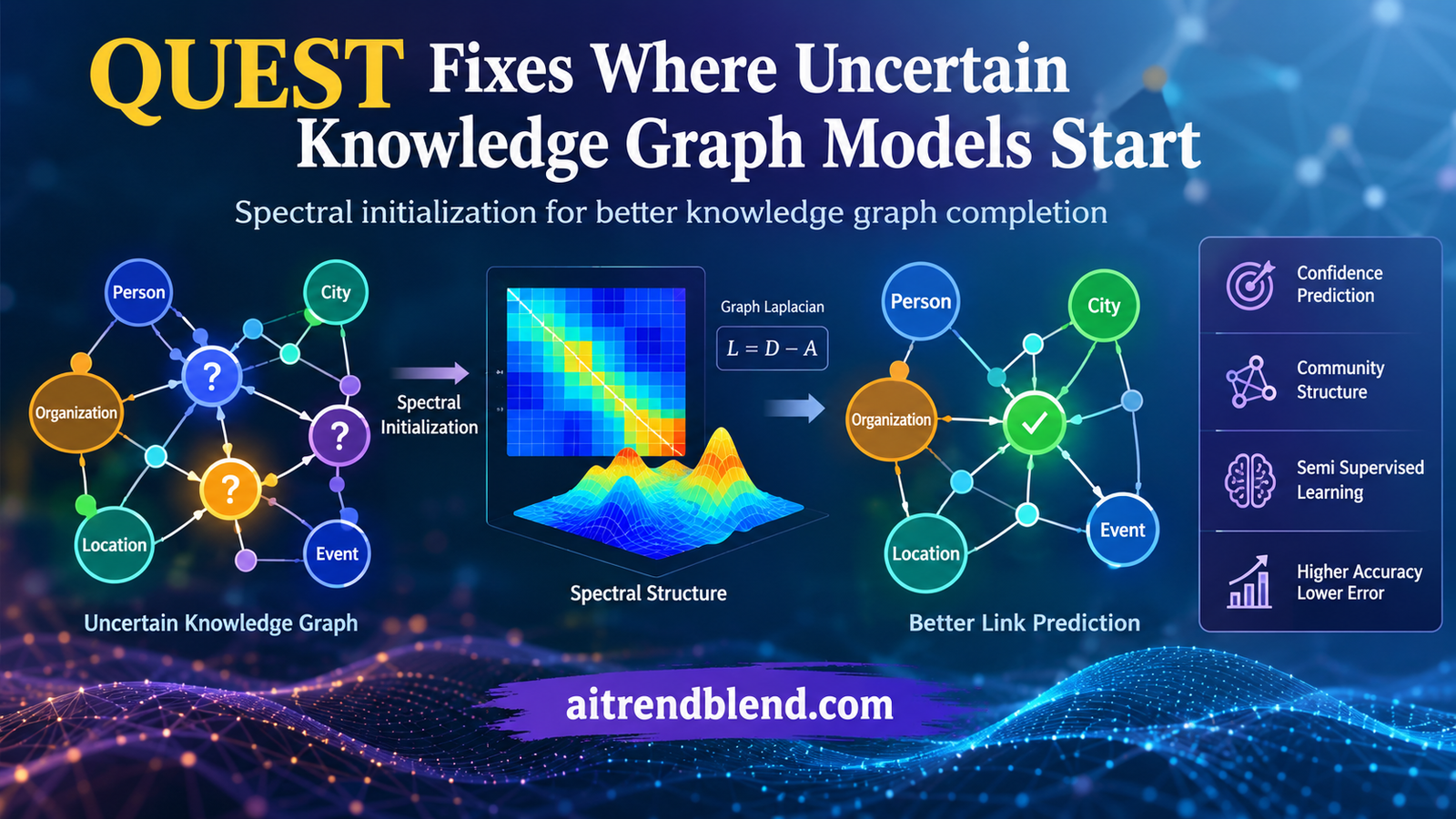
Most machine learning arguments are about the model. This one is about the starting line. A team at the University of Southern California took a leading system for completing uncertain knowledge graphs, changed nothing about how it scores facts, and simply moved where its embeddings begin. That single change cut error by as much as two thirds on one benchmark. The lesson underneath is quietly provocative. Sometimes the bottleneck is not the network at all. It is the blank page you hand it.
Key points
- An uncertain knowledge graph attaches a confidence score to every fact, and completing one means predicting both missing facts and how sure to be about them.
- QUEST adds two parameter free changes to an existing system called ssCDL, so it introduces no new weights to train.
- It initializes each entity from the spectral structure of the confidence weighted graph, placing entities in the same community near each other and centering high traffic hubs before training starts.
- It also adds a graph smoothness penalty, but switches it off exactly when self training begins, because the two objectives fight each other on dense graphs.
- On two benchmarks it beat or tied the previous best on all metrics, including a 67 percent error reduction over one strong baseline that used a fancier scoring function.
- Leaving the smoothness penalty on past the cutoff made error spike from 0.035 to 0.198 on the denser graph, which is why the scheduling matters.
What an uncertain knowledge graph is, and why it is hard
A knowledge graph stores facts as connections, a head entity, a relation, and a tail entity, such as Paris being the capital of France. An uncertain knowledge graph goes one step further and attaches a confidence score to each fact, a number between zero and one that says how sure we are the relation holds. That matters because real world knowledge is noisy. Facts mined from the web or from crowdsourced commonsense come with varying reliability, and pretending every fact is equally certain quietly corrupts anything built on top.
Completing such a graph means two things at once. Confidence prediction asks, given a fact, how confident should we be in it. Link prediction asks, given a head and a relation, which tail entities complete it and with what confidence. The trouble is that most possible facts have never been observed, so there are no confidence labels to learn from directly. Modern methods handle this with semi supervised learning, generating pseudo labels for unobserved facts and training on them alongside the real ones. It works, but it introduces a subtle failure mode that this paper zeroes in on.
Here is the gap the authors identify. The leading system, called ssCDL, models confidence as a distribution and uses a meta learning stage to invent those pseudo labels. But like the methods before it, it starts every entity embedding from random noise and then processes facts locally, one at a time. In doing so it throws away something the graph already knows about itself, its global shape, which communities of entities cluster together and which hub entities connect everything. That structural blindness is what QUEST sets out to cure, and the fix rhymes with other work on predicting missing links from the shape of a graph.
The core problem. The graph’s community and hub structure is free information sitting in the data. Starting every entity from random noise discards it, and no amount of local training fully recovers a global structure the model never saw at the outset.
Reading the shape of the graph before training
QUEST, which stands for the method the authors introduce as an extension of ssCDL, makes two parameter free additions. The first, and the more important, is spectral entity initialization. The idea comes from spectral graph theory, and it is elegant once you see it.
First, build a confidence weighted graph over the entities. For every pair of entities, sum the confidence of all facts linking them in either direction to get an edge weight, so a pair connected by several high confidence facts gets a strong edge.
That matrix L is the graph Laplacian, and its eigenvectors are the key. The smallest eigenvalue is always zero and its eigenvector is constant, so it is discarded. The next few smallest non trivial eigenvectors are the ones that matter, because they encode community structure at a large scale. Entities in the same tightly connected community get similar values in these eigenvectors, and high degree hubs land at structural centers. The same machinery is what makes tools like fast solvers built on the graph Laplacian so useful.
QUEST takes the smallest non trivial eigenvectors, as many as the embedding dimension, and stacks them into a coordinate matrix. To keep numerics stable it adds a tiny Tikhonov term to the Laplacian before the eigen solve, and it uses a shift invert method to pull out just the small eigenvectors efficiently.
The rescaling is a nice practical touch. Raw eigenvectors do not have the right scale for a neural network, so QUEST stretches them to match the standard Xavier initialization variance that the network expects. The result becomes the initial entity embedding table. Relation embeddings keep their ordinary random start, because relations do not appear in the entity Laplacian. Crucially, this whole step happens once, before training, and adds no trainable parameters. It just changes the blank page.
A helpful penalty that has to know when to quit
The second addition is a graph smoothness regularizer, and its story is more surprising. The idea is to keep connected entities close in embedding space during early training, which reinforces the structure the spectral start put there. This is formalized as a normalized Dirichlet energy, a classic measure of how much embeddings vary across edges, estimated on mini batches so it stays cheap.
So far so standard. The twist is that this penalty turns harmful partway through training. The ssCDL backbone has a self training stage that kicks in at epoch 30, where it generates pseudo labels by swapping the head or tail of a real fact for a randomly sampled entity. Those synthetic entities are often far away in the confidence weighted graph, which is the whole point, they are meant to be negatives. But the smoothness penalty, still trying to pull connected entities together, fights the self training gradient that is trying to push these random pairs apart. On a dense graph with many high confidence edges, that conflict is amplified, and training destabilizes.
The authors measured it. On the denser benchmark, leaving the smoothness penalty active past epoch 30 made the confidence error spike from 0.035 to 0.198 in just ten epochs. On the sparser benchmark, no such spike appeared. The fix is refreshingly simple. Schedule the penalty to switch off exactly when self training begins.
The cutoff follows the fixed schedule of the self training stage, not any test set tuning, which matters for honesty. After it fires, the spectral initialization is still doing its job, silently shaping optimization through the embeddings it placed, at no further cost. The smoothness penalty was training wheels, useful early and removed before it could trip the rider.
Key insight. A regularizer can be genuinely helpful and genuinely harmful in the same run. What changes is not the penalty but the stage of training. Knowing when to switch it off is the whole trick.
What the numbers say
QUEST was tested on two standard uncertain knowledge graph benchmarks, NL27k, derived from a system that mines facts from web pages, and CN15k, derived from a multilingual commonsense network. CN15k is the denser of the two, with roughly two and a half times more edges per entity, which turns out to matter. On confidence prediction, measured by mean squared error and mean absolute error where lower is better, QUEST leads.
| Method | NL27k MSE | NL27k MAE | CN15k MSE | CN15k MAE |
|---|---|---|---|---|
| PASSLEAF (RotatE) | 0.019 | 0.063 | 0.094 | 0.248 |
| ssCDL | 0.009 | 0.042 | 0.034 | 0.116 |
| QUEST (full) | 0.009 | 0.041 | 0.031 | 0.118 |
The number that makes the case sits in the CN15k column. A strong earlier baseline scored 0.094 there, and QUEST reaches 0.031, a 67 percent reduction, without changing the scoring function at all. That is the paper’s central argument in one figure. If a better start beats a fancier scorer by that margin, then initialization geometry, not scorer expressiveness, was the real bottleneck. Across all eight metric and dataset combinations, the full QUEST wins six and ties ssCDL on the other two, and the gains are consistently larger on the denser CN15k, where the community signal the spectral start captures is stronger.
Link prediction tells the same story. Here the model ranks candidate tail entities, scored by a confidence weighted mean reciprocal rank and by how often the right answer ranks first.
| Method | NL27k WMRR | NL27k Hits@1 | CN15k WMRR | CN15k Hits@1 |
|---|---|---|---|---|
| ssCDL | 0.727 | 0.636 | 0.207 | 0.133 |
| QUEST (full) | 0.736 | 0.643 | 0.212 | 0.141 |
QUEST takes the top score on every link prediction metric. The largest relative gain is a 6 percent lift in Hits@1 on CN15k, again the denser graph. None of this required a new loss for the scorer or extra parameters. It came from where the entities started and a regularizer that knew when to stop.
Which piece did the work
Because QUEST has two parts, the honest question is which one matters, and the ablation answers it in a nuanced way. The two components fix different failures, and neither dominates the other across the board.
| Configuration | NL27k MAE | CN15k MSE |
|---|---|---|
| QUEST (full) | 0.041 | 0.031 |
| Without spectral initialization | 0.044 | 0.031 |
| Without graph smoothness | 0.041 | 0.030 |
Remove the spectral initialization and the sparse graph suffers, with mean absolute error regressing about 4.5 percent against the baseline, which pins spectral initialization as the main driver of confidence quality on sparse graphs. Remove the smoothness penalty instead and the dense graph actually posts its best confidence error, since without the penalty there is no conflict to schedule around. The authors are careful here. That lower dense error is reached through an unstable trajectory that remains sensitive to which checkpoint you pick, which is exactly the instability the scheduling exists to remove. No single ablation dominates the full model across all eight evaluations, which is the tidy justification for keeping both, one for initialization geometry and one for early stage stability.
Where it falls short
The honest caveats start with scope. QUEST is evaluated on two uncertain knowledge graph benchmarks, and it inherits the surrounding machinery of ssCDL, including its confidence head and its fixed self training schedule. The epoch 30 cutoff is not tuned on the test set, which is good, but it is also not adaptive, so a graph whose self training kicks in on a different rhythm would need the schedule adjusted. This is a preprint, so the results are strong early evidence rather than a settled benchmark sweep.
There are two more structural limits worth naming. The spectral step is a one time cost, but computing eigenvectors of a Laplacian can get expensive on very large graphs, so the approach as described is most comfortable at the scale of these benchmarks rather than at web scale with hundreds of millions of entities. And the Laplacian QUEST builds is undirected and relation agnostic. It sums confidence across all relation types and ignores which way an edge points, so it captures who is connected to whom but not the semantics of how. A richer construction that respected relation direction and type might capture more, at the price of the parameter free simplicity that makes this version appealing.
The authors also flag a responsible use point that is easy to skip past. Uncertain knowledge graphs can encode noise, bias, and coverage gaps from their sources, so a predicted confidence is not the same as a verified truth. In any high stakes setting those numbers deserve calibration checks and human oversight rather than blind trust, a caution that applies to the whole class of methods, not just this one.
Why the approach travels
Strip away the knowledge graph specifics and QUEST is a clean demonstration of two ideas that generalize. The first is that structure aware initialization is undervalued. When your data has a natural graph, its spectral coordinates are a free, principled starting position that no random draw can match, and paying a one time cost to use them can beat a more expensive model. The second is that regularizers have a shelf life. A penalty that helps early can hurt late, and scheduling it against the phases of training is often cleaner than tuning its strength.
Both ideas reach well beyond uncertain facts. Any embedding model over a graph, from recommendation to molecular property prediction, could seed its entities spectrally, and any pipeline that switches on a second objective partway through, as self training and curriculum methods do, should ask whether an earlier regularizer is now working against it. The same structure first instinct shows up across recent graph work, from coarsening a graph while preserving its shape to the theory of what message passing can and cannot represent. QUEST’s contribution is to show, with a controlled swap that touches nothing but the starting point, how much of the performance was hiding in the geometry all along.
Reference implementation in PyTorch
The code below is a runnable reconstruction of QUEST’s two ideas, spectral entity initialization and the scheduled smoothness penalty, based on the paper’s equations. It builds a confidence weighted adjacency from triples, forms the graph Laplacian, extracts the smallest non trivial eigenvectors with a sparse solver, rescales them to a standard initialization target, and provides a mini batch Dirichlet energy penalty with a scheduling wrapper that switches off at the self training cutoff. A smoke test runs it on a small synthetic graph. Plug the initialized table and the scheduled penalty into an ssCDL style trainer for real experiments.
# quest_reference.py
# Spectral entity initialization and scheduled graph smoothness for UKG completion.

import numpy as np
import scipy.sparse as sp
from scipy.sparse.linalg import eigsh
import torch


def confidence_weighted_laplacian(triples, n_entities):
    """triples: list of (head, tail, confidence). Build A then L = D - A."""
    rows, cols, vals = [], [], []
    for h, t, s in triples:
        rows += [h, t]; cols += [t, h]; vals += [s, s]   # undirected, Eq 1
    A = sp.csr_matrix((vals, (rows, cols)), shape=(n_entities, n_entities))
    deg = np.asarray(A.sum(1)).ravel()
    L = sp.diags(deg) - A                                # graph Laplacian, Eq 2
    return L.tocsr()


def spectral_init(L, dim, eps=1e-5):
    """k smallest non trivial eigenvectors, rescaled to the Xavier target."""
    n = L.shape[0]
    L_reg = L + eps * sp.identity(n)                     # Tikhonov term, Eq 3
    # ask for dim + 1 smallest eigenpairs via shift invert, drop the constant one
    k = min(dim + 1, n - 1)
    vals, vecs = eigsh(L_reg, k=k, sigma=0, which="LM", tol=1e-4, maxiter=2000)
    order = np.argsort(vals)
    vecs = vecs[:, order][:, 1:dim + 1]              # discard trivial eigenvector, Eq 4
    U = vecs.astype(np.float32)
    tau = np.sqrt(2.0 / (n + dim))                     # Xavier target std, Eq 5
    U = tau / (U.std() + 1e-8) * U
    return torch.from_numpy(U)                           # E^(0)


def smoothness_penalty(embed, batch, batch_size=2048):
    """Mini batch Dirichlet energy over confidence weighted edges, Eq 6."""
    idx = torch.randint(0, batch.shape[0], (min(batch_size, batch.shape[0]),))
    h, t, s = batch[idx, 0].long(), batch[idx, 1].long(), batch[idx, 2]
    diff = embed[h] - embed[t]
    return (s * (diff * diff).sum(-1)).mean()


def smoothness_weight(epoch, lam=1.0, pcdg_start=30):
    """Scheduling rule, active before self training, off after, Eq 8."""
    return lam if epoch < pcdg_start else 0.0


def total_loss(cdl_rl_loss, embed, batch, epoch):
    """Augmented objective, Eq 7, with the penalty scheduled off at epoch 30."""
    w = smoothness_weight(epoch)
    if w == 0.0:
        return cdl_rl_loss
    return cdl_rl_loss + w * smoothness_penalty(embed, batch)


if __name__ == "__main__":
    # small synthetic UKG: two communities loosely linked
    rng = np.random.default_rng(0)
    n, dim = 60, 16
    triples = []
    for _ in range(400):
        c = rng.integers(0, 2)
        a = rng.integers(c * 30, c * 30 + 30)
        b = rng.integers(c * 30, c * 30 + 30)
        triples.append((int(a), int(b), float(rng.uniform(0.5, 1.0))))

    L = confidence_weighted_laplacian(triples, n)
    E0 = spectral_init(L, dim)
    embed = torch.nn.Parameter(E0.clone())
    batch = torch.tensor(triples, dtype=torch.float32)

    print("init table", tuple(E0.shape), "std", round(E0.std().item(), 4))
    print("penalty at epoch 10", round(total_loss(torch.tensor(1.0), embed, batch, 10).item(), 4))
    print("penalty at epoch 40", round(total_loss(torch.tensor(1.0), embed, batch, 40).item(), 4))
Conclusion
The core achievement of QUEST is to show that where a model starts can matter as much as how it scores. By seeding entity embeddings from the spectral structure of the confidence weighted graph, and adding a smoothness penalty that switches off before it can conflict with self training, the method beat or tied the previous best on every metric across two benchmarks, and cut error by 67 percent against a strong baseline on the denser graph, all without touching the scoring function or adding a single trainable parameter. That is an unusually clean result, because it isolates the cause.
The conceptual shift worth keeping is that the graph knows things about itself that random initialization throws away. Communities and hubs are already encoded in the Laplacian’s eigenvectors, and handing that map to the model as a starting position is cheaper and more principled than making it rediscover the structure from noise through local updates. The larger the community signal, which is to say the denser the graph, the more this pays off, which is exactly the pattern the results show.
The scheduling finding is the quieter lesson, and maybe the more portable one. A regularizer is not simply good or bad. Its sign can flip with the phase of training, and the spike from 0.035 to 0.198 when the penalty was left on too long is a vivid reminder that a helpful early objective can become a destabilizing late one. Switching it off against the training schedule, rather than tuning its weight, removed the instability without any test set fiddling.
The honest limitations keep it grounded. This is a preprint on two benchmarks, it inherits a fixed schedule and a relation agnostic undirected Laplacian, and its spectral step could strain at web scale. Those are real boundaries, and the authors name them. But none of them undercut the central claim, which is modest and well supported. For this class of problem, initialization geometry was a bigger lever than scorer design, and almost nobody was pulling it.
For anyone building embedding models over graphs, the practical takeaway is compact. Before reaching for a bigger scorer, try starting your entities from the graph’s own spectral coordinates, and if you switch on a second objective partway through training, check whether an earlier regularizer has quietly become your enemy. QUEST is a preprint with clear equations, and the reference above is a place to start testing the idea on a graph of your own.
Frequently asked questions
What is an uncertain knowledge graph?
It is a knowledge graph in which every fact, expressed as a head entity, a relation, and a tail entity, carries a confidence score between zero and one that says how reliable the fact is. This models the reality that knowledge mined from the web or from commonsense sources varies in trustworthiness, rather than treating every fact as equally certain.
What does QUEST change compared with earlier methods?
QUEST adds two parameter free changes to an existing system called ssCDL. It initializes entity embeddings from the spectral structure of the confidence weighted graph rather than from random noise, and it adds a graph smoothness penalty that is scheduled to switch off when self training begins. It does not change the scoring function or add any trainable parameters.
What is spectral initialization and why does it help?
Spectral initialization places each entity using the smallest non trivial eigenvectors of the graph Laplacian, which encode the graph’s community and hub structure. Entities in the same community start near each other and hubs start at structural centers, so the model begins with the global topology already reflected in its embeddings instead of having to rediscover it from random values.
Why does the smoothness penalty have to be turned off?
The self training stage generates pseudo labels by pairing an entity with a randomly sampled, usually distant entity, which the model should push apart. The smoothness penalty tries to pull connected entities together, so on dense graphs the two objectives conflict and training destabilizes. Leaving the penalty on past the cutoff made error spike from 0.035 to 0.198, so QUEST switches it off exactly when self training starts.
How much did QUEST improve results?
Across two benchmarks it beat or tied the previous best on all metrics. On the denser CN15k graph it cut confidence error to 0.031 against a strong baseline’s 0.094, a 67 percent reduction, and improved Hits@1 by 6 percent, all without changing the scoring function. Gains were consistently larger on the denser graph where community structure is stronger.
What are the main limitations?
It is an unreviewed preprint evaluated on two benchmarks, it inherits a fixed self training schedule, and its undirected Laplacian ignores relation direction and type. Computing eigenvectors is a one time cost that could become expensive on very large graphs, and predicted confidences should be treated with calibration checks and human oversight rather than as verified truth in high stakes settings.
Read the source
This analysis draws on the QUEST preprint. You can also reach it through the inline link earlier in this article, at arXiv:2609.02519.
Read the paper on arXiv Datasets and background [OWNER, replace with the QUEST code repo or the NL27k and CN15k dataset link once confirmed]Academic citation. Jahin, M.A., Fuad, T.R., Pujara, J., and Knoblock, C.A. Spectral Initialization and Scheduled Graph Smoothness for Uncertain Knowledge Graph Completion. arXiv preprint arXiv:2609.02519, 2026. University of Southern California and Islamic University of Technology. Available at https://arxiv.org/abs/2609.02519.
This analysis is based on the published paper and an independent evaluation of its claims. The paper is a preprint and has not completed peer review.