
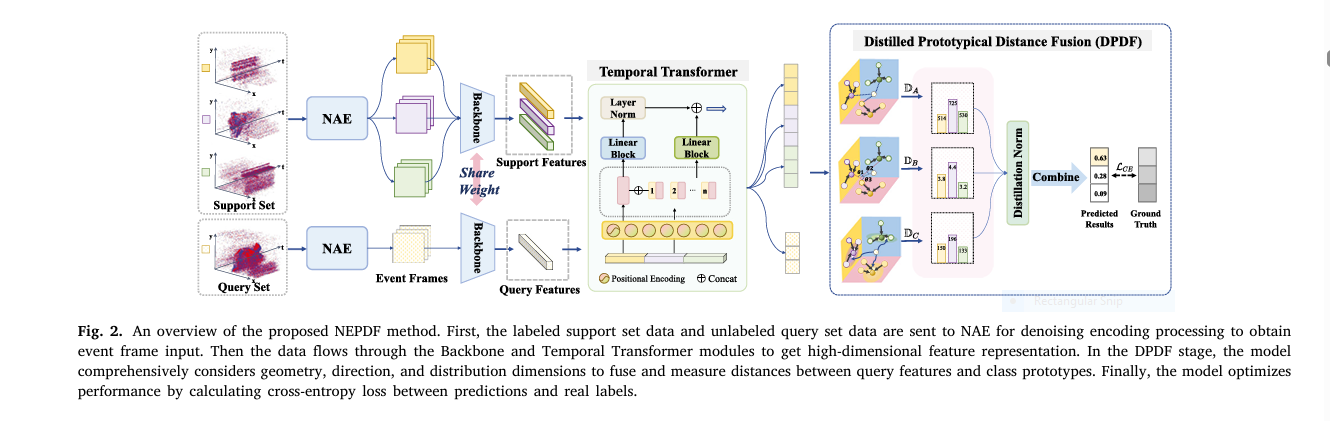
A person starts an action in front of a camera. A conventional video system records a sequence of complete pictures. An event camera instead reports local changes in brightness as they happen. The recognition system receives a moving trail of evidence, with useful motion mixed among isolated sensor events. Now give it only one labelled example of a new action. It must decide both which events deserve attention and which similarities deserve trust.
Recognizing an action from a trail of changes
The useful question behind NEPDF is whether an action recognizer can reuse knowledge when annotations are scarce and its input is unusually noisy. Zanxi Ruan and colleagues study that question in Few shot event based action recognition, published in Neural Networks. The author affiliations include the National University of Defense Technology, the University of Trento, and the Chinese University of Hong Kong.
Their system does two kinds of housekeeping. It cleans the event stream before making images, then brings different measures of similarity onto comparable scales before making a decision. Between those stages sits an image backbone initialized from CLIP and a Temporal Transformer. This is a useful fit for our vision transformers and attention hub, because the study asks how conventional visual representations can be adapted to a different sensing process.
An event consists of a location, a timestamp, and a polarity indicating the direction of a brightness change. A stationary region may produce little information, while moving edges produce many events. The representation therefore changes what a model sees and what it can lose. It also makes preprocessing unusually consequential. Removing an isolated event might eliminate noise, but removing a faint cluster could erase the first sign of a meaningful movement.
The study should not be read as a demonstration that event sensing automatically solves difficult lighting, privacy, or deployment problems. Those claims require their own evaluations. Nor is NEPDF a spiking neural network merely because it receives events. It converts selected events into frames and uses familiar deep learning components to reason about their sequence.
What one labelled example really means
Few shot experiments organize recognition into small tasks called episodes. Each episode contains labelled support clips and separate query clips. In a five way one shot episode, the model chooses among five candidate classes using one support example per class. Query labels are hidden from the classifier and used to calculate performance. The classes used for final evaluation should be separate from those used to learn the representation.
This distinction matters when a result is described as learning from one example. The support set is small, but the model does not start with no knowledge. NEPDF uses a pretrained CLIP visual encoder and learns through many training episodes. Its reported ability concerns adaptation to a new classification task with a small labelled support set, not training the entire recognition system from a handful of raw recordings.
The conceptual ancestry is familiar. Prototypical Networks by Snell, Swersky, and Zemel, cited in the paper, represent a class through its support features. Radford and colleagues provide the CLIP foundation, while the Transformer literature supplies attention across tokens. These prior works are discussed through the source paper and its bibliography. NEPDF brings those ideas into an event recognition pipeline rather than establishing each ingredient from scratch.
Our analysis of MIFOMO and label propagation raises a related evaluation question. How much of an apparent few shot improvement comes from the representation, and how much comes from the mechanism that assigns labels? For NEPDF, a fair answer requires holding the pretrained backbone, episode construction, preprocessing, and class split constant while changing the decision rule.
Cleaning events without assuming a uniform crowd
The first major component is the Noise Aware Event Encoder, abbreviated NAE. Its Temporal Spatial Adaptive Denoising module, or TSAD, estimates a local spatial scale from neighbouring events. Rather than apply one fixed spatial radius to every location, it uses the average distance to the nearest neighbours. A dense patch and a sparse patch can therefore receive different neighbourhood sizes.
The radius describes spatial proximity. A separate temporal condition limits how far apart two events may occur. Valid neighbours receive larger weights when their timestamps are close. The resulting support score determines whether an event survives. Written as an explicit weighted neighbourhood sum, the filtering idea is
Here the neighbour count, temporal window, decay parameter, and threshold all affect what remains. The equation makes the central tradeoff visible. Events should have nearby companions, but companionship must also occur at a relevant time. An old event at the same pixel is not necessarily evidence for the present movement.
There is a practical catch in the word adaptive. A radius derived from local density can accommodate changes in activity, but density is not the same thing as semantic importance. A small distant hand movement can be meaningful and sparse. A noisy region can be dense. The filter offers a useful inductive preference, not a guarantee that every removed event was irrelevant.
Timestamp units also matter. A decay value has no operational meaning without knowing whether time is measured in seconds, sensor ticks, or a normalized coordinate. Anyone implementing this stage must record that convention and keep it identical across training and evaluation. The paper reports dataset specific settings, which reinforces the need to treat preprocessing as part of the experimental protocol rather than an invisible default.
From irregular events to temporal attention
After filtering, the stream is divided into bins containing equal numbers of events. Positive and negative polarities become positive and negative pixel values, and the event representation is arranged for an image encoder. The study uses frames resized to 224 by 224 pixels. CLIP supplies the pretrained visual representation, and a Temporal Transformer combines information across the sequence.
Equal event counts do not mean equal durations. A busy interval can fill a bin quickly, while a quiet interval can take much longer. That choice gives each frame a similar event budget but changes the relationship between frame index and physical time. Two actions with similar spatial patterns but different speeds may be harder to distinguish if the representation does not preserve enough timing information.
This suggests a useful follow up experiment. Compare equal event bins with equal duration bins while controlling the number of frames and total computation. Then examine errors for actions that differ mainly in speed or ordering. Such an experiment would reveal whether the adaptive sampling removes nuisance variation or discards a discriminative cue.
The temporal model deserves the same care. An image backbone can identify a plausible pose without knowing whether a person is beginning or ending an action. Sequence attention supplies context across frames, but its benefit depends on the information that survived binning. Our discussion of video vision transformers provides a broader companion to this distinction between recognizing appearances and modelling change.
Why compare a query in three different ways?
NEPDF next compares a query representation with the prototypes of candidate classes. Distilled Prototypical Distance Fusion, abbreviated DPDF, combines Euclidean distance, cosine distance, and an entropy regularized transport distance. The motivation is reasonable. A single representation can look similar under one geometric interpretation and dissimilar under another.
Euclidean distance responds to differences in both direction and magnitude. Cosine distance focuses on direction. The transport component compares distributions under a ground cost. These measures need not make identical mistakes, which creates an opportunity for fusion. However, merely using three formulas does not establish that they contribute three independent sources of evidence.
The transport formulation introduces implementation decisions that deserve explicit documentation. Feature vectors must become distributions, a cost must express the distance between their support locations, and a numerical solver must approximate the coupling. These choices affect both the value and its gradients. The paper does not provide enough detail to treat any convenient implementation as an exact replica.
Raw distances also live on different scales. DPDF standardizes each distance over the candidate classes for a particular query, then averages the standardized values with equal weights. A class with a lower fused distance is a better match. In a classification implementation, negating these distances produces logits that can be trained with cross entropy.
The small stabilizer in this explanatory equation prevents division by zero. A reference implementation must define how it handles nearly identical distances. Standardization can otherwise magnify tiny numerical differences into an apparently meaningful ranking.
The word distilled needs particular care. In this formulation it does not imply a separate teacher network supervising a student with an additional distillation objective. The described training objective is cross entropy. The normalization called soft in the fusion discussion is a standardization of distances, not proof that a conventional teacher and student training pipeline exists.
What the main results actually establish
The main comparison covers THU-CHL, THU-EACT-50, HARDVS, and HMDB-DVS. The authors report 15000 training episodes for each dataset and average performance over 10000 evaluation episodes. They describe a class split in proportions of seven to two to one, with no class overlap between the initial partitions. Training uses SGD with a learning rate of 0.001 and a MultiStepLR decay factor of 0.1.
| Dataset | 3 way 1 shot | 3 way 3 shot | 5 way 1 shot | 5 way 5 shot |
|---|---|---|---|---|
| THU-CHL | 82.3 | 90.6 | 73.7 | 85.5 |
| THU-EACT-50 | 37.6 | 41.5 | 32.5 | 37.1 |
| HARDVS | 50.8 | 58.6 | 43.0 | 51.4 |
| HMDB-DVS | 50.0 | 55.8 | 33.5 | 39.4 |
The most useful pattern is the variation across datasets. THU-CHL is much more favourable than THU-EACT-50. HARDVS and HMDB-DVS sit between those extremes in several settings. That spread is part of the finding. It warns against describing NEPDF with one headline accuracy detached from the dataset and episode structure.
The baseline comparison is also stronger when the most competitive baseline is visible. SimpleShot reaches 49.2 percent on the THU-CHL five way five shot task, while RelationNet reaches 55.8 percent there. On HARDVS, SimpleShot reaches 46.6 percent in that setting. NEPDF reports 85.5 and 51.4 percent respectively. These comparisons show that the size of the improvement depends heavily on the collection.
A large number of sampled episodes reduces uncertainty about the chosen episode distribution, but it does not automatically measure variability across model training seeds, class splits, cameras, or environments. The main table does not supply confidence intervals. Later experiments provide different results under a separate tuning and seed protocol, so those standard deviations should not be attached to the main table as if they were its uncertainty estimates.
Ablations show that the pieces interact
| Configuration | THU-CHL | THU-EACT-50 | HARDVS | HMDB-DVS |
|---|---|---|---|---|
| Without temporal module | 66.4 | 29.3 | 47.0 | 30.0 |
| Temporal baseline | 75.3 | 31.8 | 48.1 | 32.2 |
| Temporal plus TSAD | 77.5 | 34.0 | 50.6 | 33.5 |
| Temporal plus DPDF | 84.1 | 35.3 | 50.1 | 35.1 |
| Full NEPDF | 85.5 | 37.1 | 51.4 | 39.4 |
The ablations support keeping both noise handling and distance fusion, but they do not imply that one component dominates everywhere. On HARDVS, adding TSAD to the temporal baseline yields 50.6 percent, while adding DPDF yields 50.1 percent. On THU-CHL, the DPDF configuration is much stronger than the TSAD configuration. The complete pipeline reaches the highest value among these configurations on each listed dataset.
Those gains should not be added together as independent contributions. A cleaner representation changes the distances that fusion receives, and a different fusion rule changes which representation errors are costly. The modules act on the same prediction pathway. A factorial experiment is more informative than attributing the entire improvement to whichever component sounds most novel.
The smaller HARDVS experiment is a separate result
The study also constructs HARDVS Small from 30 percent of the original dataset and uses it for another comparison with action recognition methods. NEPDF reaches 98.3 percent in the five way five shot column of that experiment. The corresponding main HARDVS result is 51.4 percent. These are different experimental settings and must remain separate.
Even within the subset table, choosing the comparison carefully matters. TRX reaches 81.0 percent without the proposed denoising and 83.0 percent with TSAD in the same column. Comparing NEPDF only with the unmodified version hides the stronger listed competitor. The result remains favourable to NEPDF, but its interpretation should follow the best relevant baseline rather than the largest available gap.
Where the theoretical argument needs restraint
The paper motivates fusion through complementary information and robustness. A vector containing several measurements can preserve information absent from any one measurement. That observation does not prove that their scalar average preserves all of it. Averaging is a compression step. Evidence that the distance vector is informative is therefore different from evidence that equal weights are optimal for every task.
The experiments favour standardized equal weighting over the tested adaptive weighting alternative on THU-CHL. That is useful empirical evidence for a simple rule under the reported conditions. It does not establish that learned weights always fail. A weighting model may struggle because training episodes are scarce, because its objective is poorly matched to evaluation, or because distance statistics change between classes.
Standardization equalizes spread, not quality. A weak measure can still receive the same influence as a strong measure after normalization. Correlated measures can also count similar evidence more than once. A sensible next analysis would measure how often the metrics disagree, which disagreement patterns predict errors, and whether calibration changes with the number of candidate classes.
This connects to a broader question in reliability aware fusion. Combining inputs is useful when their contributions are understood. A practical system should be able to reveal when a component is helping, redundant, or actively misleading, rather than assuming that an additional branch always strengthens a decision.
Speed claims need a clearly drawn boundary
The runtime study reports large improvements for the event preprocessing component. At the highest event density range, covering 100000 to 300000 events, the CPU NAE time is 1773.89 milliseconds and the CUDA time is 26.81 milliseconds. The reported acceleration concerns this preprocessing stage. DPDF takes 2.06 milliseconds in that row.
These timings do not describe the complete recognition system from sensor arrival to final prediction. Image encoding, temporal attention, data transfer, batching, and any buffering needed to construct frames also consume time. Hardware acceleration makes the preprocessing more plausible for demanding workloads, but a full latency claim needs measurements with those stages included.
The distinction is especially relevant for streaming applications. Waiting until an event bin fills can dominate latency during quiet periods even if the neural network itself is fast. A useful deployment benchmark would report response time across different motion densities as well as peak throughput on a large prepared batch.
“All the codes and data used or analyzed in this research can be accessed upon reasonable request from the corresponding author.”
Ruan and colleagues, data availability statement
What remains uncertain
Reproducibility is the first limitation. The paper states that code and data can be accessed upon reasonable request from the corresponding author. Its promise of public code should not be treated as evidence that a complete maintained release is already available. This article does not claim to have verified an official executable release or reproduced the reported experiments.
The validation description also deserves clarification. The initial protocol separates classes into training, testing, and validation partitions. A later hyperparameter section describes taking part of the original meta testing collection for meta validation. Before replication, researchers should establish exactly which classes or examples were reassigned and which final evaluation examples remained untouched. This is a request for protocol clarity, not evidence that leakage occurred.
Several architectural and numerical choices remain open in the text, including transport distribution construction, the ground cost, solver settings, and details of the temporal encoder. Event pixel collisions and timestamp scaling also need explicit conventions. Small choices in these places can alter results enough that implementation similarity should not be mistaken for experimental equivalence.
Finally, the reported benchmarks do not establish transfer to every sensor or real deployment. Event densities, camera motion, background activity, and action definitions can change. Evaluation should include failure examples and class specific outcomes, especially where a global mean hides confusion between visually similar actions. The useful target is a recognizer whose limits are measurable, not a single attractive table entry.
A useful direction with a measurable boundary
NEPDF demonstrates a coherent way to connect event denoising with pretrained visual features and episodic classification. Its main achievement is the integration of these stages and the reported gains across several event action benchmarks. The results deserve attention because the system addresses both the quality of the incoming evidence and the geometry of the final decision.
The conceptual shift is to treat preprocessing and similarity as parts of one recognition problem. An event representation is not simply a video waiting to be decoded, and a nearest prototype decision is not uniquely defined until its metric is chosen. NEPDF makes both choices explicit enough to motivate controlled experiments.
Some ideas could transfer to other domains that produce sparse observations or offer few labelled examples. Adaptive filtering and standardized distance fusion are candidates for testing. Their transfer should remain a hypothesis until the representation, noise process, and class geometry of the new domain have been examined.
The strongest unresolved questions concern reproducibility, distribution shift, and the relationship between benchmark protocols. A public implementation with fixed splits, preprocessing conventions, and complete runtime measurements would make the evidence much easier to assess. Comparisons should also isolate the effect of the pretrained backbone from the effect of the new modules.
The next useful advance would explain when the three distances disagree and whether those disagreements reveal unreliable predictions. It would also test whether equal event binning preserves the timing cues needed for difficult action pairs. A system that knows which evidence it can trust is a more informative goal than one that merely adds another similarity score.
Read NEPDF as a promising research design with uneven difficulty across datasets. Its value is clearest when every result keeps its experimental context and every implementation choice stays visible.
Executable PyTorch reference
The following code is an independent teaching implementation of the pipeline, not the authors’ software. It includes event filtering, equal event binning, a frame encoder, temporal attention, prototype construction, three distances, cross entropy training, evaluation, and a synthetic smoke test. Install PyTorch and save the code as a Python file to run it.
The small default vision transformer uses random weights so that the example can run without downloading a pretrained model. Real experiments require a compatible pretrained CLIP visual adapter returning one feature vector per frame. The transport example converts feature coordinates into probability masses with softmax and uses squared distance between ordered coordinates as its ground cost. That arbitrary coordinate geometry is an explicitly chosen illustration, not a recovered detail of NEPDF.
Other documented choices include excluding each event from its own neighbour set, retaining the last polarity at a pixel within a bin, and using a small temporal encoder. The denoising implementation computes a full pairwise distance matrix and is unsuitable for the largest event streams in the paper. Replace it with an efficient neighbour search before scaling. The smoke test checks mathematical and training behaviour on synthetic inputs rather than claiming any benchmark accuracy.
Open the complete PyTorch reference and smoke test
"""Independent NEPDF teaching reference. Python 3.10+, pip install torch.
Not official code or a reproduction of reported benchmark scores.
Defaults are SMALL synthetic-test settings, not paper hyperparameters.
Pass a pretrained CLIP visual adapter returning [B,D] for real experiments.
"""
import math
import torch
from torch import nn
from torch.nn import functional as F

def tsad(events, k=4, dt=1.0, tau=1.0, threshold=1.0):
    """Events [E,4] = x,y,t,p. O(E^2), intended for small examples.
    Choices: spatial xy radius, exclude self, normalized timestamps supplied
    by caller, weighted temporal neighbors. No claimed CUDA optimization.
    """
    if tau <= 0 or dt < 0 or k < 1:
        raise ValueError('Invalid neighborhood settings')
    if len(events) < 2:
        return events[:0]
    if not torch.isfinite(events).all():
        raise ValueError('Nonfinite event')
    distance = torch.cdist(events[:, :2].float(), events[:, :2].float())
    distance.fill_diagonal_(float('inf'))
    radius = distance.topk(min(k, len(events)-1), largest=False).values.mean(1)
    times = events[:, 2].double()
    elapsed = (times[:, None] - times[None, :]).abs()
    valid = (distance <= radius[:, None]) & (elapsed <= dt)
    score = (valid * torch.exp(-elapsed / tau)).sum(1)
    return events[score >= threshold]

def event_frames(events, bins=3, height=16, width=16):
    """Equal EVENT COUNT bins. Last event at each pixel wins, an explicit
    implementation choice where the paper does not specify collisions.
    Empty bins contain zero. Three identical channels feed image encoders.
    """
    if min(bins, height, width) < 1:
        raise ValueError('Positive dimensions required')
    frames = torch.zeros(bins, 3, height, width, device=events.device)
    ordered = events[events[:, 2].argsort(stable=True)]
    for b, chunk in enumerate(torch.tensor_split(ordered, bins)):
        for event in chunk:
            x, y = int(event[0]), int(event[1])
            if not (0 <= x < width and 0 <= y < height):
                raise ValueError('Coordinate outside sensor')
            if float(event[3]) not in (0.0, 1.0):
                raise ValueError('Expected polarity 0 or 1')
            frames[b, :, y, x] = 1.0 if event[3] == 1 else -1.0
    return frames

class SmallFrameViT(nn.Module):
    """Randomly initialized smoke-test backbone, NOT pretrained CLIP."""
    def __init__(self, image=16, patch=4, dim=16):
        super().__init__()
        if image % patch:
            raise ValueError('Patch must divide image')
        self.patch = nn.Conv2d(3, dim, patch, patch)
        self.pos = nn.Parameter(torch.zeros(1, (image//patch)**2, dim))
        layer = nn.TransformerEncoderLayer(dim, 4, 2*dim, dropout=0,
                                           batch_first=True)
        self.encoder = nn.TransformerEncoder(layer, 1, enable_nested_tensor=False)
        self.norm = nn.LayerNorm(dim)
    def forward(self, x):
        tokens = self.patch(x).flatten(2).transpose(1, 2)
        return self.norm(self.encoder(tokens + self.pos).mean(1))

class EventEncoder(nn.Module):
    def __init__(self, frame_encoder=None, dim=16, max_frames=8):
        super().__init__()
        self.visual = frame_encoder if frame_encoder is not None else SmallFrameViT(dim=dim)
        self.time_pos = nn.Parameter(torch.randn(1, max_frames, dim)*0.02)
        layer = nn.TransformerEncoderLayer(dim, 4, 2*dim, dropout=0,
                                           batch_first=True)
        self.temporal = nn.TransformerEncoder(layer, 1, enable_nested_tensor=False)
    def forward(self, frames):
        batch, length, channels, height, width = frames.shape
        if length > self.time_pos.shape[1]:
            raise ValueError('Too many temporal bins')
        encoded = self.visual(frames.reshape(-1, channels, height, width))
        tokens = encoded.reshape(batch, length, -1)
        return self.temporal(tokens + self.time_pos[:, :length]).mean(1)

def transport_distance(query, prototype, epsilon=0.1, iterations=60,
                       return_plan=False):
    """Entropic OT with KL against the independent joint distribution.
    CHOICES: softmax feature masses and squared distance on ordered feature
    indices. This coordinate geometry is arbitrary, not specified by paper.
    Broadcasting accepts query [Q,1,D], prototype [1,N,D].
    """
    if epsilon <= 0:
        raise ValueError('Positive regularization required')
    log_a, log_b = query.log_softmax(-1), prototype.log_softmax(-1)
    coordinates = torch.linspace(0, 1, query.shape[-1], device=query.device,
                                 dtype=query.dtype)
    cost = (coordinates[:, None] - coordinates[None, :]).square()
    log_reference = log_a.unsqueeze(-1) + log_b.unsqueeze(-2)
    kernel = log_reference - cost / epsilon
    u, v = torch.zeros_like(log_a), torch.zeros_like(log_b)
    for _ in range(iterations):
        u = log_a - torch.logsumexp(kernel + v.unsqueeze(-2), dim=-1)
        v = log_b - torch.logsumexp(kernel + u.unsqueeze(-1), dim=-2)
    log_plan = kernel + u.unsqueeze(-1) + v.unsqueeze(-2)
    plan = log_plan.exp()
    result = (plan * (cost + epsilon*(log_plan-log_reference))).sum((-1,-2))
    return (result, plan) if return_plan else result

class NEPDFReference(nn.Module):
    def __init__(self, encoder=None):
        super().__init__()
        self.encoder = encoder if encoder is not None else EventEncoder()
    def distances(self, q, prototypes):
        euclidean = torch.linalg.vector_norm(q[:, None] - prototypes[None], dim=-1)
        cosine = 1 - F.normalize(q, dim=-1) @ F.normalize(prototypes, dim=-1).T
        wasserstein = transport_distance(q[:, None], prototypes[None])
        raw = torch.stack([euclidean, cosine, wasserstein], dim=-1)
        # Standardize over candidate classes separately for each query/metric.
        mean = raw.mean(dim=1, keepdim=True)
        scale = raw.var(dim=1, unbiased=False, keepdim=True).sqrt().clamp_min(1e-6)
        return ((raw-mean)/scale).mean(-1)
    def forward(self, support, support_labels, query, ways):
        support_features, q = self.encoder(support), self.encoder(query)
        prototypes = []
        for c in range(ways):
            mask = support_labels == c
            if not mask.any():
                raise ValueError('Missing support class')
            prototypes.append(support_features[mask].mean(0))
        return -self.distances(q, torch.stack(prototypes))

def sample_episode(class_tensors, ways=3, shots=1, queries=2):
    """Input maps class id -> [clips,T,3,H,W]. Provide separate dictionaries
    for disjoint train/validation/test CLASSES. Each episode uses no repeated
    clip between its support and query sets. Labels are local to an episode.
    """
    keys = list(class_tensors)
    if ways < 2 or ways > len(keys) or min(shots, queries) < 1:
        raise ValueError('Invalid episode size')
    support, query, sy, qy = [], [], [], []
    for local, ix in enumerate(torch.randperm(len(keys))[:ways]):
        clips = class_tensors[keys[int(ix)]]
        if len(clips) < shots + queries:
            raise ValueError('Not enough distinct clips')
        selection = torch.randperm(len(clips), device=clips.device)[:shots+queries]
        support.append(clips[selection[:shots]])
        query.append(clips[selection[shots:]])
        sy.extend([local]*shots)
        qy.extend([local]*queries)
    device = support[0].device
    return (torch.cat(support), torch.tensor(sy, device=device),
            torch.cat(query), torch.tensor(qy, device=device), ways)

def train_episode(model, optimizer, episode):
    model.train()
    support, sy, query, qy, ways = episode
    optimizer.zero_grad(set_to_none=True)
    logits = model(support, sy, query, ways)
    loss = F.cross_entropy(logits, qy)  # No invented teacher distillation loss.
    if not torch.isfinite(loss):
        raise RuntimeError('Nonfinite training loss')
    loss.backward()
    if not all(p.grad is None or torch.isfinite(p.grad).all() for p in model.parameters()):
        raise RuntimeError('Nonfinite gradient')
    optimizer.step()
    return float(loss.detach())

@torch.no_grad()
def evaluate(model, episodes):
    model.eval()
    correct, count = 0, 0
    for support, sy, query, qy, ways in episodes:
        prediction = model(support, sy, query, ways).argmax(-1)
        correct += int((prediction == qy).sum())
        count += qy.numel()
    if count == 0:
        raise ValueError('Empty evaluation')
    return correct/count

def fit(model, train_classes, episodes=10, ways=3, shots=1, queries=2,
        milestones=(5, 8)):
    # Paper LR and gamma. Small episode count/milestones here are demo choices.
    optimizer = torch.optim.SGD(model.parameters(), lr=0.001)
    scheduler = torch.optim.lr_scheduler.MultiStepLR(optimizer, milestones, gamma=0.1)
    losses = []
    for _ in range(episodes):
        losses.append(train_episode(model, optimizer,
                                    sample_episode(train_classes, ways, shots, queries)))
        scheduler.step()
    return losses

def smoke_test():
    torch.manual_seed(7)
    torch.set_num_threads(1)
    events = torch.tensor([[1,1,0,1],[1,2,.1,0],[2,1,.2,1],
                           [2,2,.3,1],[15,15,2,0]], dtype=torch.float64)
    kept = tsad(events, k=2, dt=.5, tau=1, threshold=.5)
    assert 0 < len(kept) < len(events)
    assert event_frames(kept).shape == (3,3,16,16)
    assert not event_frames(events[:0]).any()
    a, b = torch.randn(2,1,16), torch.randn(1,3,16)
    value, plan = transport_distance(a, b, return_plan=True)
    assert torch.allclose(plan.sum(-1), a.softmax(-1).expand(2,3,16), atol=1e-4)
    assert torch.allclose(plan.sum(-2), b.softmax(-1).expand(2,3,16), atol=1e-4)
    assert torch.isfinite(value).all()
    train = {c: torch.randn(5,3,3,16,16) for c in range(4)}
    test = {c: torch.randn(5,3,3,16,16) for c in range(10,14)}
    assert set(train).isdisjoint(test)
    model = NEPDFReference()
    loss = fit(model, train, episodes=2)
    assert all(math.isfinite(x) for x in loss)
    assert torch.isfinite(model.distances(torch.zeros(2,16), torch.zeros(3,16))).all()
    q, p = torch.randn(2,16), torch.randn(3,16)
    permutation = torch.tensor([2,0,1])
    assert torch.allclose(model.distances(q,p)[:, permutation],
                          model.distances(q,p[permutation]), atol=1e-5)
    accuracy = evaluate(model, [sample_episode(test)])
    assert 0 <= accuracy <= 1
    print('PASS: preprocessing, OT marginals, finite training, class permutation, evaluation')
    print('Synthetic smoke test only. No benchmark accuracy reproduced.')

if __name__ == '__main__':
    smoke_test()
Frequently asked questions
What is NEPDF?
NEPDF is a research framework for few shot event based action recognition. It combines event denoising, pretrained visual features, temporal attention, and fusion of three prototype distances.
Does one shot mean the entire model learns from one clip?
No. One shot means one labelled support example per class in an evaluation episode. The representation still relies on pretraining and episodic training.
Does NEPDF use a spiking neural network?
The described pipeline converts events into frames and uses a visual encoder and a Temporal Transformer. Event input alone does not make a model a spiking neural network.
Does NEPDF achieve 98.3 percent on the main HARDVS benchmark?
No. The 98.3 percent five way five shot result belongs to the separate HARDVS Small experiment. The main HARDVS result in that setting is 51.4 percent.
Does distilled fusion require a separate teacher model?
The described DPDF training uses cross entropy and standardized distance fusion. Its name should not be interpreted as evidence of an additional teacher and student distillation objective.
Does this reference code reproduce the paper results?
No. It is an independent implementation with explicit choices for underspecified details and a small synthetic test backbone. Benchmark replication requires compatible pretrained weights, verified splits, data, and complete experimental settings.
Academic citation. Ruan, Z., Pu, N., Chen, J., Gao, S., Guo, Y., Kong, Q., Xie, Y., and Wei, Y. 2025. Few-shot event-based action recognition. Neural Networks, 191, 107750. DOI 10.1016/j.neunet.2025.107750.
This analysis is based on the published paper and an independent evaluation of its claims.
Independent evaluation means critical reading of the paper and its results, not replication of benchmark experiments. Prior work mentioned in this article is drawn from the source bibliography, including Prototypical Networks by Snell and colleagues, CLIP by Radford and colleagues, and the Transformer work by Vaswani and colleagues.
Pingback: 7 Groundbreaking Innovations in Deep Bi-Directional Predictive Coding (DBPC): The Future of Efficient Neural Networks - aitrendblend.com