Medical AI

Medical AI brings together our reporting on machine learning for clinical and biomedical problems, from diagnosis and prognosis to medical image analysis and decision support. Because mistakes in this domain carry a human cost, we pay close attention to evaluation, calibration, uncertainty, and the gap between benchmark numbers and bedside reliability. Expect grounded explainers of recent research rather than uncritical product announcements.

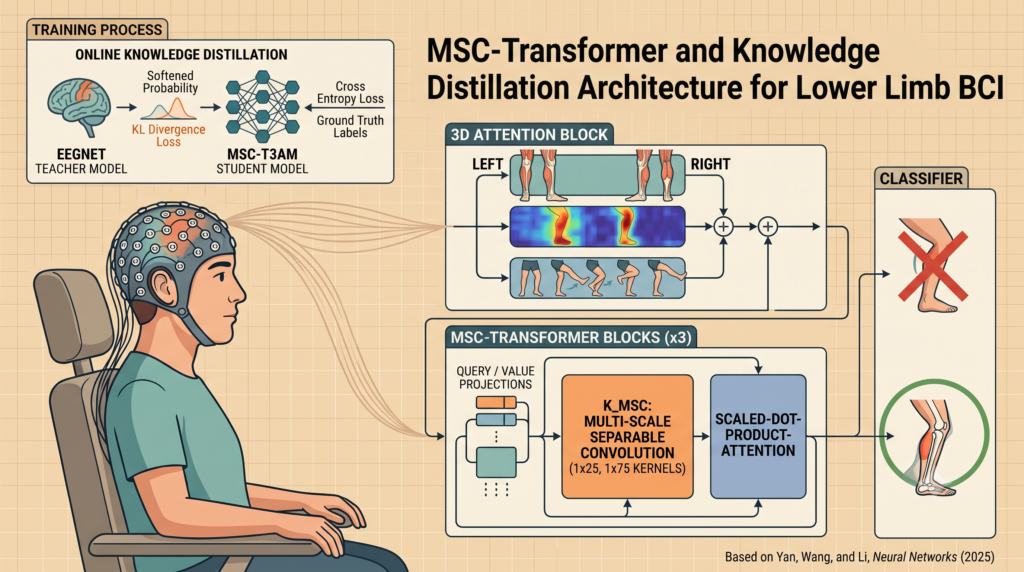
How a Transformer MSC-T3AM Learns to Tell Your Left Leg From Your Right on EEG.

How a Transformer MSC-T3AM Learns to Tell Your Left Leg From Your Right on EEG

Motor imagery research has a long history, and most of it points at the hands. You imagine gripping something, a classifier tries to figure out which hand you meant, and there are entire competition datasets built around exactly that setup.…

How a Transformer MSC-T3AM Learns to Tell Your Left Leg From Your Right on EEG Read More »

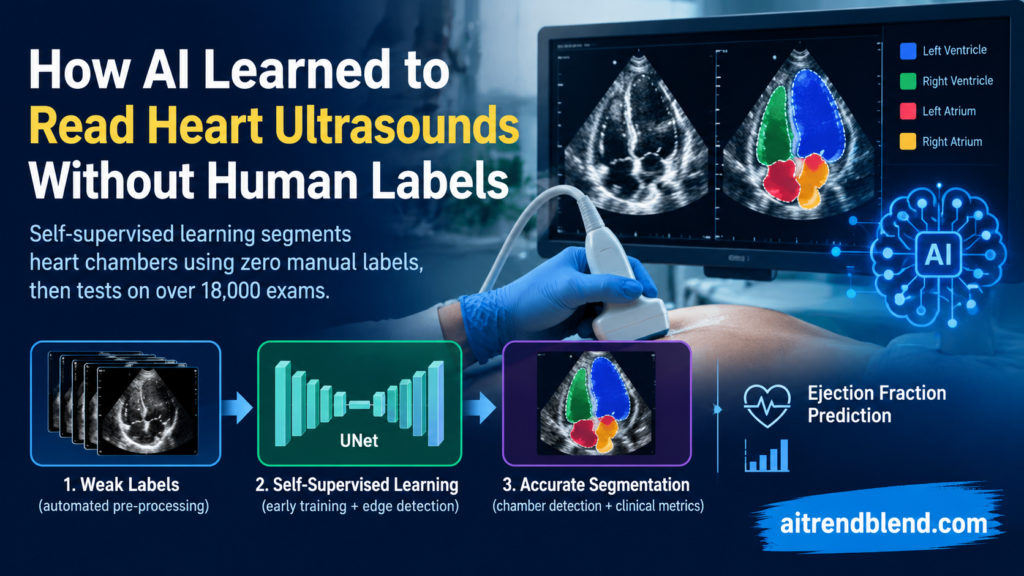
Self Supervised Learning: How AI Learned to Read Heart Ultrasounds Without Human Labels

Self Supervised Learning: How AI Learned to Read Heart Ultrasounds Without Human Labels

Every echocardiogram report that lists an ejection fraction, a chamber volume, or a wall thickness represents a human being drawing a line around a moving, low contrast, occasionally noisy structure on ultrasound. Clinical guidelines from the American Society of Echocardiography…

Self Supervised Learning: How AI Learned to Read Heart Ultrasounds Without Human Labels Read More »

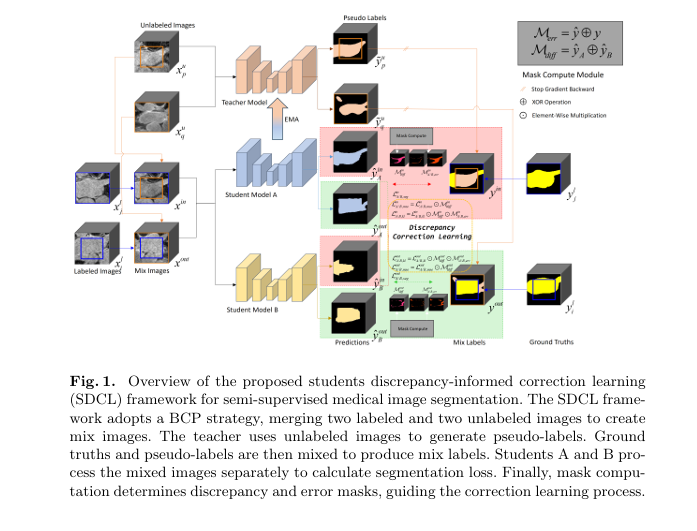
SDCL Framework for Semi-Supervised Medical Image Segmentation

SDCL: Two Students Learning From Each Other’s Mistakes Fix a Blind Spot in Segmentation

Medical image segmentation has a labeling problem that computer vision in general does not face nearly as badly. Drawing a box around a cat in a photo takes seconds. Tracing the exact boundary of a pancreas across dozens of CT…

SDCL: Two Students Learning From Each Other’s Mistakes Fix a Blind Spot in Segmentation Read More »